
Die LIPSIA-STRATEGY-Studie belegt die Nichtunterlegenheit der CAAS-vFFR-gesteuerten Revaskularisierung gegenüber der auf einem Druckdraht basierenden FFR-Revaskularisierung
Source: PR Newswire
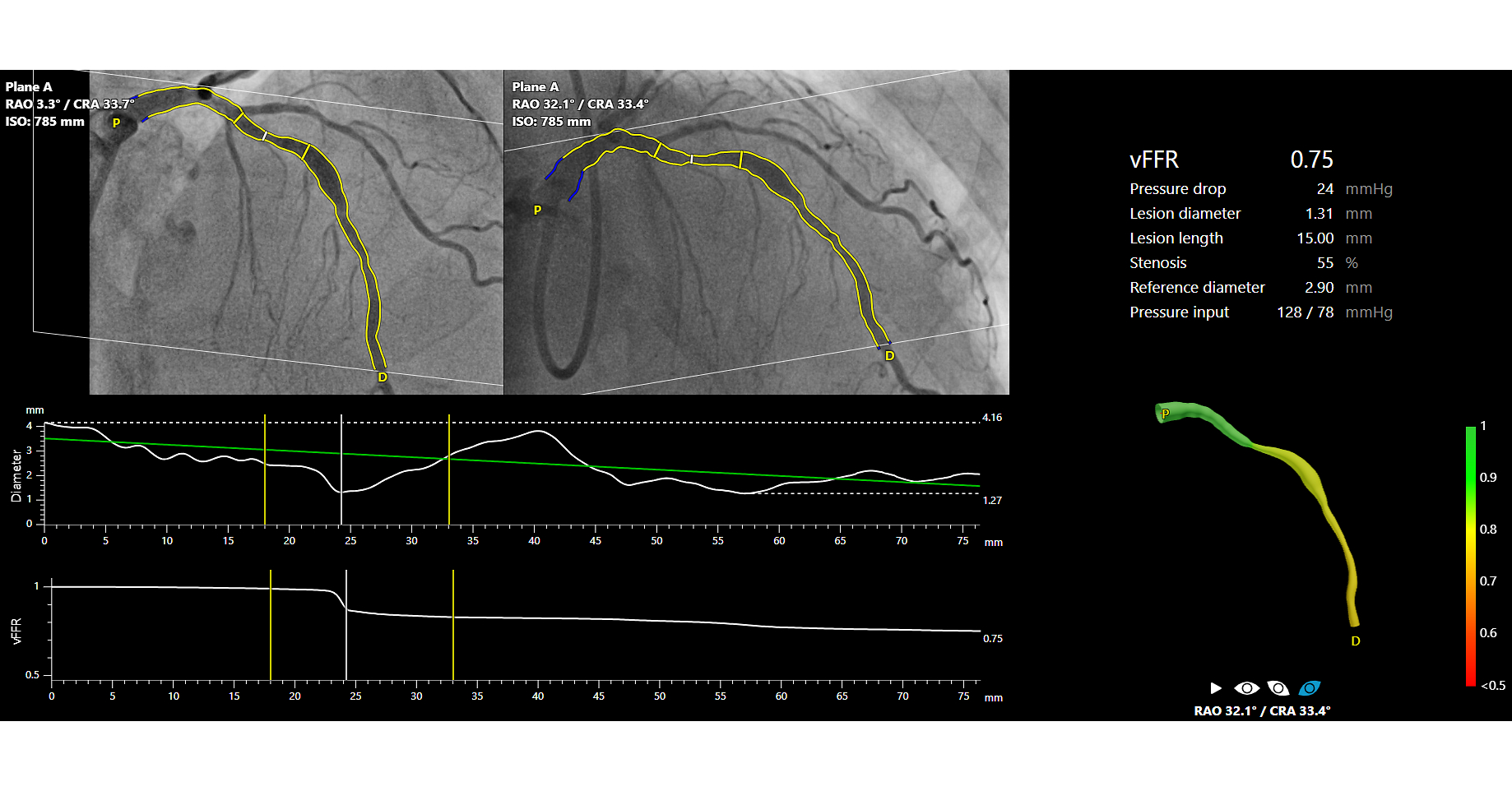
In the randomized LIPSIA-STRATEGY trial of 1,053 patients with intermediate coronary artery stenoses, CAAS-vFFR-guided revascularization met the primary endpoint and was noninferior to pressure-wire FFR for one-year clinical outcomes. The findings add independent clinical evidence for Pie Medical Imaging’s CAAS-vFFR and support a faster, less invasive workflow with shorter fluoroscopy time, though the article gives no numerical estimates for those reductions.
Analysis
The investable signal is a possible shift in cath-lab workflow, not yet demonstrated revenue growth for Pie Medical Imaging or its parent Esaote. If clinicians can make comparable revascularization decisions without a pressure wire, the value proposition could improve through simpler procedures and lower procedural burden; the corresponding risk is substitution pressure on pressure-wire-based assessment, including products associated with Abbott. That is a competitive hypothesis, not evidence of near-term lost sales: adoption, reimbursement, software access, and operator confidence determine whether workflow advantages translate into purchasing changes.
The randomized result strengthens the clinical case, but non-inferiority at one year does not establish superiority, durable outcomes, or commercial uptake. Before underwriting a product-level impact, verify the non-inferiority margin, event rates and confidence intervals, image/technical failure rates, regulatory status, reimbursement, and whether the studied workflow generalizes across centers and lesion types. The release is company-sponsored communication about an investigator-initiated study; the published paper and subsequent guideline or real-world evidence matter more than management’s adoption framing.
Near term (days), the headline may support sentiment around angiography-derived physiology, but there is no supplied public-company mapping or evidence of material consolidated earnings exposure. Over 1–3 months, watch for conference/paper detail and competitor responses. Over 6–18 months, guideline inclusion and hospital workflow economics are the key adoption catalysts. Contrarian point: a validated alternative can expand physiology-guided assessment overall rather than simply displace pressure wires, limiting the presumed loser effect.
AllMind Terminal
AI-powered research, real-time alerts, and portfolio analytics for institutional investors.
Request TrialMarket Sentiment
Overall Sentiment
moderately positive
Sentiment Score
0.45
Key Decisions for Investors
- No immediate directional trade: the article does not identify a mapped public security or quantify product revenue, and clinical validation alone is not proof of commercial conversion.
- Set an adoption watch on Pie Medical Imaging/Esaote and pressure-wire suppliers such as Abbott; seek evidence of regulatory clearance, reimbursement, installed-base access, hospital procurement, and reported utilization before sizing exposure.
- For any future relative-value thesis, require evidence that angiography-derived physiology is gaining share rather than expanding the total pool of physiology-guided procedures. Reassess if published results show a narrow safety margin, meaningful technical-failure limitations, or no guideline uptake.
- Near-term catalyst review: inspect the full JACC publication for event rates, confidence intervals, non-inferiority margin, and subgroup consistency; a materially weaker detailed profile than the press release implies would falsify the bullish adoption read-through.
More News
- Binance co-CEO Richard Teng says hackers used fake job interviews, AI tool to steal $6.3 billion in crypto 108511116
- AMD stock jumps 7% on earnings as data center revenue nearly doubles
- Marvell-Lumentum Deal Puts Optical Networking at the Center of the AI Boom
- Marvell Technology could plunge on latest multibillion-dollar acquisition
- Disney Plans Thousands of Layoffs Companywide
- AI Inference Startup Fal Raises Capital at $16 Billion Valuation