
Zhou Jianjun from Huawei: Building a Grid-Interactive AIDC Solution to Maximize Tokens Per Watt
Source: PR Newswire
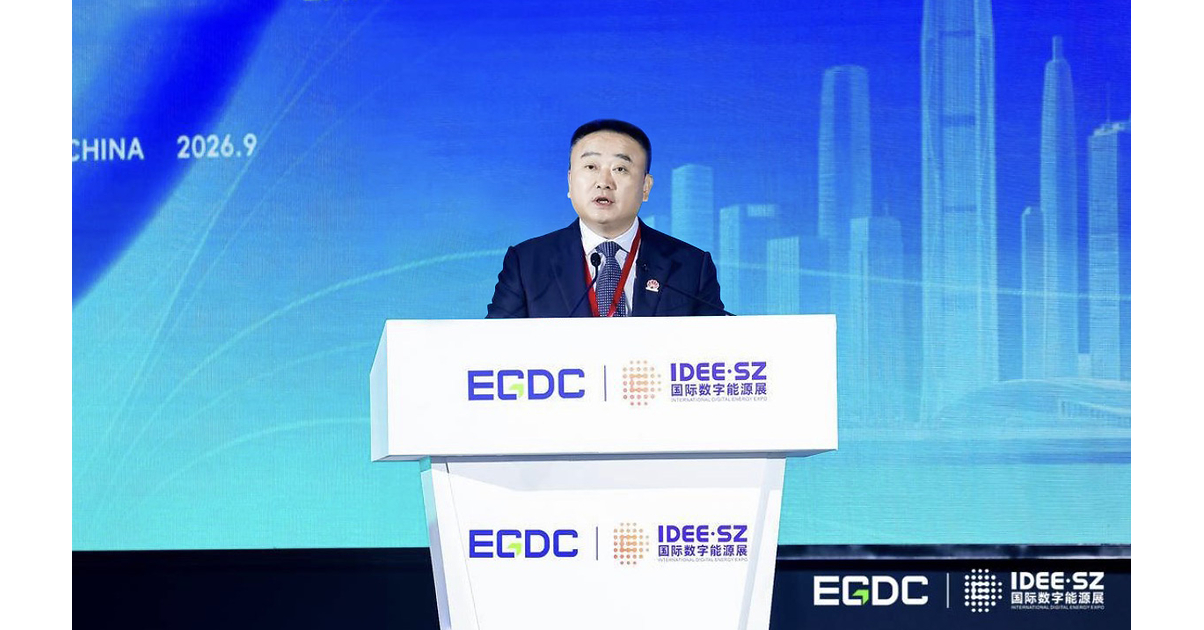
Huawei unveiled a grid-interactive AI data center (AIDC) solution designed to maximize tokens per watt as AI campuses scale from megawatt capacity toward hundreds of megawatts and gigawatts. The "3+1" architecture combines grid-forming generation and storage, solid-state-transformer energy routing, MW-scale liquid cooling, AI-enabled operations and prefabricated delivery. The solution positions Huawei to address power-grid volatility, high-density cooling and deployment-speed constraints in AI infrastructure, though the announcement provided no financial targets, customer contracts or revenue impact.
Analysis
The investable implication is a shift in AI infrastructure bottlenecks from GPU availability toward power-quality, interconnection, and thermal-density constraints. Vertiv (VRT), Eaton (ETN), Schneider Electric (SU.PA), ABB (ABB) and liquid-cooling specialists stand to gain if hyperscalers increasingly procure integrated power-and-cooling architectures rather than discrete UPS and HVAC equipment. This favors vendors with certified systems, field-service capacity, and utility relationships; it may pressure lower-end component suppliers whose products become commoditized within prefabricated modules.
Near term, this is not independently verifiable demand evidence and should not alter estimates. Over the next 1-3 quarters, the relevant catalyst is whether hyperscaler capex disclosures begin identifying electrical interconnection delays, on-site storage, liquid cooling, or prefabricated power modules as deployment constraints. A more consequential 6-18 month effect would be higher attach rates for batteries, medium-voltage equipment, power conversion, and cooling per MW of AI load—supporting revenue durability even if GPU shipment growth normalizes.
The consensus risk is treating incremental data-center capex as uniformly bullish for VRT and ETN. Grid-interactive designs can lower peak demand charges and improve utilization, but they also shift value toward utility-scale storage and power-electronics vendors; aggressive customer self-build could compress conventional UPS economics. The thesis is falsified if AI campuses continue to secure firm utility power without material interconnection delays, or if liquid-cooling adoption remains limited to a narrow set of accelerator racks rather than becoming a campus-level standard.
AllMind Terminal
AI-powered research, real-time alerts, and portfolio analytics for institutional investors.
Request TrialMarket Sentiment
Overall Sentiment
mildly positive
Sentiment Score
0.38
Key Decisions for Investors
- No immediate Huawei-linked trade: treat this as a watch item until customer orders, deployment locations, and technical performance data are independently disclosed.
- Maintain a 6-12 month quality bias toward VRT and ETN versus diversified industrial peers with less data-center exposure; add only on capex-driven pullbacks, with thesis review if either company guides to declining data-center backlog conversion or weaker service attach rates.
- Screen long candidates in grid-scale storage and power conversion, including FLNC and NXT, for evidence that data-center customers are becoming a material end market; do not initiate solely on this announcement because revenue exposure is currently unquantified.
- Consider a 3-6 month relative-value basket long VRT/ETN and short a broad industrial ETF such as XLI only if upcoming hyperscaler commentary confirms power interconnection or cooling as the binding constraint; exit if utility-power availability improves or AI capex guidance is cut.
More News
- Bank of Japan raises interest rates to 31-year high, flags concerns over inflation
- Italy to deploy warships to protect shipping through Bab al-Mandeb
- Oil prices fall as Saudi supply hopes outweigh fresh Houthi strikes
- Oil prices fall for 3rd day as supply concerns ease, diplomacy in focus
- Oil Traders Stymied by Iran War Stalemate: Evening Briefing Americas
- Australia’s central bank chief warns inflation risks materialising
From AllMind Research
- Anthropic IPO Preview: Valuation, Timing, and What to Watch
- Shein After the IPO: Venue, Valuation, and What Must Be Proved
- What AI Research Tools Should a Small Hedge Fund Buy First?
- Bitcoin's 52% Crash Proves It's a Tech Stock: Here's What That Means for Portfolio Construction
- What Is an AI Investment Research Platform?