
CookieYes Launches MCP Server to Manage Cookie Consent Inside Claude and ChatGPT
Source: PR Newswire
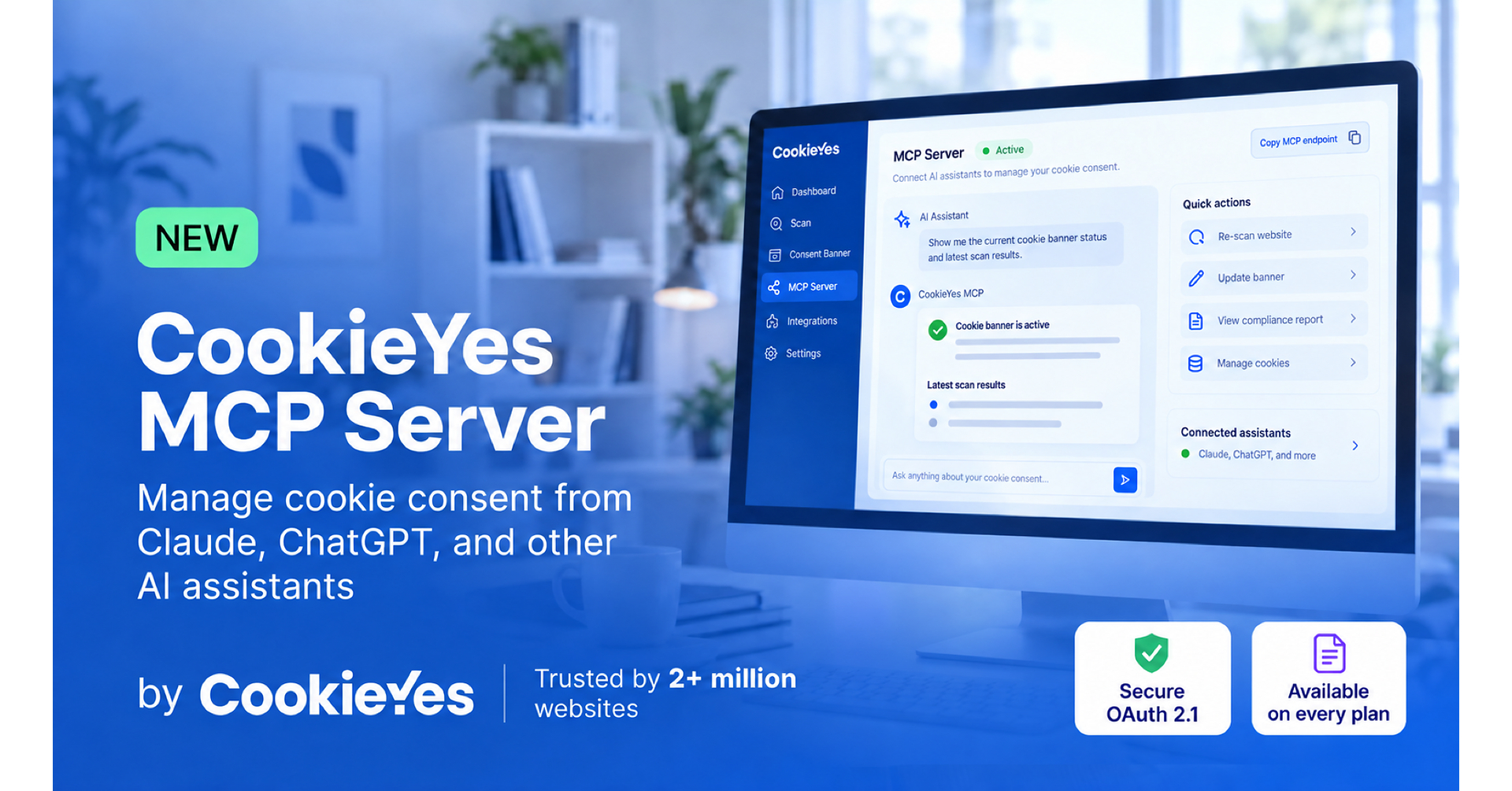
CookieYes launched a Model Context Protocol server that enables customers to manage cookie-consent banners, review scans, and make approved configuration changes through AI assistants including Claude and ChatGPT. The product offers 10 tools, with three write-action tools requiring user approval, and limits AI access to banner configuration and scan metadata rather than personal data, consent records, credentials, or billing information. The MCP server is available across all plans, including free, extending AI-enabled consent-management capabilities to CookieYes's base of more than 2 million websites.
Analysis
This is strategically more relevant to the consent-management software ecosystem than to GOOG or DPZ. Natural-language administration lowers implementation friction and could improve free-to-paid conversion for CookieYes, but making the capability available at no incremental charge also accelerates feature commoditization across CMP vendors. Incumbents such as OneTrust (private), TrustArc (private) and Usercentrics (private) retain the more defensible enterprise moat: audit workflows, policy controls, regional compliance coverage, integrations and liability-sensitive procurement—not dashboard usability.
For GOOG, the incremental financial effect is immaterial, but broader AI-agent adoption could reduce friction around Google CMP-related compliance and preserve publisher willingness to operate within Google’s privacy stack. The more important second-order risk is security: agent-mediated configuration changes create a new misconfiguration and prompt-injection attack surface. A visible incident involving non-compliant banners or unauthorized production changes would favor enterprise vendors with granular permissions, immutable audit trails and workflow segregation; absent that, this is routine product news rather than a tradable catalyst.
Over 1-3 months, monitor whether comparable vendors begin bundling MCP access and whether agencies report lower labor hours per managed domain. Over 6-18 months, AI agents may pressure low-end CMP pricing while expanding the total addressable market among smaller sites that previously tolerated incomplete compliance. The thesis is falsified if enterprise buyers treat conversational controls as unacceptable without role-based approvals and audit evidence, limiting adoption to low-risk SMB workflows.
AllMind Terminal
AI-powered research, real-time alerts, and portfolio analytics for institutional investors.
Request TrialMarket Sentiment
Overall Sentiment
moderately positive
Sentiment Score
0.42
Ticker Sentiment
Key Decisions for Investors
- No standalone trade in GOOG or DPZ: expected earnings sensitivity is de minimis and neither company has a direct monetization linkage to this launch.
- Maintain GOOG as a watch item rather than adding exposure; reassess only if Google reports measurable adoption of AI-agent integrations across its publisher/privacy tooling or signals higher compliance-services monetization over the next 2-3 quarters.
- For private-market diligence, favor enterprise CMP vendors with auditable approval workflows, role-based access controls and regulated-industry penetration; avoid underwriting premium multiples to SMB-focused CMP platforms solely on MCP functionality.
- Set an alert for a material AI-agent consent/configuration breach or regulator action within the next 6-12 months; that would be a catalyst for consolidation and enterprise share gains by compliance platforms with stronger governance controls.
More News
- Jensen Huang says Nvidia will sell twice as many chips next year
- Warsh says AI’s hyperscalers are part of why your borrowing costs are rising: ‘The competition for capital is real’
- AI coding agents' 0-click RCE flaw could hand attackers keys to the kingdom
- Goldman’s top strategist just added hard numbers to his earnings-bubble warning
- Waymo to bring autonomous ride-hailing to Singapore in 2028
- Waymo says Singapore will be its next international robotaxi city