
Nashua Ambulatory Surgical Center Performs First Outpatient Total Knee Replacement, Expanding Orthopedic Total Joint Program
Source: PRWeb
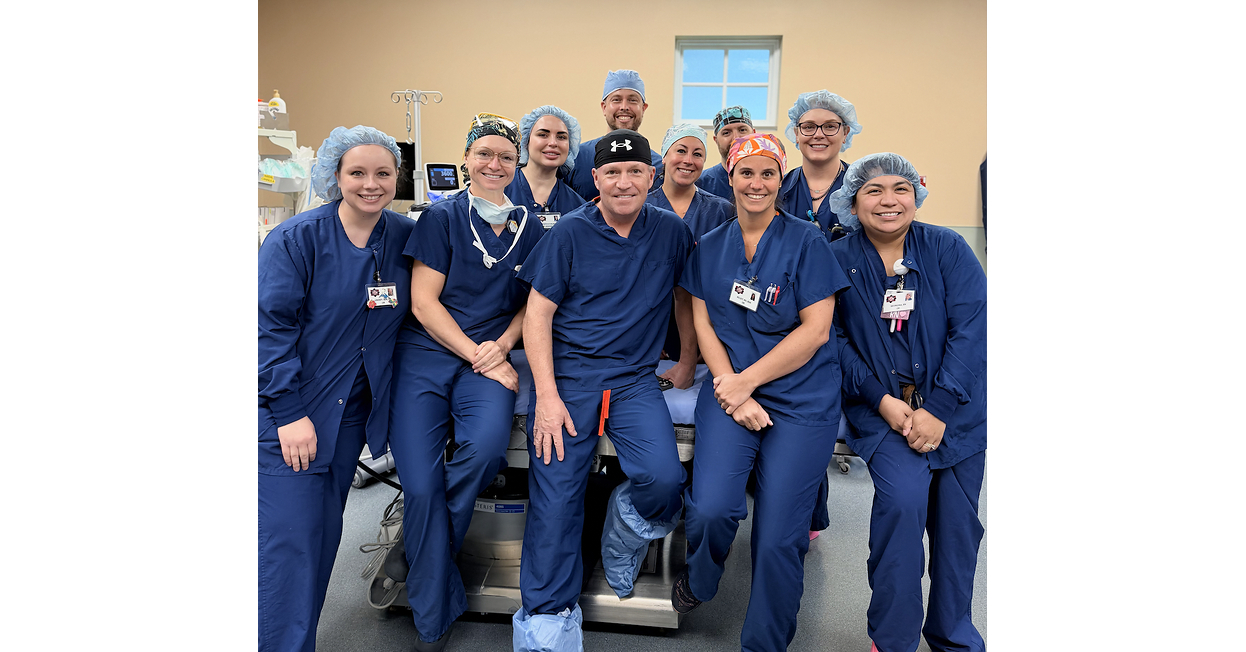
Nashua Ambulatory Surgical Center (NASC) announced it has completed its first outpatient Total Knee Replacement, expanding its orthopedic total joint program in collaboration with New Hampshire Orthopaedic Center (NHOC). The surgery was performed by Eric Benson, MD, and NASC says outpatient total joint replacement enables same-night recovery for eligible patients with shorter recovery and a more comfortable healing environment versus hospital-based surgery. The news is operational/expansionary, with limited immediate implications for public-market valuations.
Analysis
This is a site-of-service migration signal more than a company-specific catalyst. Outpatient total knee replacement expands the addressable volume for ASCs and surgeon-owned platforms by pulling a high-margin elective procedure out of hospital settings, where fixed-cost absorption is less favorable. The first-order beneficiary is any scaled outpatient operator with orthopedic density; the second-order beneficiaries are implant and surgical-support vendors that can sell into more procedures without needing hospital bed capacity.
The market may be underestimating how quickly payer economics can accelerate this trend once a few centers demonstrate low complication rates and same-day discharge. If commercial plans and Medicare Advantage continue to prefer lower-cost outpatient pathways, hospitals with elective ortho mix lose leverage, while ASCs gain pricing power with surgeons and local health systems. That said, this is still an anecdotal data point: one successful case does not prove durable reimbursement, surgeon throughput, or patient selection economics.
The key risk is reversal from payer pushback or adverse clinical outcomes, which would slow adoption over the next 1-3 quarters. Watch for any denial patterns, readmission signals, or state/regional policy changes that could cap outpatient TKR growth; those would quickly blunt the thesis. The contrarian view is that the real winner is not the local center but the enablement stack, so direct exposure should be through broader outpatient-orthopedic proxies rather than any one facility.
AllMind Terminal
AI-powered research, real-time alerts, and portfolio analytics for institutional investors.
Request TrialMarket Sentiment
Overall Sentiment
mildly positive
Sentiment Score
0.10
Key Decisions for Investors
- No direct trade on NASC; treat this as a low-signal confirmation of a broader outpatient shift, not an investable standalone catalyst.
- Conditional long SGRY on any follow-through in outpatient arthroplasty volume data over the next 3-6 months; pair against THC or HCA only if you get evidence of meaningful elective ortho case leakage from hospitals.
- For a lower-beta expression, accumulate ZBH or SYK on weakness over 3-12 months; thesis is modest volume tailwind from broader outpatient joint adoption, with risk limited if payer reimbursement tightens.
- Set a watch item on CMS/commercial payer policy and local complication/readmission trends; if outpatient TKR expands without reimbursement friction, revisit a larger ASC vs hospital pair trade.
More News
- CoreWeave credit default swaps hit distress levels as investors sour on AI debt
- Penske Automotive agrees to be taken private by Penske, Mitsui
- Faraday Copper completes acquisition of BHP’s San Manuel project
- Supermicro promised a new CFO in December 2024. A $2.5 billion smuggling case and a co-founder’s arrest later, it has one
- Blackstone President Jon Gray Bets Big on AI Boom
- Ukraine to resume strikes on Russian refineries, shattering hopes of an 'energy ceasefire'
From AllMind Research
- Anthropic IPO Preview: Valuation, Timing, and What to Watch
- Shein After the IPO: Venue, Valuation, and What Must Be Proved
- What AI Research Tools Should a Small Hedge Fund Buy First?
- Weekly Update: Unstructured Data Search, Ask AI, and Advanced Futures Data
- Best AI Stock Research Tools for Professional Investors