
Global Clinical Trials Market to Reach USD 99.4 Bn. by 2034 at 6.13% CAGR as Personalized Medicine, Decentralized Trials, AI Integration, and Rising Biopharmaceutical R&D Accelerate Market Growth, Reports Maximize Market Research
Source: PR Newswire
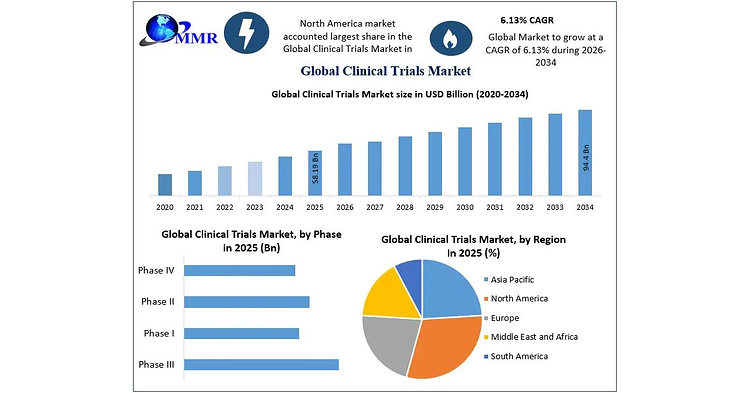
Maximize Market Research forecasts the global clinical trials market to expand from $58.19 billion in 2025 to $99.4 billion by 2034, a 6.13% CAGR. Growth is expected to be supported by biopharma R&D, personalized medicine, oncology and chronic-disease research, and adoption of decentralized trials, AI, remote monitoring, and real-world evidence. High trial costs, regulatory complexity, patient recruitment constraints, and clinical-data security risks remain key headwinds.
Analysis
This is not a near-term earnings catalyst: the long-duration market forecast is promotional and provides no evidence of incremental bookings, backlog conversion, pricing, or sponsor budget acceleration. The investable read is that CRO revenue growth will increasingly bifurcate between scaled operators that can absorb protocol complexity and data-security costs (IQV, ICLR, TMO) and smaller/full-service peers exposed to fixed-site and labor utilization (FTRE). AI-enabled trial design is more likely to be a margin-defense tool than a new revenue pool; sponsors will seek lower cycle times and pass a meaningful share of productivity gains back through procurement.
MEDP remains the cleaner operating leverage expression if biotech funding and trial starts improve over the next 1-3 quarters: its mid-sized, therapeutically focused model has more sensitivity to incremental program starts than diversified IQV or TMO. Conversely, the structural growth narrative does not eliminate the current industry constraint—clinical-stage biotech cancellations, delayed enrollment, and sponsor reprioritization can depress CRO utilization before any forecasted demand materializes. CRL has a differentiated upside path through preclinical-to-clinical handoffs, but this also leaves it most exposed if early-stage biotech capital formation weakens.
The contrarian point is that decentralized trials may reduce addressable service revenue per study even as trial volumes rise. Remote monitoring, synthetic control arms, and better patient matching can lower site visits, lab draws, and monitoring intensity; that favors software/data vendors and sponsors more than traditional labor-heavy CROs. Watch quarterly book-to-bill, net new awards, cancellation rates, backlog conversion, and management commentary on pricing—these are the variables capable of supporting multiple expansion over 6-18 months, not a generic industry CAGR.
AllMind Terminal
AI-powered research, real-time alerts, and portfolio analytics for institutional investors.
Request TrialMarket Sentiment
Overall Sentiment
mildly positive
Sentiment Score
0.38
Ticker Sentiment
Key Decisions for Investors
- No immediate sector-wide trade on this release; treat it as a confirmation of a 6-18 month structural theme, not a forecast revision. Require two consecutive quarters of improving book-to-bill and backlog conversion before adding broad CRO beta.
- Prefer a 3-6 month pair: long MEDP / short FTRE, sized market-neutral. MEDP offers greater upside to recovering biotech trial starts and utilization, while FTRE carries greater execution and integration risk; reassess if FTRE reports sustained positive net new awards and improving adjusted EBITDA margin.
- Accumulate IQV on broad healthcare-services weakness for a 12-18 month hold rather than chase momentum. Its scale in data, real-world evidence, and global execution should defend margins better than peers if sponsors demand productivity; thesis fails if organic revenue growth remains below mid-single digits or pricing compresses despite utilization improvement.
- Use CRL as a high-beta watch item, not a recommendation, pending evidence of biotech funding recovery and preclinical demand stabilization. A durable pickup in early-stage awards would create operating leverage; another quarter of weak DSA/backlog conversion would invalidate the recovery setup.
- For diversified exposure, favor TMO over pure-play CROs during the next 6-12 months: laboratory and workflow exposure provides a less binary participation in trial complexity. The risk is that lower testing intensity from decentralized protocols offsets volume gains; monitor bioproduction and clinical-research segment organic growth.
More News
- Yields keep rising, Novo's tough week, why cat product sales are surging and more in Morning Squawk
- Nanexa and Novo enter into EUR 1.165 billion global license and collaboration agreement for long-acting injectables
- Could This Be Novo Nordisk’s Next Billion-Dollar Weight-Loss Product?
- AbbVie vs. Pfizer: Which Healthcare Stock Makes Your Portfolio Healthier in 2026?
- Charles River Targets 5%-7% Growth, $300M Savings in 2030 Plan
- Stock Movers: UBS, Novo, Hello Fresh (Podcast)
From AllMind Research
- Anthropic IPO Preview: Valuation, Timing, and What to Watch
- Shein After the IPO: Venue, Valuation, and What Must Be Proved
- What AI Research Tools Should a Small Hedge Fund Buy First?
- Automating Financial Model Updates: A Source-Controlled Workflow
- Weekly Update: Live Event Center, In-App Documents, and Faster Transcripts