
California home sales and prices rise in August despite higher mortgage rates, housing costs, C.A.R. reports
Source: PR Newswire
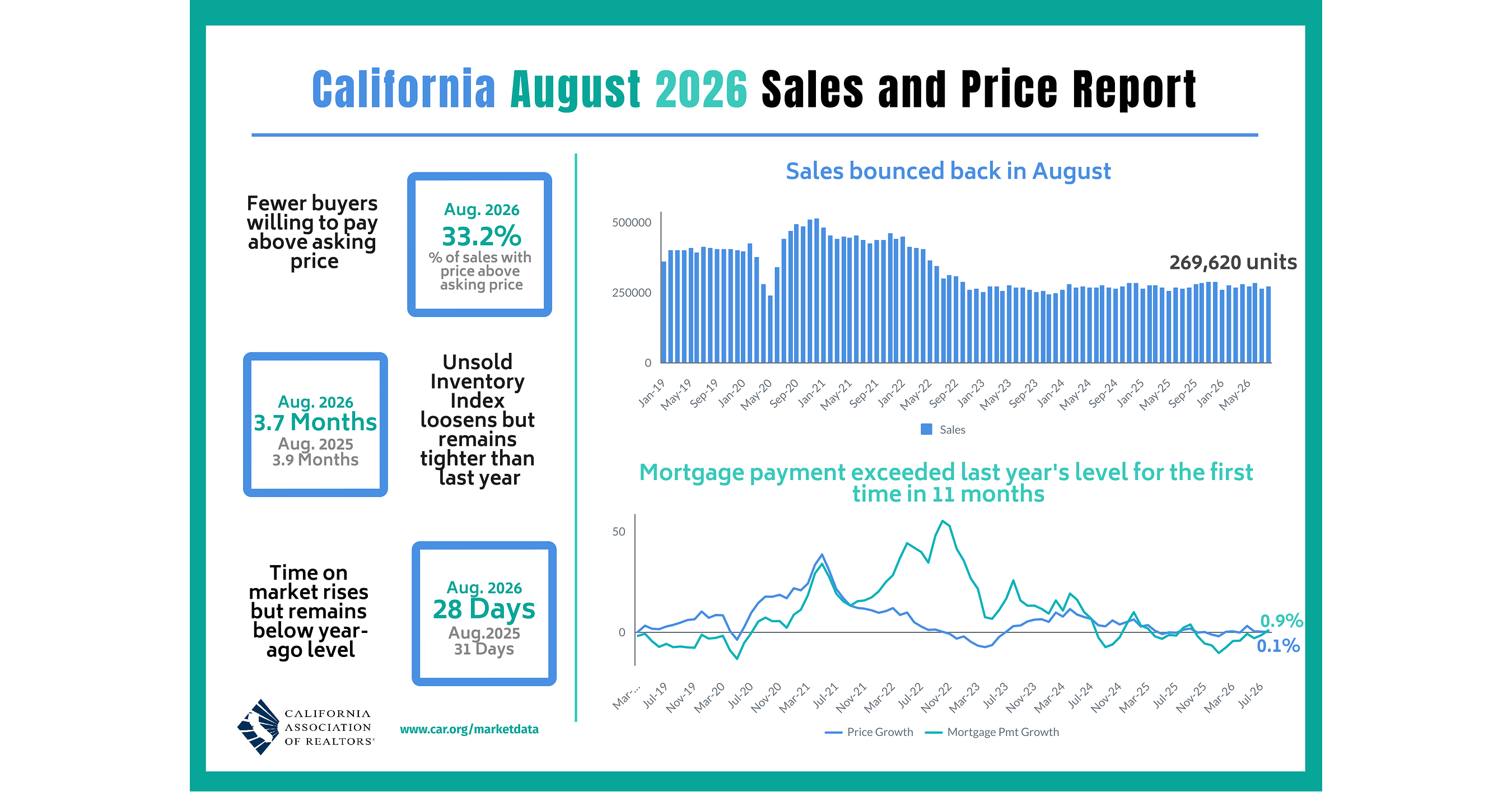
California existing single-family home sales rose 2.4% month over month and 1.4% year over year in August to a 269,620 seasonally adjusted annualized rate, while the median price increased 1.6% to $901,420 but was only 0.1% above a year earlier. The market remains constrained, with sales below the 300,000-unit annualized benchmark for a 47th consecutive month and the 30-year fixed mortgage rate averaging 6.67% in August before exceeding 7.0% in September. Inventory rose 8.8% month over month to 3.7 months and pending sales softened, signaling weaker demand and potential price pressure into the fall.
Analysis
The key investable signal is not the modest transaction rebound but deteriorating marginal demand: more inventory is being absorbed more slowly despite a shrinking listing base. That combination points to lower seller pricing power into the seasonally weak period and reduces the probability that California resale activity meaningfully lifts mortgage-origination volumes in 4Q. The weakness in attached housing is especially relevant because first-time and payment-sensitive buyers are the most rate-elastic cohort; this is a negative read-through for purchase-focused lenders and mortgage insurers rather than for national homebuilders with controlled new-home incentives.
FMCC is not a clean expression of California resale conditions. Its earnings sensitivity is primarily to guarantee-book credit performance, net interest income, capital-rule outcomes and conservatorship policy; a softer California market matters only if it broadens into delinquencies, house-price declines and higher loss severity. The near-term offset is that constrained resale supply can limit outright price declines, while the company’s geographic diversification reduces California-specific loss exposure. Thus, this report alone does not change a fundamental FMCC thesis.
Over the next 1-3 months, the relevant transmission channel is mortgage-rate persistence: payment shock suppresses turnover, which pressures broker, title and purchase-lending economics before it materially affects mortgage-credit losses. Over 6-18 months, sustained weaker price-per-square-foot trends in high-cost coastal markets would matter more than median-price data, because it would erode refinance and purchase collateral values simultaneously. A rapid decline in Treasury yields, or a policy-driven expansion of conforming-loan affordability, would reverse the turnover headwind and favor mortgage-finance beta.
Contrarianly, low resale inventory and relatively quick sale times imply a frozen market, not necessarily a distressed one. Consensus may over-extrapolate activity weakness into credit stress: absent a labor-market deterioration, sellers retain substantial embedded equity and forced-sale supply remains the critical missing ingredient.
AllMind Terminal
AI-powered research, real-time alerts, and portfolio analytics for institutional investors.
Request TrialMarket Sentiment
Overall Sentiment
mildly negative
Sentiment Score
-0.18
Key Decisions for Investors
- No new directional FMCC position on this data alone; maintain policy/capital-rule catalysts as the primary underwriting variables. Reassess only if California price-per-square-foot declines accelerate for 2-3 consecutive months alongside rising delinquencies or a widening mortgage-credit spread.
- For a 1-3 month housing-activity hedge, favor a tactical short in RKT versus long XHB rather than a broad homebuilder short: purchase-origination and transaction services are more exposed to frozen resale turnover, while builders can use rate buydowns and incentives to take share. Cover if 30-year mortgage rates fall below 6.5% or purchase applications turn positive on a sustained basis.
- Avoid extrapolating this report into a short of DHI, LEN or PHM. Their new-home channel can benefit from resale lock-in; consider long XHB only after confirming that builder incentives are lifting orders without a material gross-margin guide-down.
- Set an alert on the 10-year Treasury yield and mortgage rates rather than August sales: a sustained move lower in mortgage rates is the asymmetric upside catalyst for RKT and broader mortgage-finance activity, while rates remaining above 7% through year-end would validate the turnover-pressure thesis.
More News
- Oil extends losses as Saudi Arabia reportedly offers ship-to-ship crude transfers after pipeline hit
- Japan’s corporate leaders sound alarm over weak yen — even dollar-earners are voicing concerns
- Fed hikes again - an AI-Picked insurer is still cashing in
- Hawkish Fed lifts dollar to seven-week high as focus turn to BOJ
- Oil prices extend losses as fears of Middle East supply disruptions ease
- 'Science fiction': Transport companies — the backbone of economy — are sounding alarm on fuel prices