
Down for Good® Reinvents the Duvet System with a Patented Three-Piece Design for Easier Changes, a Secure Fit and Simpler Washing
Source: PR Newswire
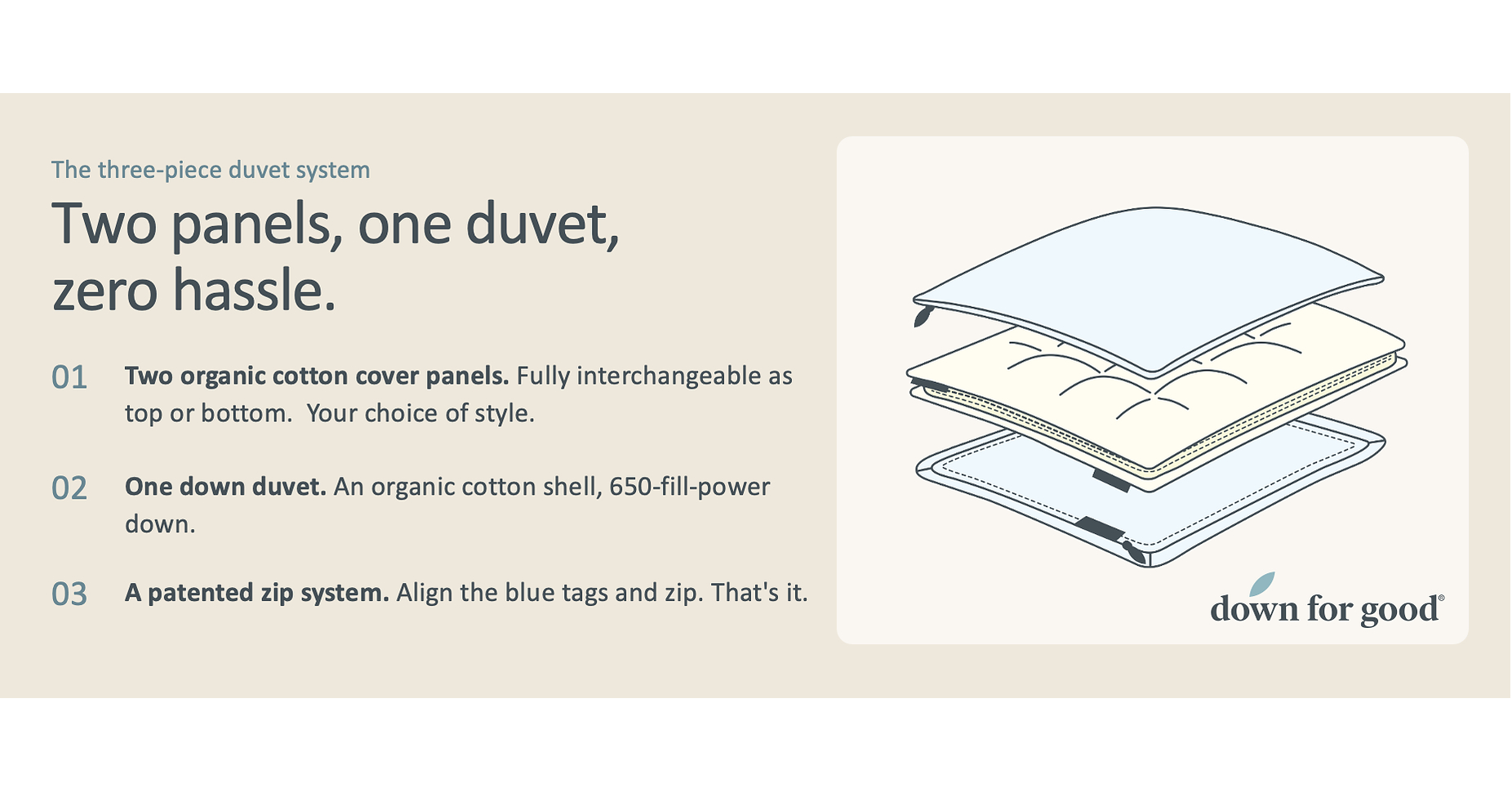
Down for Good introduced a patented three-piece duvet system with two interchangeable organic-cotton cover panels that zip to a down duvet, aiming to simplify changes and reduce shifting. Complete sets are priced at $740–$905, and individual panels at $120–$145; the company also offers a limited 10-year warranty and a used-panel take-back program subject to terms.
Analysis
The commercial question is conversion, not whether duvet changes are inconvenient: a premium set priced at $740–$905 must persuade buyers that easier laundering and a more secure fit justify a substantial purchase. Search volume signals friction, not willingness to pay. The modular design could create incremental panel sales and extend product life, but replacement frequency, repeat-purchase behavior, acquisition costs, and gross margins are undisclosed; the take-back and warranty language should not be treated as proof of lower lifecycle cost or realized sustainability benefits.
Competitive advantage depends on patent scope and enforcement. If claims cover only a narrow zipper configuration, established bedding brands could replicate the customer benefit through alternative fasteners or bundle designs, limiting pricing power. If the claims are broad and enforceable, the product may earn differentiation, but a launch announcement alone does not establish durable distribution or share gains.
Near term (days to weeks), this is a low-information product launch with no identified listed-company exposure. Over 1–3 months, watch for independent reviews, sell-through, retailer placement, and evidence customers buy additional panels. Over 6–18 months, the key test is whether repeat panel purchases and lower return rates offset premium-material and fulfillment costs. The contrarian risk is that a clearly improved user experience remains a niche premium product: the friction may be real, but customers may tolerate it rather than replace bedding they already own. No public-market trade is supported by the supplied information.
AllMind Terminal
AI-powered research, real-time alerts, and portfolio analytics for institutional investors.
Request TrialMarket Sentiment
Overall Sentiment
mildly positive
Sentiment Score
0.25
Key Decisions for Investors
- No trade on the launch alone: no ticker or listed-company linkage is supplied, and the release provides no verified sales, margins, or distribution data.
- Put the brand on a commercial watchlist; seek sell-through, customer-acquisition cost, return rates, repeat panel purchases, and channel mix before underwriting durable economics.
- Verify the patent claims and any enforcement activity. A narrow or easy-to-design-around patent would weaken the moat; broad enforceable claims would improve the case for sustained premium pricing.
- Treat sustainability and durability as unproven economic benefits until take-back utilization, reuse or recycling outcomes, warranty claims, and product-life data are disclosed.
More News
- Binance co-CEO Richard Teng says hackers used fake job interviews, AI tool to steal $6.3 billion in crypto 108511116
- AMD stock jumps 7% on earnings as data center revenue nearly doubles
- Marvell Technology could plunge on latest multibillion-dollar acquisition
- Disney Plans Thousands of Layoffs Companywide
- 5 things to watch on Election Day as Democrats push for control of Congress
- AMD rides data center riches to ‘largest and most profitable’ quarter in history