
Japanese Startup Bets Iron Man-Inspired Homes Can Beat Humanoids
Source: Bloomberg
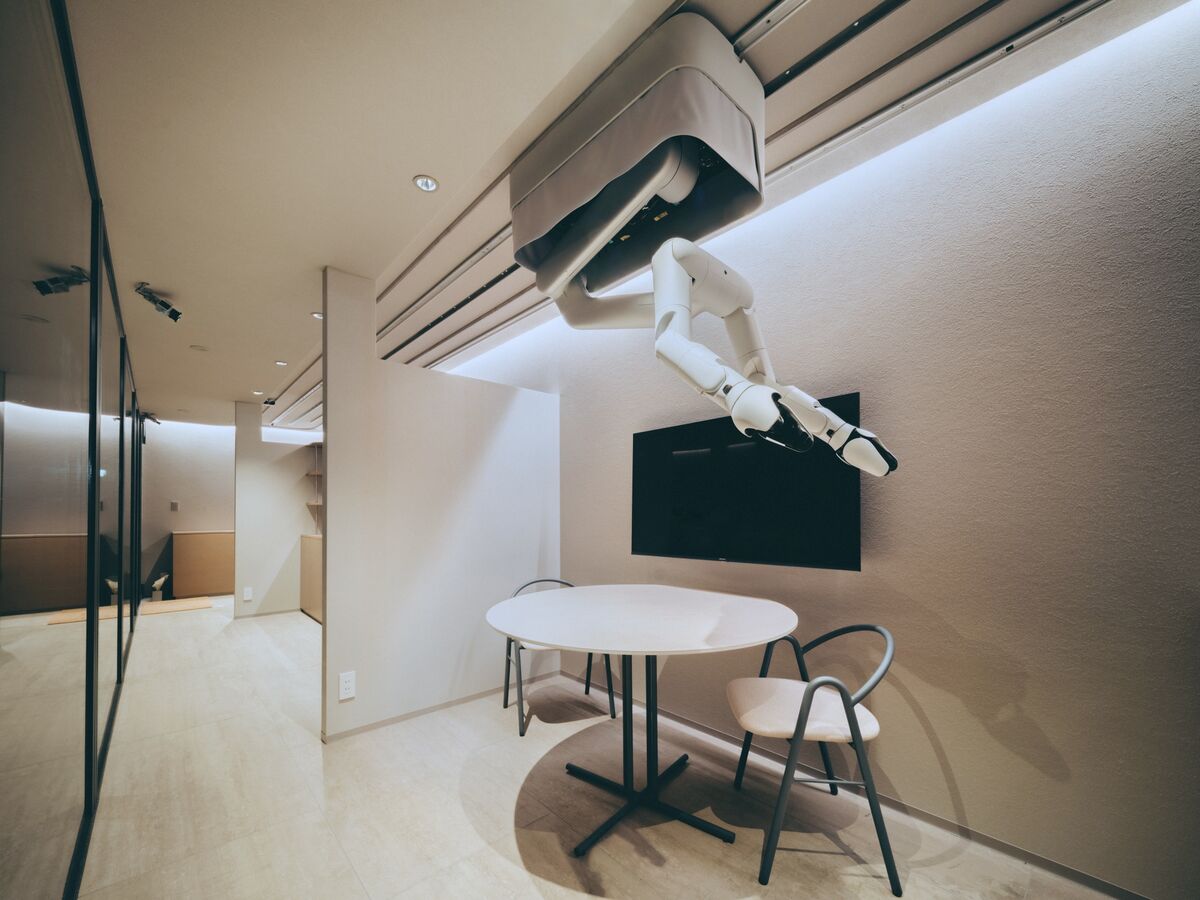
Tokyo-based MW Inc. plans to sell its first home equipped with built-in robotic housekeeping arms by 2028, positioning fixed home automation as an alternative to humanoid robots. CEO Shuzo Narita targets production of up to 10,000 robot-equipped homes annually by 2035, equivalent to roughly 5% of Japan's current new-home construction.
Analysis
This is not yet an investable robotics demand signal; the relevant question is whether fixed-location automation can reach a materially lower total-cost-of-ownership than general-purpose humanoids. Embedded systems avoid the hardest humanoid constraints—mobility, battery life, fall risk and unconstrained perception—so a successful design could shift early household-robot spend toward appliance-like modules rather than premium standalone robots. That would favor Japanese component ecosystems with exposure to servo motors, sensors, machine vision and factory automation over pure-play humanoid developers.
The principal bottleneck is housing economics, not robotics capability. A builder can amortize installation, mapping and maintenance across standardized units, but adoption requires a price premium that is below the present value of household labor savings and does not impair resale liquidity. Japan's aging demographics make the value proposition stronger in senior-oriented developments over 6-18 months, yet low household formation and a fragmented existing-home market make a 10,000-unit annual run-rate ambition difficult without major developer partnerships or public long-term-care subsidies.
Near term, treat announcements of alliances with Sekisui House (1928), Daiwa House (1925), Panasonic Holdings (6752) or major Japanese homebuilders as the actionable catalyst—not prototype publicity. A credible pilot needs independently disclosed installation cost, service contract pricing, utilization rates and builder gross-margin impact; absent those, the technology claim has no read-through to listed automation multiples. Contrarian view: the architecture may be more commercially viable than humanoids in constrained tasks, but embedded hardware can also become a low-margin feature captured by developers and appliance OEMs rather than the robotics vendor.
AllMind Terminal
AI-powered research, real-time alerts, and portfolio analytics for institutional investors.
Request TrialMarket Sentiment
Overall Sentiment
mildly positive
Sentiment Score
0.25
Key Decisions for Investors
- No direct position on MW: remain on watch through 2028. Require a named development partner, paid pilot and disclosed unit economics before assigning commercial value to the concept.
- Monitor 6752 and 6506 (Yaskawa Electric) for evidence that residential automation is becoming a new end-market; consider a small 6-12 month basket only after orders or backlog commentary identifies housing-related robotics demand. Falsifier: management characterizes residential demand as immaterial or pilot-only.
- If Japanese builders announce bundled robotic-home projects, favor a relative-value long 1928 or 1925 versus TOPIX Real Estate (1617) only where the builder can pass through the upgrade cost without gross-margin dilution. Exit if presales fail to command a premium or incentives are required to move inventory.
- Avoid extrapolating the development to humanoid-robotics valuations in the next 1-3 months. Fixed-installation adoption would be a negative competitive read-through for general-purpose humanoid platforms only if builders explicitly substitute embedded arms for mobile humanoid service contracts.
More News
- Here’s the ‘core economic flaw’ in the AI bull case as stock and bond trades unravel, according to a top economist
- Biotech stocks are surging. How investors can play the new drug innovation boom
- AI funding fears rattle Wall Street. Here's how we're adjusting our portfolio
- Nvidia's role as AI financier faces first big test as neoclouds take market hit
- Ukraine says Starlink and Starshield high speed restrictions have been lifted
- Goldman says these top tech stocks have plenty of upside ahead of earnings