
The Good Crisp Company Announces its Crinkle Cut Chips are Now Seed Oil Free Certified®
Source: PRWeb
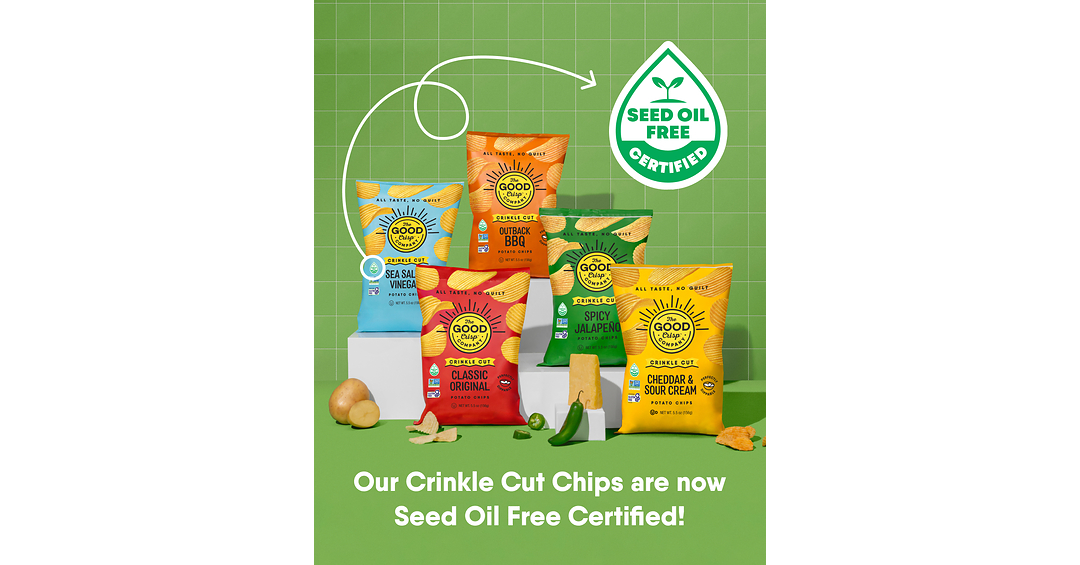
The Good Crisp Company said its full Crinkle Cut Chips line is now Seed Oil Free Certified®, with the certification process including ingredient documentation, auditing, and independent lab testing. The company will also pursue certification for additional product lines, and it noted it uses only RSPO Certified Sustainable Palm Oil. Packaging across the Crinkle Cut Chips range will carry the Seed Oil Free Certified® seal, supporting consumer transparency amid rising avoidance of seed oils (about one-third of Americans).
Analysis
This reads as low-cost brand signaling more than a near-term earnings catalyst. For public comps, the important mechanism is not the certification itself but whether it improves shelf conversion enough to support mix and price realization; if it does, the benefit should accrue first to smaller, niche snack brands that can monetize a clean-label premium without having to rework an entire portfolio. The larger incumbents are more likely to experience margin drag if consumer demand shifts force reformulation across SKUs, because their scale turns ingredient changes into a supply-chain project rather than a marketing win.
The second-order effect is that "seed-oil-free" is not automatically margin-accretive: it can push formulations toward palm, avocado, or olive oil, each with different cost and ESG tradeoffs. RSPO palm may blunt the nutrition objection, but it creates a separate sustainability and perception risk that could limit the durability of the message if scrutiny rises. That makes this more of a category segmentation story than a broad consumables rerating.
Contrarian view: the consensus may be overweighting how sticky this preference is at the store level. If scanner data do not show repeat purchase and household penetration within 1-2 quarters, the certification will likely fade into a commodity label rather than a moat. The key falsifier is any evidence that the claim lifts velocity enough to offset higher ingredient and packaging costs; absent that, this is promotional, not structural.
AllMind Terminal
AI-powered research, real-time alerts, and portfolio analytics for institutional investors.
Request TrialMarket Sentiment
Overall Sentiment
mildly positive
Sentiment Score
0.15
Ticker Sentiment
Key Decisions for Investors
- No immediate position in TBHC on certification alone; wait 1-2 quarters for scanner data or distributor commentary that shows repeat purchase and shelf expansion before treating it as a fundamental inflection.
- Watchlist trade: long UTZ or HAIN vs short MDLZ/PEP over 3-6 months if clean-label snack share is actually inflecting; target a modest 150-250 bps relative outperformance, but only if gross margin does not compress.
- Set an alert on ingredient-cost inflation for brands shifting away from seed oils; a move higher in palm/olive/avocado input costs would quickly erase any pricing benefit and invalidate the thesis.
- If the certification narrative broadens across multiple SKUs, consider a small basket long in better-for-you snack proxies only on pullbacks; otherwise treat this as a marketing event with limited tradability.
More News
- Palantir patient data tech rejected by many NHS trusts in England
- Why did CoreWeave stock get crushed this week? Look to this corner of the debt market for clues
- Diageo's Toxic Spill Hits Pristine River in Scottish Whisky Country
- AI stock sell-off ramps up over debt-fueled data center spending fears: ‘Full-blown crisis of confidence'
- Stock fixing scandal could see Turkish companies frozen out of global indexes
- Apple’s $1,999 iPhone Duo puts the company's status-symbol power to the test
From AllMind Research
- Anthropic IPO Preview: Valuation, Timing, and What to Watch
- Shein After the IPO: Venue, Valuation, and What Must Be Proved
- What AI Research Tools Should a Small Hedge Fund Buy First?
- Capital Intensity as Gravity: The AI Trade Enters Its Industrial Era (Looking at Q3 2025 Earnings in Tech)
- AI Portfolio Monitoring: Build an Alert Policy Analysts Can Audit