
Cervoz Launches MIL-STD-810H M.2 NVMe SSDs for Mission-Critical Embedded Systems
Source: PR Newswire
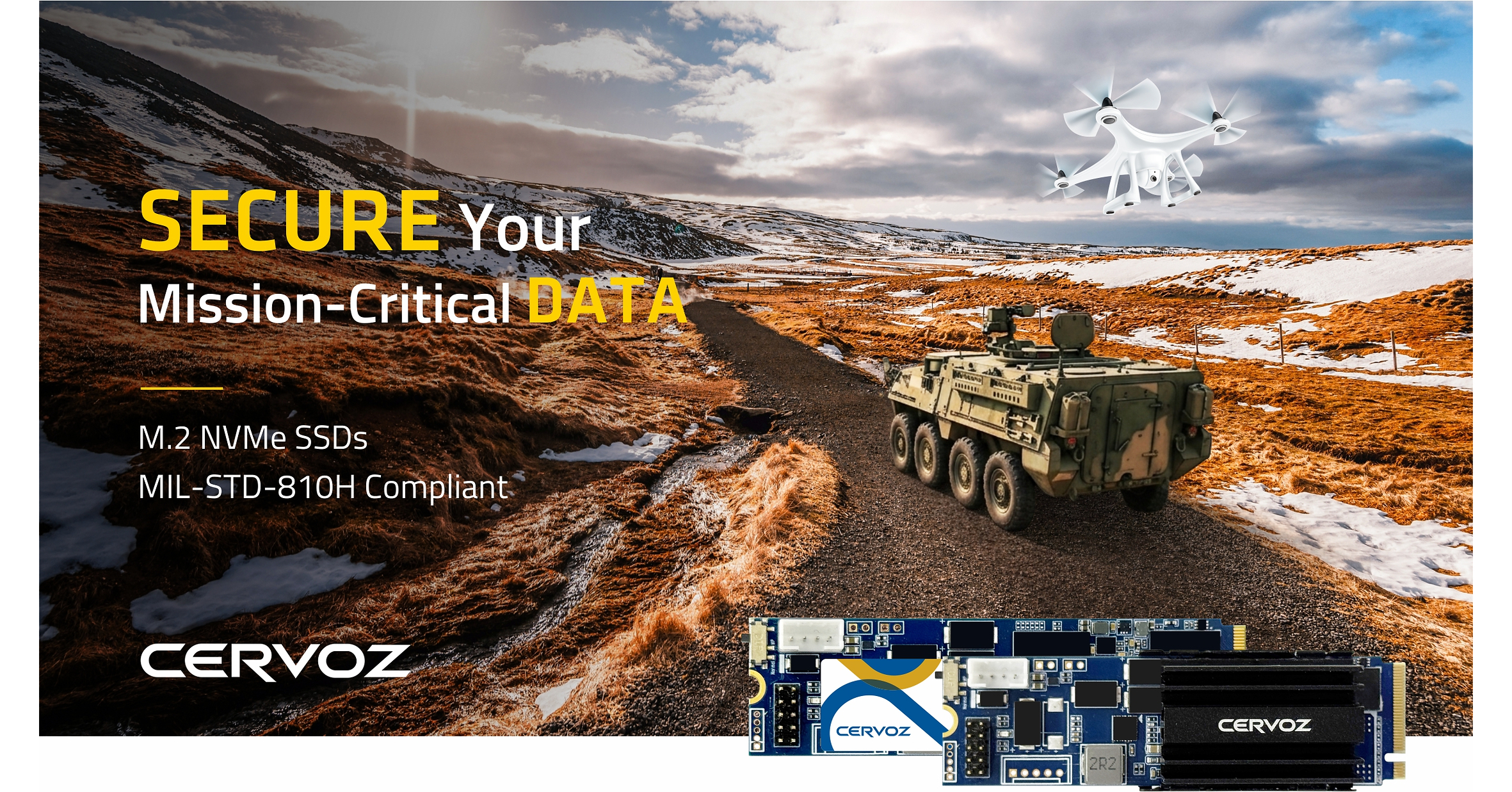
Cervoz launched its T449 and T459 MIL-STD-810H-compliant M.2 NVMe SSDs for defense, aerospace, transportation and industrial embedded systems. The PCIe Gen4 drives provide up to 5,085 MB/s read and 4,765 MB/s write speeds, capacities up to 2TB, and operating-temperature options from -40°C to +85°C. Hardware security features include write protection, rapid erase and a high-voltage physical-destruction function designed to permanently disable NAND storage in compromised equipment.
Analysis
This is not independently evidence of material revenue acceleration for any listed storage vendor; qualification cycles, platform-level design wins, and low-volume/high-mix procurement make the near-term signal weak. The relevant read-through is that rugged edge-compute demand increasingly requires storage vendors to bundle endurance, environmental certification, and hardware sanitization rather than compete solely on sequential throughput. That raises switching costs after qualification and favors suppliers with long lifecycle support, secure firmware, and controlled NAND sourcing.
The second-order beneficiary is the defense-edge compute ecosystem: Mercury Systems (MRCY), Curtiss-Wright (CW), and Kratos (KTOS) can use certified secure storage as a component in higher-value mission-computer and unmanned-system configurations. For memory makers, Micron (MU) has the most direct strategic exposure through industrial-grade NAND and a domestic-supply narrative, although Cervoz's component sourcing and unit volumes are undisclosed; this launch should not be treated as a MU revenue datapoint. Kioxia, Solidigm, and other merchant NAND suppliers face a modest competitive risk where hardware-destruction capability becomes a procurement requirement rather than an optional feature.
Over 6-18 months, procurement specifications could migrate toward physical sanitization for unattended platforms, creating a premium niche but also potential export-control and certification friction. The contrarian view is that the addressable market is too fragmented to move NAND demand meaningfully: system OEMs may instead adopt encrypted removable storage or centralized data architectures, reducing the need for destructive SSDs. Falsification for the positive defense-edge thesis would be flat MRCY/CW backlog conversion, delayed unmanned-platform awards, or evidence that major primes standardize on alternative secure-storage modules.
AllMind Terminal
AI-powered research, real-time alerts, and portfolio analytics for institutional investors.
Request TrialMarket Sentiment
Overall Sentiment
mildly positive
Sentiment Score
0.35
Key Decisions for Investors
- No standalone trade on Cervoz's launch; monitor the next 1-2 quarters for named platform qualifications, volume commitments, and disclosed NAND/controller sourcing before assigning revenue significance.
- Maintain a 6-12 month tactical long bias in CW versus a short XLI hedge if defense-electronics backlog and margin conversion remain intact; rugged-compute content growth is more monetizable at subsystem integrators than at commodity storage vendors. Exit on a material backlog-guide reduction or 200bp+ segment-margin compression.
- Watch MRCY for evidence of improving execution before initiating: a long is justified only if quarterly bookings improve and cash conversion stabilizes, since secure edge-compute demand will not offset program delays or working-capital risk.
- For MU, treat industrial/defense SSD qualification wins as qualitative support rather than a catalyst. Add only on broader NAND pricing and utilization confirmation; the thesis is invalidated if NAND contract pricing weakens despite supply discipline.
More News
- US to send third aircraft carrier towards Iran: US official to Al Jazeera
- Nvidia Faces Questions Over China AI Chip Smuggling Cases
- ‘They’ll be hit very hard’: Trump sends roughly 9,000 troops and a third aircraft carrier to the Middle East after warning strikes on Iran
- Russia’s Putin rules out ceasefire with Ukraine during speech in Moscow
- ‘Playing a dangerous game’: Putin threatens using ‘all its arsenal’ if there is a ‘direct attack on the Russian Federation’
- US May Send Third Carrier Strike Group to Middle East