
Threekit Launches AI-Native CPQ for Manufacturing: Built for the Web, Built for Dealers, Built for the AI Age
Source: PR Newswire
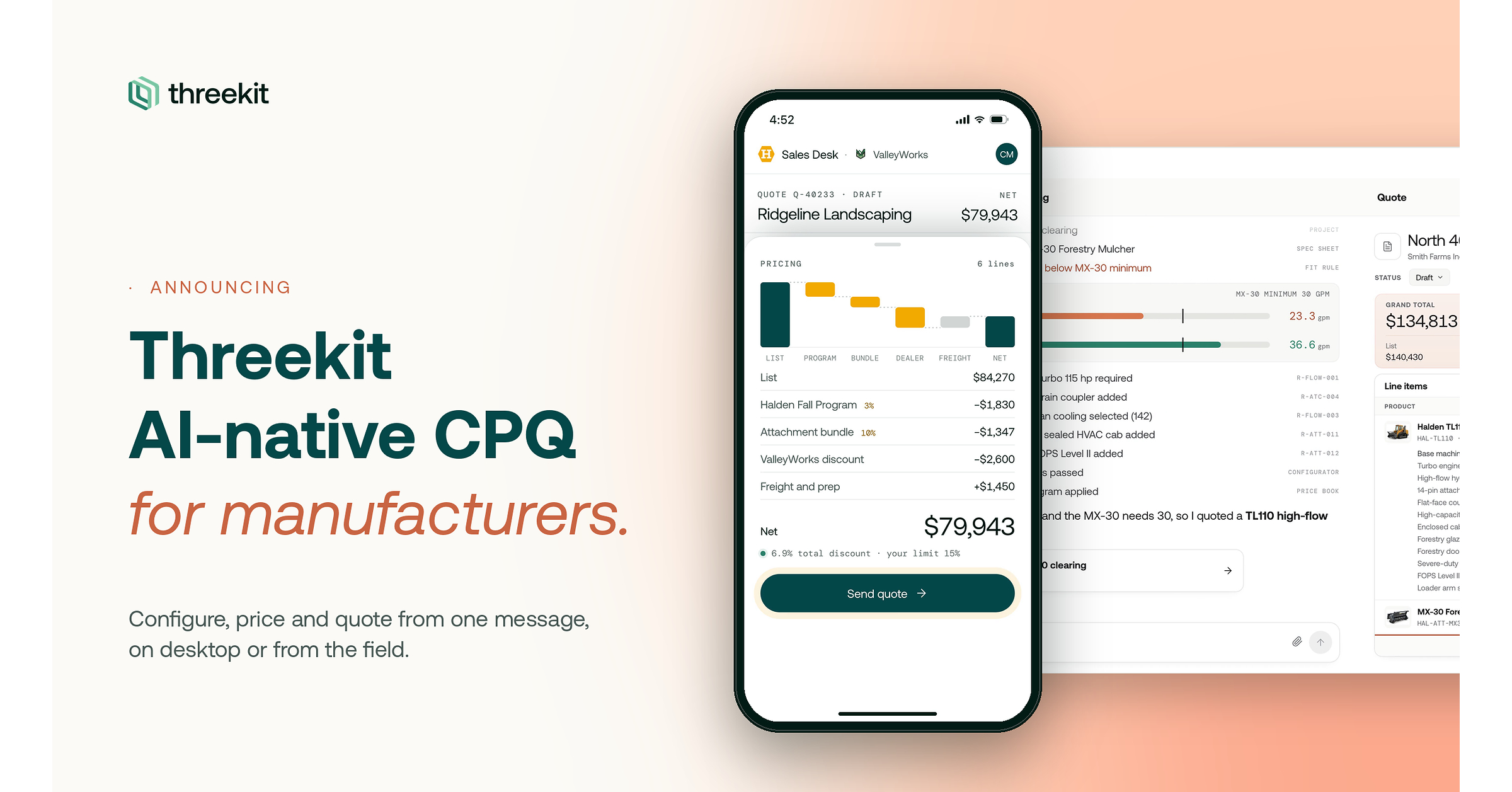
Threekit launched AI-Native CPQ, a conversational configure-price-quote platform designed for manufacturers and B2B sellers to generate governed product recommendations and quotes from text, photos, voice notes, specifications and RFPs. The company says a window-and-door manufacturer doubled leads using its web buying experience, while a commercial plumbing manufacturer cut quote-production time by 4x. The launch targets a broader shift toward AI-enabled, self-service B2B purchasing but is unlikely to have broad public-market impact.
Analysis
This is incrementally more relevant to Salesforce and Oracle’s installed CPQ bases than to the named manufacturers: conversational intake lowers the usability advantage that incumbent workflow suites derive from trained internal users. The near-term financial effect on CRM and ORCL is immaterial, but Threekit’s web-embedded architecture could pressure seat-based CPQ expansion and professional-services attach rates if it converts dealer and self-service channels from lead capture into quote generation. The key competitive variable is not generative-AI branding; it is whether AI-generated configurations remain accurate enough to avoid costly order errors and warranty claims.
For FBIN, OC, SCS and ASSA.B, the potential value lies in conversion and sales-cost leverage rather than software spend. Dealers and specification-heavy channels are structurally prone to slow quote cycles, so a credible reduction in quote turnaround can improve win rates and reduce dependence on scarce technical sales labor over 6-18 months; the benefit should be greatest where product complexity is high and gross margins can absorb digital-channel investment. However, vendor-reported lead and productivity metrics are not sufficient evidence of realized revenue uplift, and easier cross-channel price discovery could weaken dealer pricing discipline.
Consensus may overread this as a direct public-software disruption trade. Threekit remains private and the addressable deployments require catalog normalization, rules governance and integration work—implementation friction protects CRM and ORCL in the next 1-3 months. The more actionable signal is an enterprise digital-commerce KPI watch: material improvement in online quote conversion, dealer adoption, or selling-expense ratios would validate a broader margin and share-gain thesis for participating manufacturers.
AllMind Terminal
AI-powered research, real-time alerts, and portfolio analytics for institutional investors.
Request TrialMarket Sentiment
Overall Sentiment
moderately positive
Sentiment Score
0.48
Ticker Sentiment
Key Decisions for Investors
- No immediate directional trade in CRM or ORCL: monitor 1-2 quarterly calls for CPQ renewal commentary, AI-guided-selling attach rates, and services backlog. Consider a tactical CRM/ORCL short only if management identifies AI-native CPQ displacement or guides CPQ-related bookings lower; absent that evidence, installed-base switching costs dominate.
- Place OC, SCS and ASSA.B on a 6-18 month operational-upside watchlist. Upgrade only after evidence that digital configuration raises conversion or reduces SG&A as a percentage of sales without gross-margin dilution; a 100-200bp sustained SG&A improvement would be financially material relative to the software cost.
- For FBIN, watch dealer-channel pricing and order-error/warranty disclosures over the next two earnings cycles. A long thesis requires stable gross margin alongside faster digital lead-to-order conversion; margin pressure despite higher digital activity would indicate dealer disintermediation or discounting, invalidating the benefit.
- Use XSW or IGV as a sector-risk hedge rather than buying software disruption outright: the likely 1-3 month effect is narrative pressure on legacy CPQ valuations, while the 6-18 month outcome depends on independently verified deployment scale and configuration accuracy.
More News
- $8.2B acquisition validates AI-picked chip stock: +20% since June
- These charts show how volatile the last quarter was for stocks and bonds
- Markets slip on dollar pressure, but this IT stock is up 10% today
- Micron’s AI-driven outlook; Nike to report - what’s moving markets
- The People of Utah vs. Kevin O’Leary
- Sopra Steria widens legal challenge to Capita's Whitehall outsourcing deal