
25% of Financial Institutions Report Suspected or Confirmed Deepfake Incidents, New Survey Finds
Source: PR Newswire
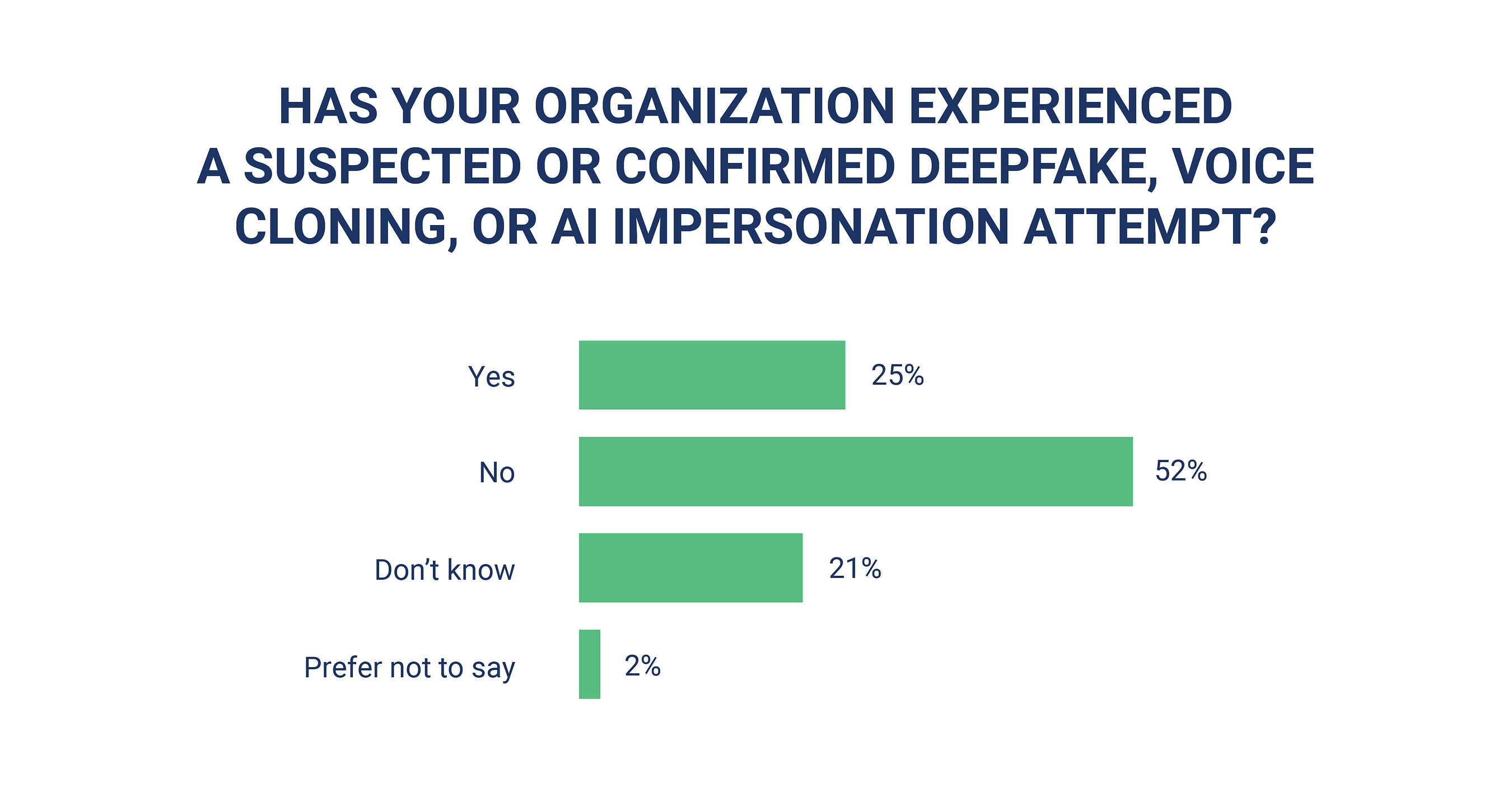
Tandem's survey of 85 financial professionals found that 25% of institutions had experienced a known deepfake, voice-cloning, or AI-impersonation incident, while another 21% could not determine whether they had been targeted. Only 8% reported high confidence in employees' ability to identify AI-generated scams, and most had not conducted deepfake-focused response exercises. The findings point to a material operational-fraud and cybersecurity readiness gap for banks and credit unions, although the survey is unlikely to have broad near-term market impact.
Analysis
This is not yet an investable read-through on fraud-loss estimates: the source is a vendor survey with a small, self-selected sample and no disclosed loss severity, control spend, or incident-validation methodology. The near-term implication is primarily a procurement narrative rather than an earnings revision catalyst. Banks with high call-center, payment-operations, and retail-account volumes face the most acute operational exposure, but large money-center institutions already carry substantial identity-verification and fraud stacks; smaller regional banks and credit unions are more likely to experience margin pressure from incremental compliance labor and point-solution spending.
The more durable beneficiary is the identity-and-access layer, where AI impersonation raises the value of device intelligence, behavioral biometrics, step-up authentication, and payment verification rather than generic endpoint security. Potential public beneficiaries include Okta (OKTA), CrowdStrike (CRWD), Palo Alto Networks (PANW), Zscaler (ZS), and cyber insurers such as Beazley (BEAZ.L), although each has only indirect exposure. A second-order negative is for digital-only financial platforms whose low-friction onboarding and support workflows may require added authentication friction, potentially pressuring conversion and service costs; watch SoFi (SOFI), Block (XYZ), and PayPal (PYPL).
Over 1-3 months, the relevant catalyst is not survey headlines but disclosed fraud losses, higher charge-offs attributable to account takeover, or explicit security-spend guidance from banks and fintechs. Over 6-18 months, widespread adoption of out-of-band payment confirmation could shift fraud economics toward smaller institutions and merchants unable to fund integrated controls. The contrarian view is that heightened awareness may reduce realized loss severity faster than expected: authentication friction and employee procedures are comparatively inexpensive versus a broad software re-architecture, limiting upside for cybersecurity multiples.
Falsify a cybersecurity-spend thesis if Q3/Q4 bank commentary continues to characterize AI fraud as contained without higher operating-expense guidance or vendor bookings acceleration. Conversely, a cluster of material-account-takeover disclosures, regulatory guidance on AI identity controls, or rising fintech transaction-loss provisions would convert this from a thematic watch item into a more actionable sector catalyst.
AllMind Terminal
AI-powered research, real-time alerts, and portfolio analytics for institutional investors.
Request TrialMarket Sentiment
Overall Sentiment
mildly negative
Sentiment Score
-0.32
Key Decisions for Investors
- No directional position solely on this release; treat it as an alert for upcoming bank and fintech earnings, where fraud-loss disclosures and incremental security opex are the required confirmation variables.
- Build a watchlist for long PANW or CRWD versus short KRE over a 6-12 month horizon if regional-bank management teams begin guiding to elevated fraud/compliance spend; the pair isolates security-budget capture from smaller-bank cost pressure. Invalidate if KRE constituents show no expense-guide revisions by the next two reporting cycles.
- Monitor SOFI, XYZ, and PYPL for increases in transaction-loss provisions, customer-support expense, or onboarding-abandonment metrics over the next 1-3 quarters. A confirmed deterioration would favor underweights versus diversified banks, not an immediate short absent quantified loss exposure.
- Watch OKTA for enterprise identity bookings and remaining-performance-obligation acceleration tied to phishing-resistant authentication. Initiate only after independently verifiable demand evidence, as deepfake concern alone does not resolve execution and valuation risk.
More News
- What investors need to know about Alphabet's stock-busting earnings report
- Our next steps for Alphabet stock after earnings disappoint at nearly every turn
- Budget 2026 speech
- Fortinet’s stock is taking a dive after earnings. Here’s why.
- The UK cuts energy bills, taxes banks and boosts defense in high-stakes budget
- Federal Reserve issues FOMC statement