
PayPal Survey Reveals Holiday Spending Isn't Slowing Down, But Shoppers Are Changing How They Spend
Source: PR Newswire
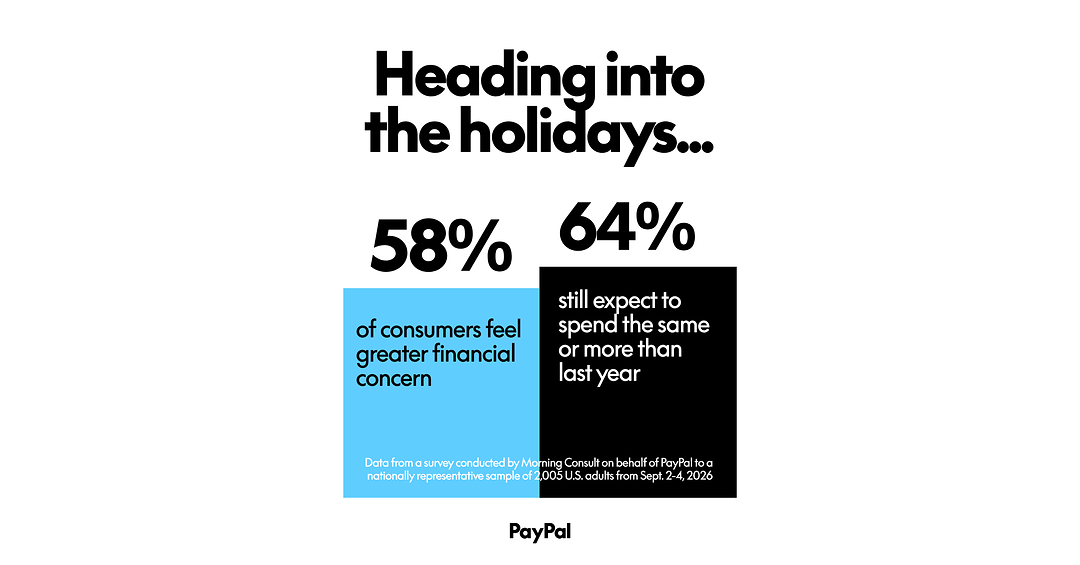
PayPal's survey found 58% of U.S. consumers are entering the 2026 holidays with greater financial concern, although 64% expect to spend the same or more than last year. Shoppers are prioritizing budgets, promotions and rewards, with 58% planning to shop before Thanksgiving and 67% favoring retailers offering rewards or cash back. BNPL demand remains significant: 55% of consumers have used or considered it, and 42% say its availability would make them more likely to complete a purchase, supporting PayPal's Pay Later and cashback product positioning.
Analysis
This is a low-conviction demand signal, not evidence of incremental holiday spend. Earlier purchasing can pull transaction volume into October-November while leaving total Q4 GMV unchanged; the more investable implication is a mix shift toward discount-led merchants and smaller-ticket checkout transactions. PYPL benefits only if conversion uplift and branded-checkout share exceed the funding cost of rewards and merchant incentives, so gross profit per transaction—not payment volume—will determine whether the holiday narrative supports a rerating.
BNPL adoption is a double-edged catalyst for PYPL. Higher attach rates can improve checkout conversion and re-engage dormant users over the next 1-3 months, but financially constrained borrowers raise loss and provisioning risk that may emerge with a lag in 1H27. AFRM and Block (XYZ) are more directly exposed to the same consumer-credit tail risk; PYPL's larger payments base makes the upside less elastic but its credit exposure less pure. MA should be broadly neutral: payment-volume growth is constructive, but installment rails and wallet funding can displace conventional card revolvers at the margin.
The consensus risk is treating flexible-payments usage as a clean fintech-growth indicator. A promotion-heavy holiday may produce strong headline TPV while compressing transaction margin and lifting customer-acquisition expense, particularly if merchants demand subsidized offers. The structural upside case requires evidence that PYPL converts holiday users into repeat branded-checkout customers without a sustained increase in loss rates; absent that, the event is more likely a seasonal engagement spike than a durable multiple catalyst.
Near-term focus should be PYPL's holiday trading commentary and any disclosed branded-checkout conversion, Pay Later receivables growth, transaction-margin trend, and delinquency/vintage data. The thesis is falsified if Q4 payment growth accelerates but transaction margin declines materially or if 30+ day delinquencies rise faster than receivables growth; conversely, stable credit metrics alongside branded-checkout share gains would justify upgrading the setup.
AllMind Terminal
AI-powered research, real-time alerts, and portfolio analytics for institutional investors.
Request TrialMarket Sentiment
Overall Sentiment
mixed
Sentiment Score
0.12
Ticker Sentiment
Key Decisions for Investors
- No immediate directional trade on the survey alone; place PYPL on a pre-earnings watch for October-November checkout-volume disclosures and app-engagement data. Upgrade only if evidence supports branded-checkout share gains rather than incentive-driven unbranded volume.
- Conditional 1-3 month pair: long PYPL / short AFRM if PYPL reports stable Pay Later credit metrics and positive transaction-margin commentary. PYPL has the more diversified earnings base, while AFRM carries greater sensitivity to a weaker-than-expected consumer-credit vintage; exit if PYPL's receivables delinquency trend deteriorates or AFRM demonstrates materially superior merchant-volume growth.
- Avoid using MA as a direct holiday-flexibility beneficiary. Maintain existing core exposure, but do not add on this signal; revisit if MA reports wallet-funded transactions are additive to card credentials rather than substitutive.
- For a bearish credit hedge into 1H27, monitor AFRM and XYZ for rising provision expense, net charge-offs, or funding-spread pressure after holiday originations season. A short is actionable only after vintage data confirm deterioration; survey intent alone is insufficient.
More News
- Cloudflare just announced a tool that lets businesses charge AI agents in stablecoins
- In the high-stakes game of chicken between CEOs and states, who blinks first?
- Ten Reasons Investors Are Driving Government Bond Yields Higher
- In photos: China's Xi hardens Taiwan warning as country celebrates week-long National Day holiday
- September Ends on a Grim Market Note: Evening Briefing Americas
- China’s Property Crisis: From Evergrande Collapse to Beijing’s Latest Measures