
AAOS submits comment letter to CMS on Physician Fee Schedule
Source: PR Newswire
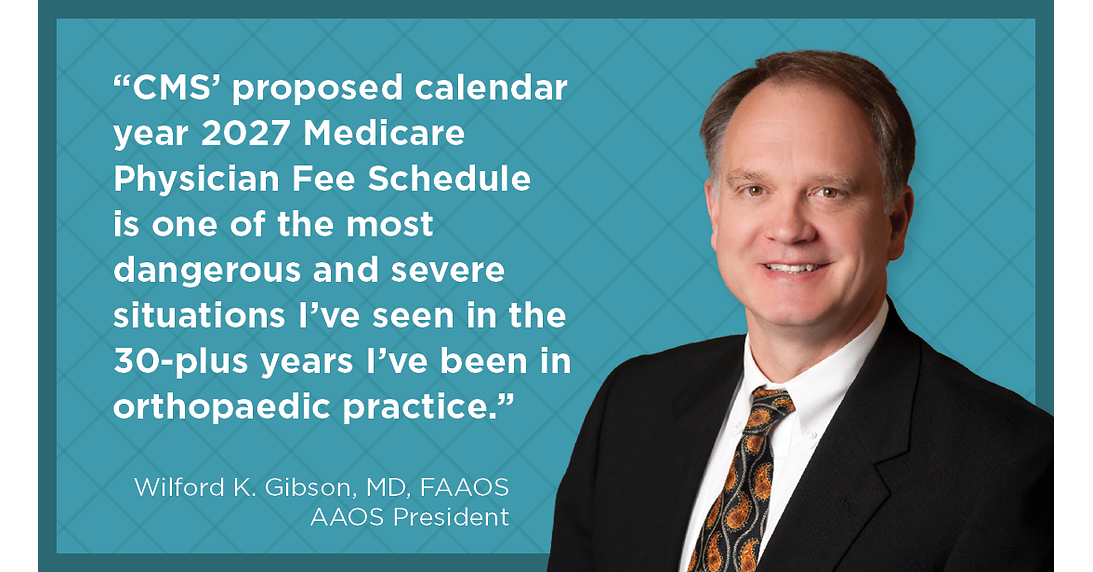
The American Association of Orthopaedic Surgeons urged CMS to withdraw or revise proposed CY2027 Medicare Physician Fee Schedule changes, including a 50% cut to separately identifiable same-day E/M and procedural services. AAOS also called for retention of CY2026 work RVUs for major joint-replacement procedures and opposed further practice-expense methodology changes without adequate impact analysis. The group warns that payment reductions and rising operating costs could impair independent orthopaedic practices, accelerate consolidation, and reduce patient access to care.
Analysis
This is principally a reimbursement-mix and site-of-care signal, not a broad managed-care or medtech earnings event. If the proposed methodology survives materially intact, subscale independent orthopaedic groups face greater fixed-cost absorption pressure, making hospital employment, private-equity-backed platform affiliation, and ambulatory-surgery-center (ASC) consolidation more likely over 6-18 months. That favors scaled operators with contracting, billing, and referral infrastructure—particularly HCA and UHS indirectly, and PE-backed practice-management assets privately—while weakening the negotiating position of independent practices.
The less obvious public-market implication is mixed for implant vendors. SYK, ZBH, JNJ/DePuy and MDT may see procedure volumes migrate toward systems and ASCs that can standardize purchasing; scale buyers can extract lower implant pricing, offsetting any volume stability. SYK is relatively better positioned through its ASC exposure and broad procedural ecosystem, while ZBH's heavier reconstruction exposure creates more sensitivity if joint-replacement economics pressure independent surgeons before consolidation is complete. Near term, however, CMS rulemaking is unlikely to alter CY2027 revenue estimates until the final rule and implementation details establish whether reductions are retained, phased, or offset elsewhere.
Consensus may overstate the probability that advocacy alone reverses the proposal: comments demonstrate political intensity but are not evidence of an economic concession. Conversely, a full reimbursement cut could be partially neutralized by utilization growth, migration to lower-cost ASCs, and commercial-rate cross-subsidization. The key falsifiers are the final conversion-factor/RVU treatment, same-day E/M policy, and any CMS impact analysis by practice size; a meaningful rollback would remove the consolidation catalyst.
AllMind Terminal
AI-powered research, real-time alerts, and portfolio analytics for institutional investors.
Request TrialMarket Sentiment
Overall Sentiment
moderately negative
Sentiment Score
-0.45
Key Decisions for Investors
- No immediate directional trade on the press release; place a CMS-final-rule alert for late 2026 and reassess only when final RVU, E/M, and practice-expense tables quantify specialty-level reimbursement.
- Maintain a 6-12 month relative preference for SYK over ZBH if final policy pressures office-based and independent joint-replacement economics: SYK's broader ASC/procedural exposure should be more resilient, while ZBH faces greater reconstruction-pricing sensitivity. Exit the relative thesis if CMS preserves 2026 arthroplasty RVUs and withdraws the E/M reduction.
- Monitor HCA and UHS for incremental orthopedic-service-line commentary and employed-physician acquisition activity over the next 2-4 quarters; treat accelerated acquisition pipelines or orthopedic volume-share gains as confirmation of consolidation. Do not establish a standalone position solely on this regulatory item because orthopedic revenue is not sufficiently disclosed.
- For medtech holdings, watch 2027 procedure-volume guidance and implant-price trends at SYK, ZBH, JNJ and MDT. A combination of stable volumes with worsening reconstruction pricing would favor reducing ZBH exposure; stable pricing plus ASC volume growth would invalidate the bearish second-order effect.
More News
- What investors need to know about Alphabet's stock-busting earnings report
- Our next steps for Alphabet stock after earnings disappoint at nearly every turn
- Budget 2026 speech
- Wendy's shares jump 15% as Nelson Peltz's Trian offers $1.4 billion to buy burger chain
- Fortinet’s stock is taking a dive after earnings. Here’s why.
- The UK cuts energy bills, taxes banks and boosts defense in high-stakes budget