
RepRisk reports 28% rise in greenwashing risk as scrutiny shifts toward the energy transition
Source: PR Newswire
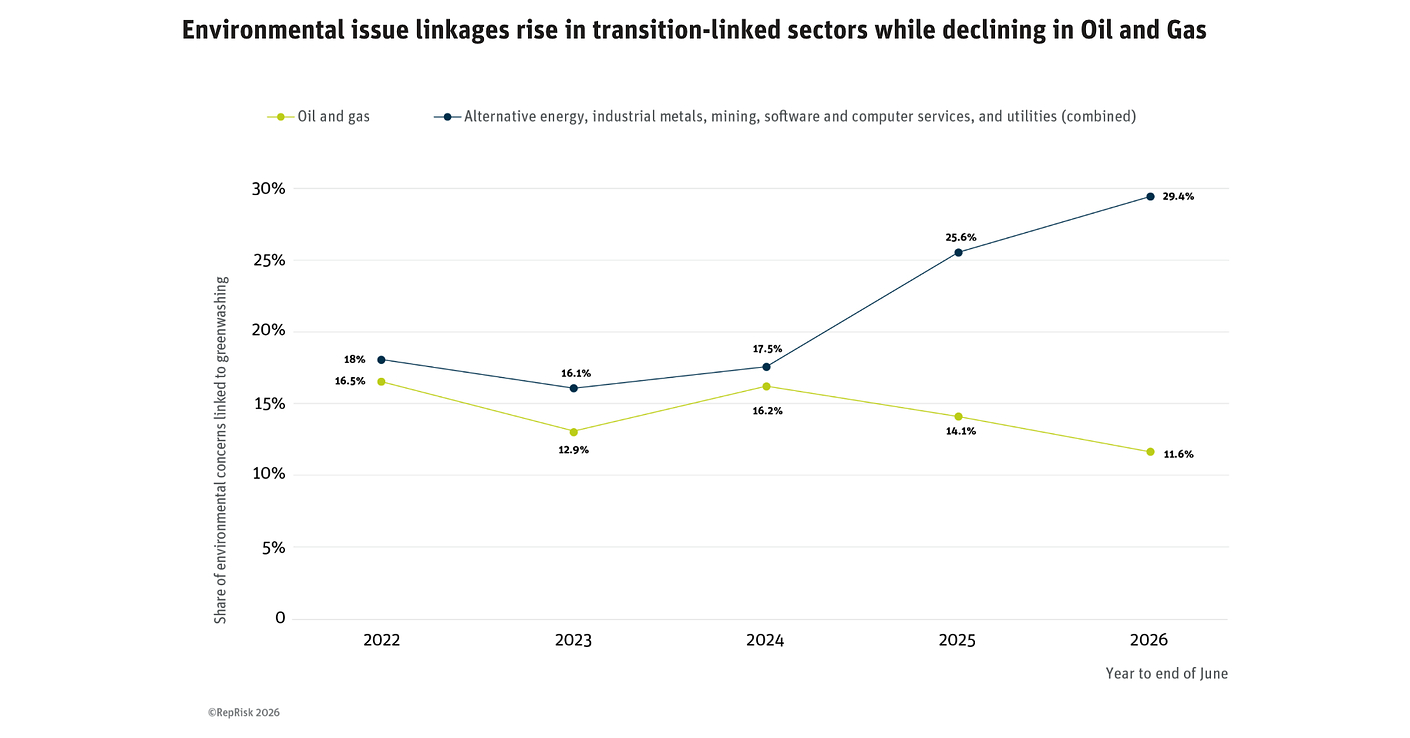
RepRisk found that 1,594 companies were linked to greenwashing in the year to June 2026, up 28% year on year; incidents rose 112% over five years. Financial Services had 305 linked companies, up 40%, and Banks had 86, up 23%. Biodiversity-related linkages nearly doubled from 162 in 2024 to 300 in 2026, surpassing climate and emissions linkages, which edged up from 272 to 275; RepRisk notes that its greenwashing methodology changed in 2025 and expanded screening scope affects absolute counts.
Analysis
The market mechanism is a higher diligence and financing hurdle for transition assets—not evidence that the transition itself is impaired. Banks and asset managers may face added monitoring, disclosure, and reputational costs through financed emissions and project exposure; lenders could respond with tighter covenants or higher required returns. That can disproportionately pressure marginal projects in mining, utilities, renewables, and data centers, while developers with auditable land-use and biodiversity plans may gain a relative advantage in permitting and access to capital. Biodiversity becoming a more prominent risk channel broadens scrutiny beyond carbon accounting to siting, water, and ecosystem impacts.
Near term, this is a weak standalone price catalyst: RepRisk linkages are not confirmed violations or quantified credit losses, and the report does not identify affected issuers or financial exposure. For the next 1–3 months, monitor whether regulators, lenders, or procurement counterparties translate scrutiny into enforcement, financing terms, or project delays. Over 6–18 months, biodiversity screening could become a more material differentiator in project selection and insurance.
Contrarian read: don’t extrapolate the five-year rise mechanically. RepRisk expanded its screening scope, and its dedicated tag began in 2025; absolute counts also reflect source and coverage growth. Even the reported sector linkages do not measure the share of revenue, assets, or lending at risk. The signal supports better issuer-level diligence, not a blanket short of ESG or transition exposure.
AllMind Terminal
AI-powered research, real-time alerts, and portfolio analytics for institutional investors.
Request TrialMarket Sentiment
Overall Sentiment
mildly negative
Sentiment Score
-0.20
Key Decisions for Investors
- No broad sector trade on this release alone. Avoid treating sector linkage counts as loss estimates; require issuer-level evidence of financing, permitting, or contract consequences before changing exposure.
- Add a watchlist flag for lenders and project developers with material transition-finance or renewable-energy claims. Verify financed-asset exposure, assurance quality, biodiversity baselines, and any covenant or underwriting changes before taking a position.
- Within transition exposure, favor projects with independently auditable biodiversity and land-use plans over similarly exposed projects relying mainly on carbon or renewable-power claims; size this as a relative-selection screen, not a near-term catalyst trade.
- Reassess if named companies face regulator action, financing repricing, project delays, or guidance changes tied to environmental claims. Conversely, if subsequent reports show stable like-for-like rates after screening-scope adjustments and no financing or permitting impact, treat the current signal as reputational noise.
More News
- Why Dangote’s Nigeria Refinery IPO Is Such a Big Deal for Africa
- Australia top court rules against coal mine expansion, citing climate harm
- A 32% beat, a +6% jump: the IT solutions name our models picked in July
- Nvidia Is on the Verge of a $6 Trillion Market Value
- Controversial $110 billion mega-merger of Paramount and Warner Bros. finally closes
- What Marvell's rosy long-term guidance means for our AI chip stocks
From AllMind Research
- Anthropic IPO Preview: Valuation, Timing, and What to Watch
- Shein After the IPO: Venue, Valuation, and What Must Be Proved
- What AI Research Tools Should a Small Hedge Fund Buy First?
- Introducing AllMind: A New Data & AI Workspace for Institutional Investors
- AI Tools for Private Equity Due Diligence: A Buyer Workflow