
Mounting Financial Pressures Threaten the Retirement of Middle-Class Americans
Source: PR Newswire
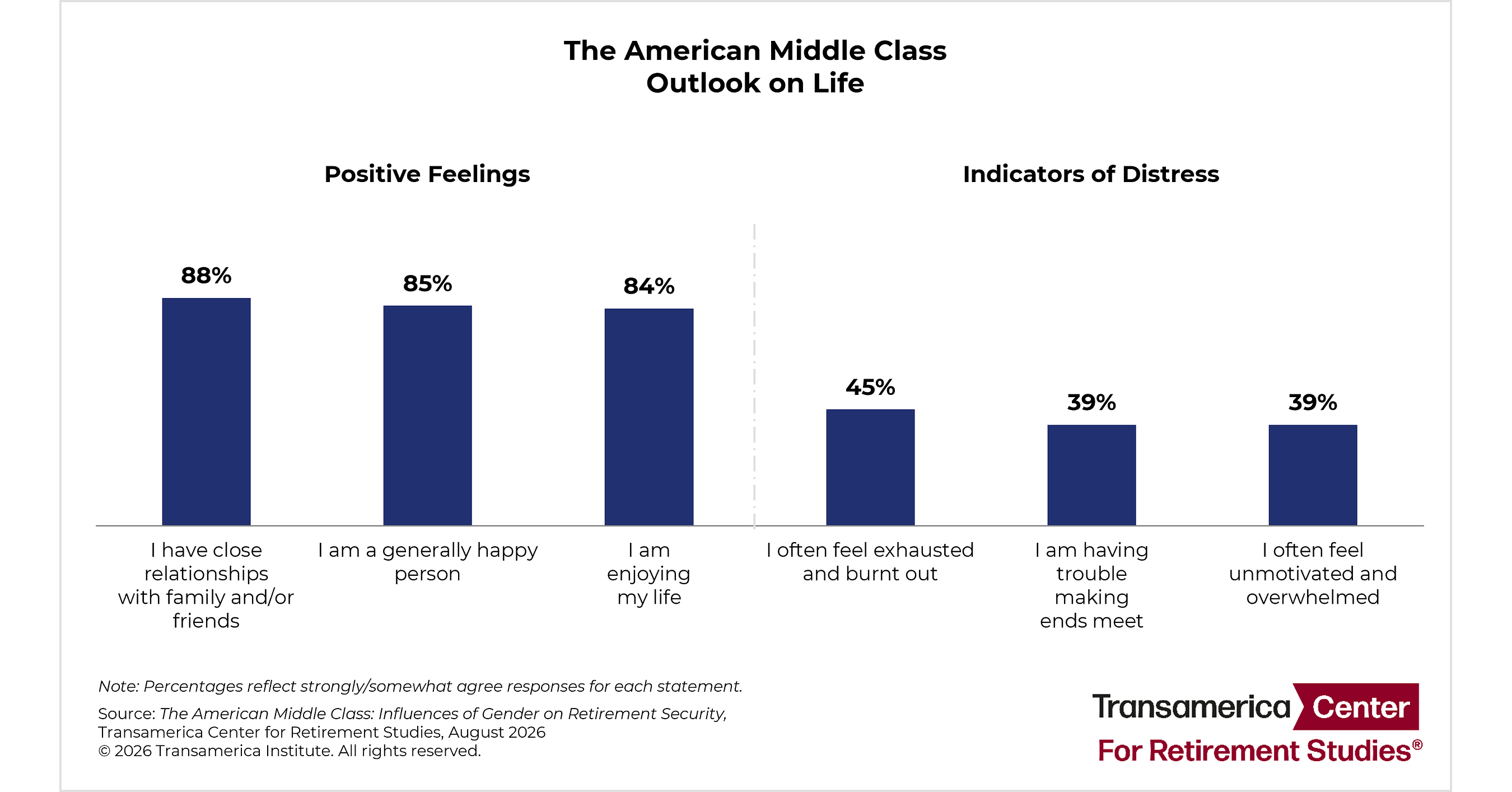
Transamerica’s survey of 7,606 middle-income Americans ($50k–<$200k) finds broad optimism but significant financial stress: 45% report often feeling exhausted/burnt out and 39% struggle to make ends meet, with 72% taking actions due to inflation (40% cutting expenses, 34% dipping into savings, 23% accumulating new credit card debt). Retirement funding concerns are prominent—among the not-yet-retired, 80% say high living costs make saving harder and 74% worry Social Security won’t be there—while average retirement account savings are estimated at $64,000 total (men $82k vs women $49k). The report also flags job-risk fears tied to AI/robotics (45% worry skills may become obsolete) and elevated caregiving/long-term care pressures (36% are current/former caregivers; retirees: 53% plan to rely on family/friends for care).
Analysis
This reads less like a one-day macro shock and more like a slow drain on household optionality. The key mechanism is cash-flow compression: when middle-income households prioritize debt service and emergency liquidity over discretionary spending, the first-order losers are consumer discretionary and lower-end credit issuers, while the quieter winners are firms selling “defensive” financial products—target-date funds, managed accounts, annuities, and long-term-care solutions.
A more interesting second-order effect is labor supply. If more workers try to extend careers, that supports labor availability in services and healthcare but also caps wage inflation at the margin, which is mildly disinflationary over 6-18 months. The caveat is that survey sentiment is not earnings power; the tradeable confirmation would be rising delinquency, lower retail traffic, or weaker contribution rates in retirement plan flows.
The contrarian takeaway is that the market may be overfocusing on consumer weakness and underpricing the demand for guaranteed income and financial advice. If job obsolescence fears rise with AI adoption, the beneficiaries are insurers and asset managers that can package retirement uncertainty into products, while the losers are cyclical lenders and discretionary names exposed to mid-income wallets. The thesis fails if consumer balance sheets reaccelerate, wage growth stays firm, and credit losses remain benign through the next 2 quarters.
AllMind Terminal
AI-powered research, real-time alerts, and portfolio analytics for institutional investors.
Request TrialMarket Sentiment
Overall Sentiment
mildly negative
Sentiment Score
-0.25
Key Decisions for Investors
- No immediate event-driven trade off the survey alone; treat this as a watch item until hard data confirms stress. Trigger to act: 30+ day credit card delinquencies, charge-offs, or retail sales weakening over the next 1-2 quarters.
- Modest long PRU or LNC vs short XLY on a 3-6 month horizon: the pair expresses retirement insecurity and later-life income demand versus compressed discretionary demand. Falsifier: consumer spending re-accelerates and insurer fundamentals do not improve in the next earnings cycle.
- If consumer credit deterioration shows up in the next monthly data, initiate short COF or buy put spreads 1-2 quarters out. Risk/reward is best if charge-offs rise before management guides conservatively; cut if delinquency trends flatten.
- Small long basket of BLK/TROW on a 6-18 month horizon if retirement-plan flows and advice demand stay resilient. This is a slower structural trade; size it modestly because the survey signal is indirect.
More News
- After France, is Italy next? Goldman Sachs flags bond risks as Rome's deficit widens
- Middle East war, high debt levels to dominate IMF-World Bank meetings in Bangkok
- CBO chief warns it’s ‘probably not plausible’ that a strong economy alone can steady U.S. debt as 5%-6% growth is needed—more than Bessent’s 3% view
- Stocks saw new highs and big declines: How the volatile AI trade moved last week's market
- Will Warner Bros. kill Skydance — or will David Ellison kill Warner Bros?
- Last-Minute Lawsuit Upends Cable One’s $480 Million Mega Broadband Deal