
Union Savings Bank Uses AI to Reduce Churn, Grow Deposits and Increase Customer Lifetime Value
Source: PR Newswire
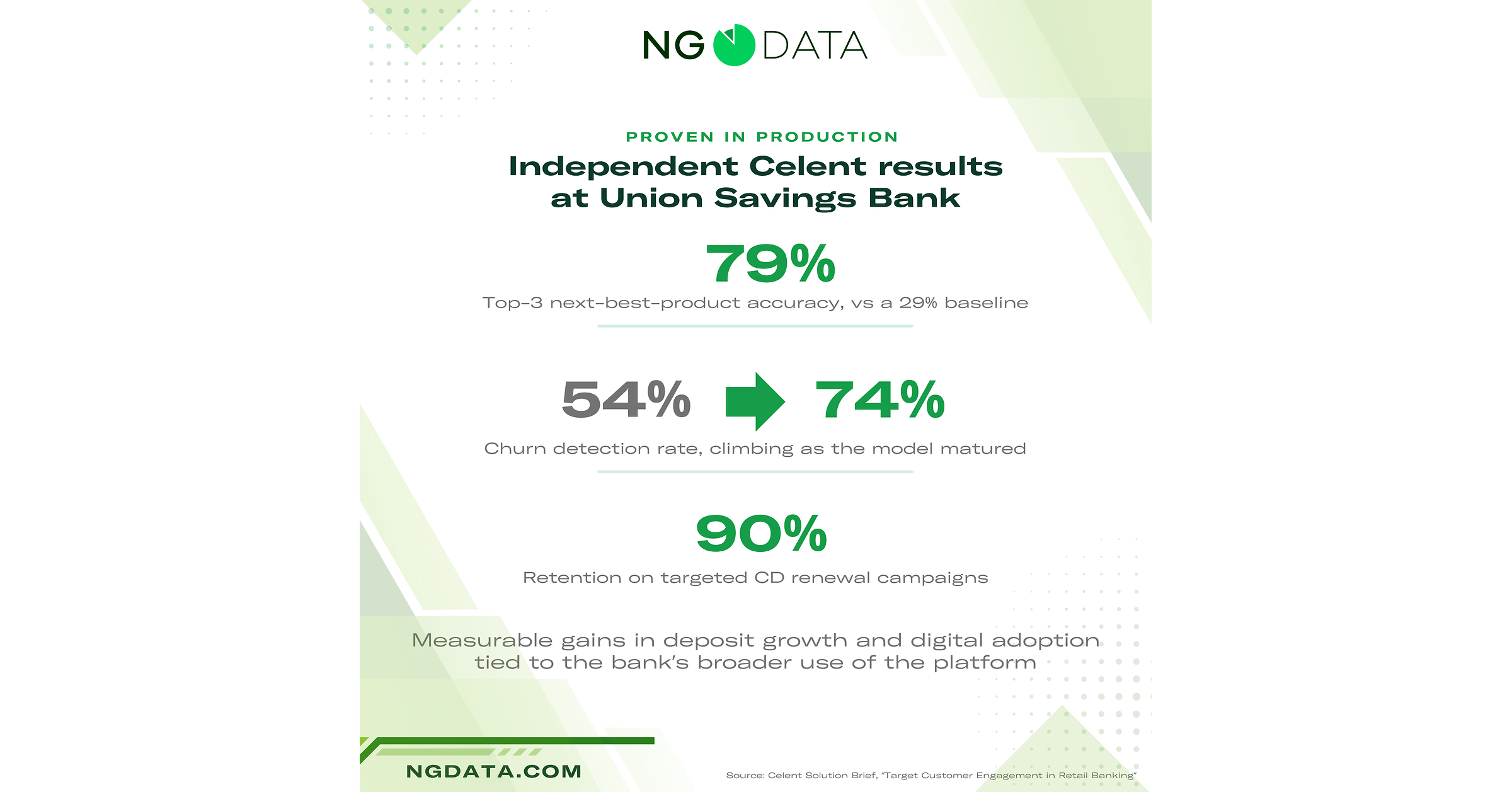
Union Savings Bank ($3.3B) is using NGDATA’s AI Hub to reduce attrition and grow Customer Lifetime Value, reporting a 74% churn catch rate and 79% next-best-product (Top-3) accuracy. In targeted Certificate of Deposit renewal campaigns, USB reports 90% retention, with the model triggering proactive, personalized engagement within existing infrastructure. While the news is performance-focused rather than a financial earnings update, it is supportive for NGDATA’s applied AI positioning in retail banking retention.
Analysis
This reads less like a bank earnings catalyst and more like evidence that low-cost customer-retention tooling is becoming table stakes for community/regional lenders. The investable implication is not revenue upside for banks, but a small reduction in deposit runoff and cross-sell leakage that can show up first in funding costs and fee mix before it ever moves loan growth. That matters most for banks with thinner funding franchises and fewer internal analytics resources, which is why the relative benefit is likely larger for smaller regionals than for already well-run franchises.
The second-order effect is competitive: if a bank can identify churn earlier and intervene cheaply, it can keep deposits sticky without paying up in rate. That compresses the advantage of pure rate shoppers and makes it harder for weaker community banks to bleed deposits fast enough to become forced sellers, which could modestly delay M&A or reduce bargain-bin consolidation. The flip side is that these are operational claims from a single deployment; the real test is whether core deposit betas and account attrition improve through a full rate cycle, not whether a model scores well in a pilot.
Contrarian view: consensus may be over-weighting the AI label and under-weighting how incremental this likely is versus standard CRM segmentation. The market should treat this as a vendor sales proof-point, not evidence of a durable moat for the bank unless management starts quantifying lower deposit costs, higher CLTV, or better retention in filings. For listed banks, the thesis is falsified if next few quarters show no improvement in core deposit stability or if operating expense rises faster than the funding benefit.
AllMind Terminal
AI-powered research, real-time alerts, and portfolio analytics for institutional investors.
Request TrialMarket Sentiment
Overall Sentiment
moderately positive
Sentiment Score
0.35
Key Decisions for Investors
- No immediate directional trade in FISI or OZK on this headline alone; treat as a watch item until next 1-2 earnings prints confirm lower deposit beta, better core deposit retention, or cross-sell lift.
- If you want a small tactical expression, prefer a relative-long basket of smaller regionals with visible deposit pressure versus a short in higher-beta regional bank exposure via KRE, but only on evidence of worsening funding costs over the next 1-3 months; stop if deposit costs fail to widen.
- Use FISI as the closer-to-theme name for a potential relative long versus OZK only if subsequent disclosures show FISI adopting similar retention analytics and translating that into lower attrition; otherwise avoid forcing the pair.
- Set a falsifier alert around the next two quarters: if core deposit balances are flat to down and noninterest expense rises without a measurable improvement in average funding cost, abandon the AI-retention thesis for the banking group.
More News
- Order to limit Starshield for Ukraine came from inside White House: Reuters reports
- The IPO drought is driving private equity-owned companies to the debt market to pay investors
- CoreWeave credit default swaps hit distress levels as investors sour on AI debt
- FDA approves Enspryng for thyroid eye disease treatment
- Giant Taiwanese chipmaker TSMC confirms it’s in talks with Elon Musk to join ‘Terafab’ complex in Texas: ‘The AI market continues to be very strong’
- The Tesla Roadster 2 Is Here—and It Flies
From AllMind Research
- Anthropic IPO Preview: Valuation, Timing, and What to Watch
- Shein After the IPO: Venue, Valuation, and What Must Be Proved
- What AI Research Tools Should a Small Hedge Fund Buy First?
- Best AI Stock Research Tools for Professional Investors
- Weekly Update: Adding Live MBO Level 3 Data - Liquidity Heatmap, OFI Charts, and More