
MicroVision Reports Third Quarter 2026 Results with Record Lidar Revenue and Accelerated Path to Profitability
Source: Newswire
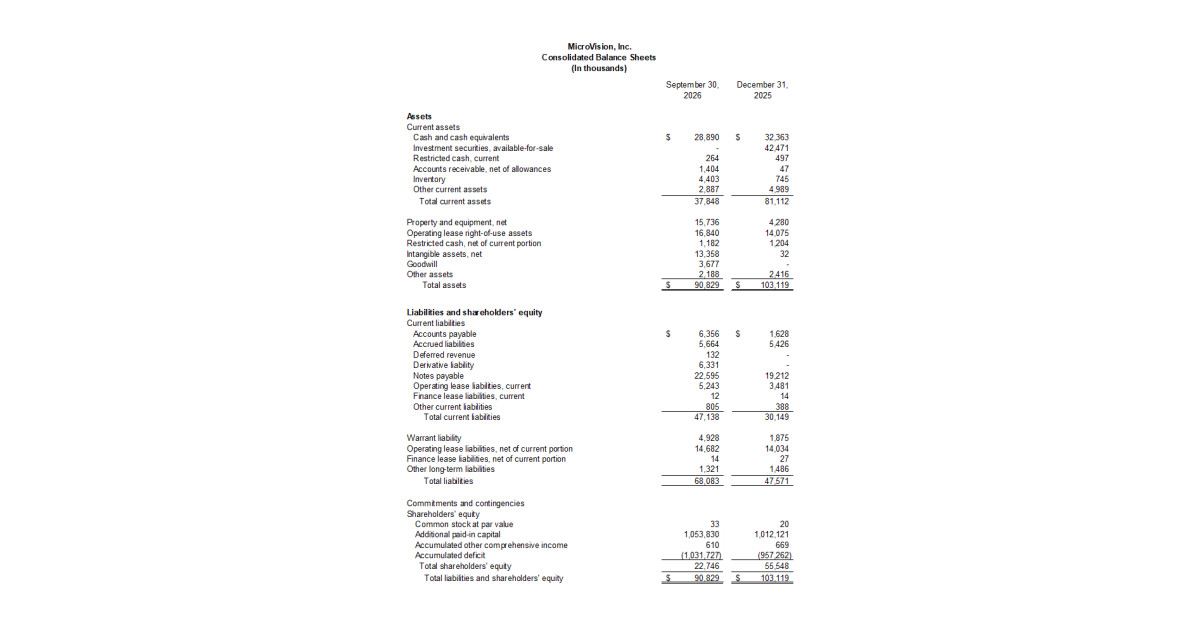
MicroVision reported Q3 2026 revenue of $2.4 million, up from $0.2 million a year earlier, with a 50% gross margin versus a negative margin in the prior-year quarter. Net loss narrowed to $12.2 million from $14.2 million, while operating expenses rose to $22.5 million, partly due to the Luminar acquisition, and the company used $13.6 million in operating cash. It maintained 2026 revenue guidance of $10 million–$15 million and expects 2027 revenue to at least double, with operating cash burn reduced to approximately $40 million.
Analysis
The key issue is conversion, not demand: backlog and shipping schedules only matter if they become recognized revenue and cash receipts. Full-year guidance implies roughly $5.2–$10.2 million of Q4 revenue, a sharp step-up from the first nine months’ pace. That makes the call’s commentary on shipment timing, customer acceptance, and backlog quality a near-term catalyst; any slippage would put the range at risk.
Reported margin improvement is encouraging but does not yet demonstrate operating leverage: at this revenue scale, a 50% gross margin produces little dollar contribution against the cost base. The $6.3 million German R&D grant also flatters near-term cash generation and should not be treated as recurring. Even if 2027 revenue doubles from the 2026 outlook, management’s projected $40 million cash burn signals that the stated path to profitability remains distant and leaves financing/dilution risk central. Cash runway should be assessed using normalized burn, not the grant-supported quarter.
Near term, the after-hours call can move the shares on quantified shipment cadence, customer concentration, and cost-cut execution. Over 1–3 months, monitor reported revenue versus the Q4 implied hurdle and cash use. Over 6–18 months, durable industrial/defense deployments could validate the platform, but automotive pilots and new adjacencies are not yet equivalent to scaled orders. The contrarian risk is that investors capitalize rapid percentage growth from a very small base as evidence of a self-funding business; the counterpoint is that successful order conversion could force a reassessment of commercial traction.
AllMind Terminal
AI-powered research, real-time alerts, and portfolio analytics for institutional investors.
Request TrialMarket Sentiment
Overall Sentiment
mixed
Sentiment Score
0.15
Ticker Sentiment
Key Decisions for Investors
- Do not chase the headline growth. Treat MVIS as a high-risk event-driven position until Q4 shipments and customer receipts validate backlog conversion; use the earnings call to check shipment timing, acceptance criteria, and customer concentration.
- For an existing MVIS long, keep position sizing disciplined and define a review trigger: revenue below the implied Q4 hurdle, backlog slippage, or cash use that fails to improve would weaken the thesis and increase dilution risk.
- Avoid initiating a directional short solely on the cash-burn profile: successful conversion of purchase orders or credible cost reductions could drive sharp short-term repricing. Reassess after the call and verify liquidity/borrow before considering a hedge.
- Track normalized quarterly operating cash use excluding the German grant, working-capital movements, and any financing activity. A sustained reduction toward the 2027 cash-burn target is more meaningful than one quarter of improved non-GAAP results.
More News
- What investors need to know about Alphabet's stock-busting earnings report
- Our next steps for Alphabet stock after earnings disappoint at nearly every turn
- Budget 2026 speech
- SK Hynix says the memory-chip shortage will last until 2030—and more than half its production is booked for the next two years
- China’s tech darlings are losing their shine. Here’s what’s behind the sell-off
- GE Vernova shares slip despite a beat-and-raise. What the sellers are getting wrong