
Oracle Investor Day 2026: Accelerating Value Creation
Source: PR Newswire
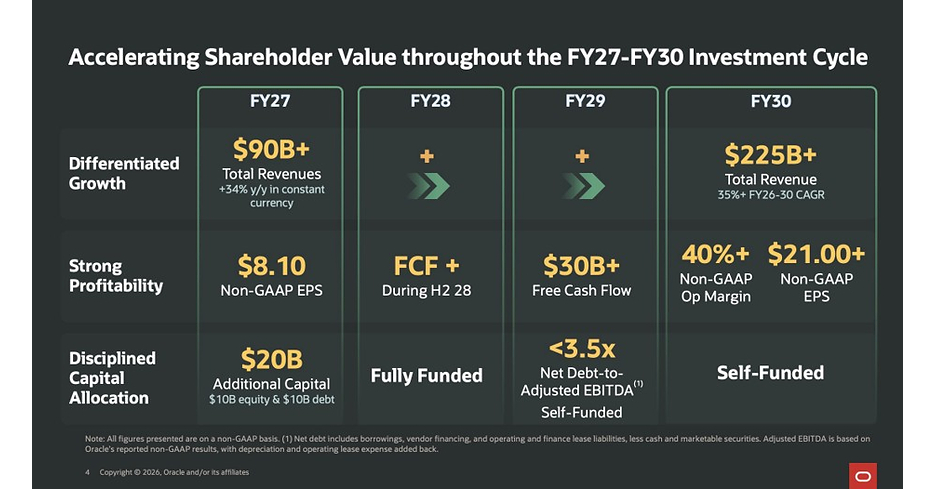
Oracle set an FY30 target of $225 billion or more in revenue, implying over 35% CAGR from FY26, with non-GAAP operating margin of at least 40% and non-GAAP EPS of $21 or more. It expects positive free cash flow in the second half of FY28 and at least $30 billion in FY29, while limiting additional capital-market funding through FY30 to $20 billion, split between $10 billion in equity and $10 billion in gross debt. Oracle reaffirmed FY27 revenue guidance of at least $90 billion and non-GAAP EPS of $8.10.
Analysis
Oracle: execution and financing, not the headline growth rate, are the trade. The guidance can support a near-term rerating, but the key underwriting question is whether contracted cloud demand converts into recognized revenue and cash flow without capex staying elevated longer than planned. The FY29 self-funding milestone is especially sensitive to that sequencing: a delay would leave Oracle more reliant on external capital just as it is competing for costly compute capacity.
Customer prepayments and vendor financing reduce Oracle’s upfront cash burden, but shift working-capital and funding exposure to customers and suppliers. Watch for signs those arrangements are becoming necessary to sustain bookings, rather than simply smoothing investment. Continued buildout also tightens competition for GPUs, power and data-center capacity; that may benefit equipment and infrastructure providers while pressuring Oracle’s costs and potentially delaying returns. AWS, Microsoft Azure and Google Cloud remain formidable competitors, though AI demand could expand the market rather than merely redistribute share.
Near term, the outlook is a positive sentiment catalyst. Over the next 1–3 months, quarterly cloud growth, backlog conversion and capex are more informative than aspirational FY30 targets. Over 6–18 months, the thesis depends on capex stepping down and cash conversion improving. Treat the targets cautiously: they are forward-looking non-GAAP measures, and the leverage definition includes vendor financing and lease liabilities. A sustained capex ramp, weakening cloud conversion, or deterioration in credit metrics would undermine the self-funding narrative.
AllMind Terminal
AI-powered research, real-time alerts, and portfolio analytics for institutional investors.
Request TrialMarket Sentiment
Overall Sentiment
moderately positive
Sentiment Score
0.55
Ticker Sentiment
Key Decisions for Investors
- Avoid chasing an event-driven gap higher. Consider scaling into ORCL on post-event weakness only if the next results show cloud demand converting into revenue and capex remains consistent with the stated investment cycle; reassess if capex fails to moderate or credit metrics worsen.
- Set a 1–3 month alert for cloud revenue growth, remaining performance obligations conversion, capex, and vendor-financing/customer-prepayment trends. Strong bookings without improving cash conversion would weaken the quality of the bull case.
- For relative-value work, compare ORCL’s cloud growth and cash conversion with AWS, Microsoft Azure and Google Cloud before taking a pair trade; the release alone does not establish that Oracle is gaining share or that peers are losing it.
- Revisit the thesis if management delays the FY29 cash-flow transition, materially raises funding needs, or if rating-agency actions indicate pressure on investment-grade credit quality.
More News
- Oracle shares jump as it targets $30B in free cash flow by 2029
- Google alters its cloud playbook, enlisting partners to sell more AI chips
- Why is Oracle stock surging 11% today?
- Oracle Stock Jumps 11% on Rosy Long-Term Targets
- Stock Market Today, Oct. 28: Markets Edge Higher as Fed Holds Rates Steady
- Stock Market Today, Oct. 28: Oracle Surges on Fiscal 2030 Revenue Guidance of $225 Billion