
IgniteTech bringt KI, die Unternehmenssoftware rund um die Uhr repariert, testet und ausliefert.
Source: PR Newswire
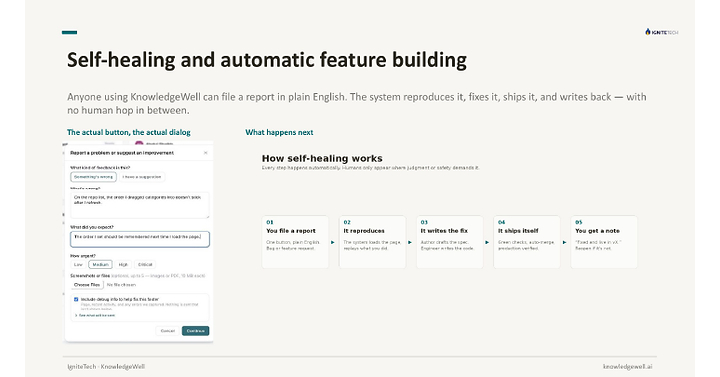
IgniteTech outlined an AI system designed to handle enterprise software bug reports and feature requests end to end: clarify and reproduce issues, develop and test fixes, deploy updates, and notify customers, subject to product guardrails and human controls for sensitive actions. Khoros plans to begin applying the approach to its Aurora AI and Iris platforms; two internal IgniteTech systems are already self-improving, with Anvil releasing four versions and 17 changes requested by five colleagues during a four-day period. The company says the system remains early-stage and can make mistakes.
Analysis
The investable signal is not autonomous code generation; it is whether vendors can safely turn customer-reported defects into lower support costs and faster retention/upsell outcomes. If validated, this shifts advantage toward firms with strong product telemetry, automated test coverage, and disciplined release controls—not necessarily firms with the best coding model. That could pressure labor-intensive maintenance and support models over 6–18 months, while raising customer expectations for response times across enterprise SaaS.
The key risk is a mismatch between the demo and production economics: ambiguous requests, regressions, security incidents, or customer-specific edge cases can make human review and rollback the bottleneck. Faster release cadence can also increase incident frequency and reputational damage; keeping access, billing, and data-deletion actions human-controlled limits some risks but does not establish reliability at scale. The claims are company-reported and do not quantify adoption, savings, defect rates, or customer outcomes.
Near term, this is weak evidence for a broad software repricing. Over 1–3 months, watch for customer deployments, independently verified resolution times, escaped-defect rates, and support cost per customer. Structurally, GitLab (GTLB), Microsoft (MSFT), and ServiceNow (NOW) could benefit if governance and workflow orchestration become monetizable control layers; generic code generation alone risks commoditization. Anthropic is mentioned as industry context, not as a direct beneficiary of this deployment, so the article supplies no standalone catalyst for ANT. The thesis weakens if autonomous changes require substantial human rework or increase production incidents.
AllMind Terminal
AI-powered research, real-time alerts, and portfolio analytics for institutional investors.
Request TrialMarket Sentiment
Overall Sentiment
mildly positive
Sentiment Score
0.30
Key Decisions for Investors
- No immediate position in ANT or the software sector on this announcement alone: the claimed operating benefits are not independently measured, and there is no demonstrated revenue or cost impact.
- Set a 1–3 month diligence trigger for evidence of paid customer rollout, support-cost reduction, time-to-resolution improvement, and stable escaped-defect/security metrics. Treat those as prerequisites—not assumptions—for a long thesis in the relevant vendor.
- For a 6–18 month watchlist, favor governance, testing, and workflow platforms such as GTLB, MSFT, and NOW over undifferentiated AI coding exposure if customers begin paying for controlled deployment rather than code generation. Reassess if human review remains the throughput constraint or incident rates rise.
More News
- AI stocks fall as Texas governor result raises data center risks
- OpenAI, ready to IPO in 2027, now counts majority of sales from enterprises, Brockman says
- Meta brings Conductor on board its model train
- Texas was the new epicenter of the AI data center buildout. That might be kaput.
- Dario Amodei wants ‘a country of geniuses in a data center.’ Realizing that vision requires risky financial mechanics, Anthropic’s IPO filing shows
- Mid-Q4 Investor Conferences Update: After AI Selloff, Wall Street Searches for Answers