
Ya está disponible MSI XpertStation WS300, basado en NVIDIA DGX Station
Source: PR Newswire
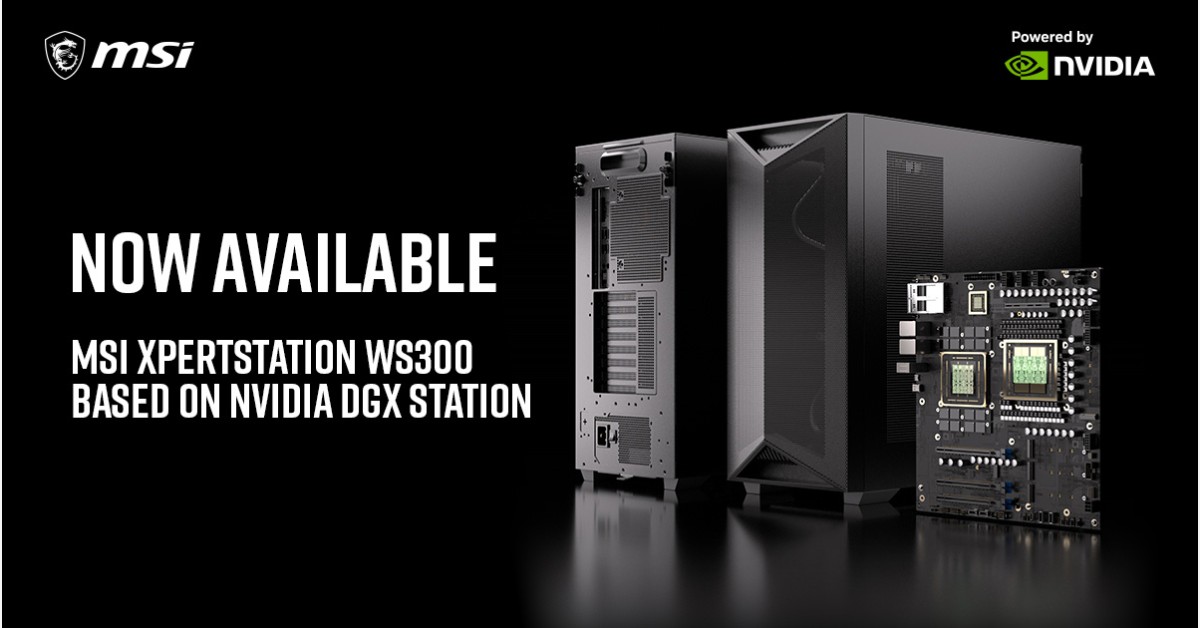
MSI launched the XpertStation WS300, an AI desktop workstation based on NVIDIA’s DGX Station architecture and the NVIDIA GB300 Grace Blackwell Ultra Desktop Superchip, positioning it for local enterprise AI development and inference. The system supports up to 748GB of coherent memory and dual 400GbE networking for scaling two units, aiming to reduce CPU-GPU data movement and lower recurring cloud inference costs. The news is positive for enterprise AI tooling, though it’s primarily a product announcement with limited direct market-wide impact.
Analysis
This is incremental evidence that NVIDIA is pushing Blackwell-class silicon down the enterprise deployment curve, not just upward into hyperscale capex. The strategic value is less the unit volume than the pull-through: every turnkey desktop system sold creates a new reference architecture that can anchor future rack-scale and software stack adoption. That favors NVDA’s ecosystem power and helps defend premium pricing if local inference becomes a budget line item inside enterprises rather than a discretionary lab expense.
The near-term revenue impact is likely small, but the second-order effect is that on-prem inference becomes easier to justify versus cloud tokens, which can slow marginal AI spend flowing to AWS, Azure, and GCP while increasing demand for NVIDIA-attached enterprise hardware. That is a mild headwind for cloud GPU rental economics and a modest tailwind for channel partners and system integrators that can package deployment, but it is not obviously a margin windfall for the OEM layer because these systems are typically low-ASP, pass-through heavy, and more about access than economics.
The contrarian point is that this kind of launch can look more important than it is: enterprise buyers still need data, security, and workflow reasons to move from pilots to always-on agents, so adoption may remain lumpy for quarters. What would falsify the thesis is evidence that enterprise inference spend continues to concentrate in the cloud or that Blackwell supply constraints prevent channel products from shipping at scale; if NVIDIA commentary in the next two earnings calls does not show enterprise system pull-through, the market should treat this as marketing rather than demand proof.
From a timing perspective, the first reaction window is days, the proof window is 1-3 months via channel checks and management commentary, and the structural read-through is 6-18 months if more OEMs clone the reference design. The key question is whether this becomes a repeatable enterprise procurement motion or just a premium niche for AI developers with large local models. If the former, it strengthens NVIDIA’s moat by moving the company closer to full-stack enterprise standardization; if the latter, it remains a nice-to-have rather than a thesis-changing catalyst.
AllMind Terminal
AI-powered research, real-time alerts, and portfolio analytics for institutional investors.
Request TrialMarket Sentiment
Overall Sentiment
mildly positive
Sentiment Score
0.25
Ticker Sentiment
Key Decisions for Investors
- Maintain a tactical long bias on NVDA into any post-news weakness; use pullbacks rather than breakouts, since the announcement is supportive but not revenue-transformative in the next quarter.
- Pair idea: long NVDA / short a basket of cloud-inference beneficiaries (e.g., AMZN, MSFT, GOOGL) for 1-3 months if channel checks suggest more local deployment and slower marginal cloud GPU growth; thesis breaks if hyperscaler AI capex re-accelerates.
- Watch-dog alert, not a trade: track NVDA enterprise segment commentary and OEM shipment breadth over the next 1-2 earnings prints; if multiple partners launch similar DGX-based systems, that is stronger evidence of durable demand expansion.
- If wanting a cleaner relative-value expression, long NVDA vs. SMCI for 3-6 months: NVIDIA captures the platform premium while system builders remain exposed to pricing pressure and lower gross margins; exit if SMCI shows meaningful share gains or margin inflection.
More News
- Nvidia GPUs are everywhere. Here are the ways companies are accessing them
- Stocks saw new highs and big declines: How the volatile AI trade moved last week's market
- Cerebras Is About as Big as Nvidia's Data Center Business Was Nearly a Decade Ago. The Similarities Mostly End There.
- Nvidia in talks to acquire Reflection AI or increase investment, FT reports
- As companies pour billions into Earth-based AI infrastructure, Google is taking the data center race off-planet
- Why Nvidia’s stock is dodging the AI credit scare that is crushing Broadcom and Oracle