
Bitmine Immersion Technologies (BMNR) annonce que ses avoirs en ETH (Ethereum) s'élèvent à 5,93 millions de jetons, et que le total de ses avoirs en cryptomonnaies et en liquidités atteint 15,7 milliards de dollars
Source: PR Newswire
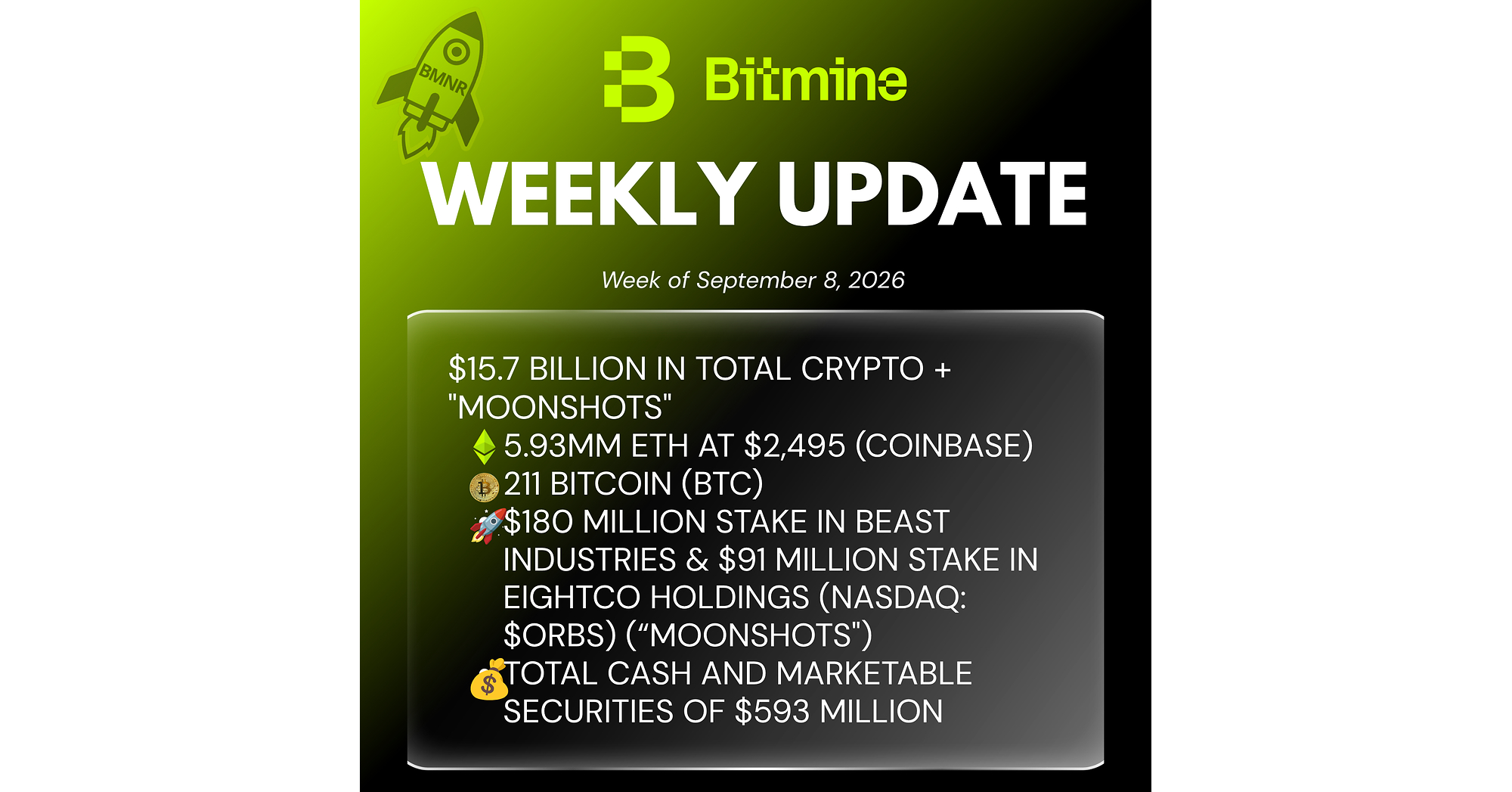
Bitmine reported $15.7B in total crypto, cash, marketable securities and moonshot holdings, including 5.93M ETH valued at $2,495 per token, equivalent to 4.9% of Ethereum's 122M-token supply. The company has staked 5.07M ETH ($12.6B), or 85% of its ETH balance, and estimates current annualized staking income of $330M, rising to $386M at full deployment. BMNR shares have risen 99% quarter-to-date, ranking fourth in the Russell 1000, while management remains bullish on ETH, citing Q3 outperformance versus the S&P 500 of 5,430bps and potential regulatory and institutional-adoption catalysts.
Analysis
BMNR has evolved from a directional ETH proxy into a leveraged closed-end crypto vehicle: its equity value should be driven by the gap between market capitalization and marked-to-market net asset value, not by reported staking revenue. The concentrated treasury creates a reflexive upside loop if the stock maintains a premium to NAV, because equity issuance can fund accretive ETH purchases; the same mechanism becomes destructive if the premium closes. With most assets exposed to ETH and a meaningful portion locked in staking, liquidity during a sharp ETH drawdown is materially weaker than the headline cash balance suggests.
The near-term catalyst is regulatory, but the relevant trade variable is not passage headlines alone: it is whether spot ETH inflows, ETH/BTC relative performance, and BMNR's premium-to-NAV expand together over the subsequent 1-3 months. Claimed staking economics should be discounted until filings separate validator revenue, operating costs, custody arrangements, slashing exposure and related-party economics around MAVAN. A large validator footprint also increases Ethereum-specific operational and governance concentration risk; any validator outage, protocol reward reduction, or security event would impair both earnings optics and the treasury narrative.
Contrarian view: the market may be pricing forced Russell benchmark demand and a scarcity premium as durable, despite both being transient sources of marginal buying. BMNR's recent momentum makes it vulnerable to a double de-rating—ETH declines and the equity premium compresses simultaneously—whereas COIN and GLXY offer more diversified transaction, custody and institutional-infrastructure exposure. ORBS is not a clean OpenAI proxy; its valuation sensitivity is likely dominated by BMNR's holding-period decisions and thin-float/speculative dynamics rather than any direct AI fundamental linkage.
Falsify the constructive case if ETH/BTC fails to make higher highs after the legislative event, BMNR's premium to independently calculated NAV contracts below 10%, or disclosed quarterly staking yield/revenue trails the indicated run-rate after costs. For a structural long, require evidence that equity issuance is accretive per share and that liquid cash plus unstaked ETH can cover operating needs without selling into volatility.
AllMind Terminal
AI-powered research, real-time alerts, and portfolio analytics for institutional investors.
Request TrialMarket Sentiment
Overall Sentiment
moderately positive
Sentiment Score
0.68
Ticker Sentiment
Key Decisions for Investors
- Do not chase BMNR after the momentum move; monitor daily premium-to-NAV using ETH marks and fully diluted shares. Initiate a tactical long only after a 15-20% pullback or consolidation if the premium is below 20% and ETH remains above its 50-day moving average; target a return to a 35-45% premium over 1-3 months, with a stop if premium-to-NAV falls below 10%.
- Express the regulatory/ETH upside more cleanly via long ETH exposure or COIN rather than BMNR for the next 30-60 days; pair with a short BMNR only if its NAV premium exceeds 40%. This isolates the likely premium normalization while retaining sector beta; cover the short on a sustained premium above 60% or demonstrably accretive capital raising.
- For 6-18 months, prefer GLXY over BMNR as an institutional digital-assets infrastructure allocation: GLXY has broader revenue sources and less single-asset treasury convexity. Reassess after both companies report quarterly disclosures on asset-custody economics, trading volumes and staking profitability.
- Avoid ORBS as an AI exposure. Treat it as a high-volatility look-through holding of BMNR until independently verifiable disclosures establish the size, terms and liquidity of any OpenAI-linked economic interest.
More News
- Grayscale's New Zcash ETF Has Gathered $1 Billion in Assets in Just 30 Days. Here's Why Investors Are So Bullish on Zcash.
- Is Bitcoin a Buy Right Now?
- Top Blockchains Continue to See Rapid Growth in AI Agent Payments. This Is the 1 Crypto You Need to Buy Right Now.
- Could Buying XRP Today Set You Up for Life?
- Here’s the ‘core economic flaw’ in the AI bull case as stock and bond trades unravel, according to a top economist
- How Pepsi fell behind in the cola wars—and then lost KFC
From AllMind Research
- Anthropic IPO Preview: Valuation, Timing, and What to Watch
- Shein After the IPO: Venue, Valuation, and What Must Be Proved
- What AI Research Tools Should a Small Hedge Fund Buy First?
- Index and ETF Holdings Data for AI Research
- Capital Intensity as Gravity: The AI Trade Enters Its Industrial Era (Looking at Q3 2025 Earnings in Tech)