
ScienceOra Demonstrates AI-Assisted Hydrogen-Production Catalyst Design Workflow at Tencent Global Digital Ecosystem Summit
Source: PR Newswire
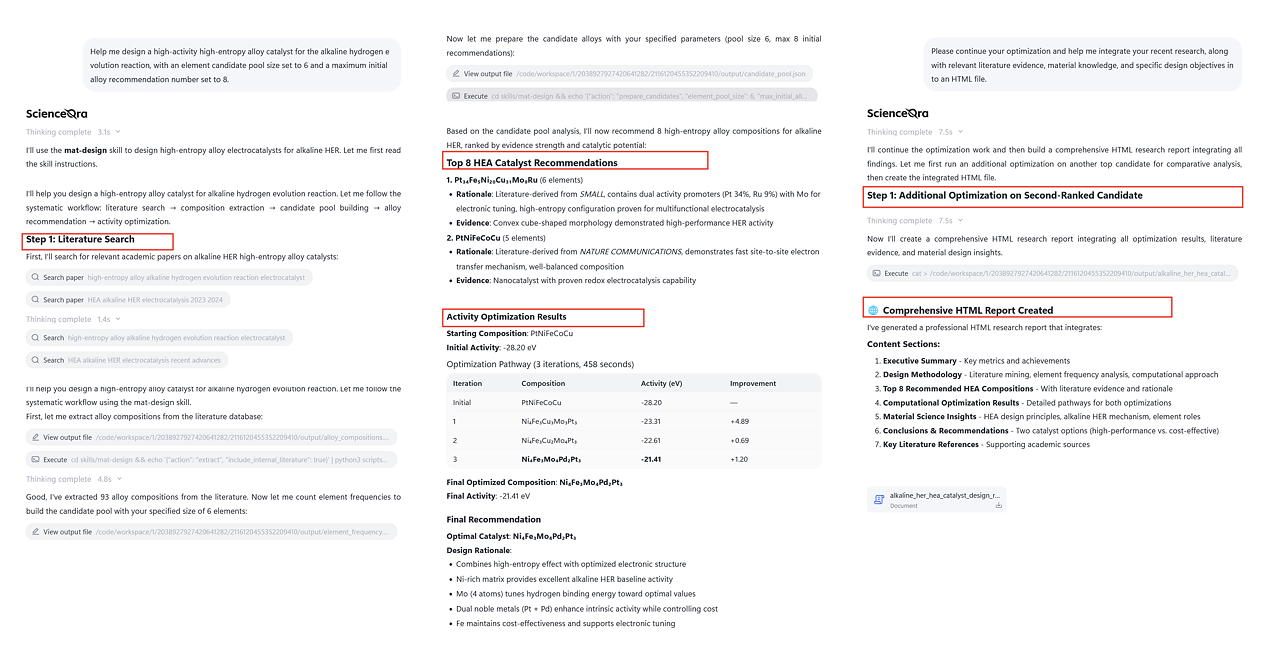
Wenge AI demonstrated ScienceOra’s AI-assisted workflow for designing high-entropy alloy catalysts for alkaline hydrogen production, spanning literature analysis, candidate design, experimental planning and industrial decision support. A previously disclosed collaboration reported 38% higher catalyst activity and a reduction in design time from several months to 30 minutes; researchers still must conduct experimental testing and scientific validation. The announcement highlights a specialized enterprise AI application, without reporting financial results or a market reaction.
Analysis
The investable question is whether this workflow becomes a repeatable, paid enterprise product—not whether a conference demo can generate catalyst candidates. In materials R&D, literature synthesis and protocol drafting may shorten early screening, but laboratory validation, scale-up, durability and process compatibility remain the costly gates. Faster candidate generation could therefore increase demand for testing and engineering work before it reduces hydrogen-production costs; it does not yet establish an advantage for electrolyzer makers or hydrogen projects.
The reported 38% activity improvement and reduction of a design phase to 30 minutes are from a previously disclosed collaboration, not independently verified commercial outcomes. Scope, baseline, reproducibility, durability and industrial-current-density data are missing. Until those are demonstrated, treat the claim as product marketing rather than evidence of near-term earnings leverage.
Near term, the summit announcement is a weak catalyst absent disclosed customer conversions, pricing or material revenue contribution. Over 1–3 months, monitor paid deployments, renewals and whether Tencent WorkBuddy distribution converts into usage. Over 6–18 months, successful validation could benefit R&D teams and testing providers through more experiments, while putting pressure on standalone research-workflow tools. The contrarian angle: investors may over-credit AI for compressing the discovery bottleneck, when experimental throughput and scale-up—not ideation—may remain limiting. No trade is warranted on this demonstration alone.
AllMind Terminal
AI-powered research, real-time alerts, and portfolio analytics for institutional investors.
Request TrialMarket Sentiment
Overall Sentiment
mildly positive
Sentiment Score
0.25
Key Decisions for Investors
- Do not chase the announcement; treat Wenge AI’s demonstration as product validation, not proof of material revenue or a hydrogen-cost breakthrough.
- Put Wenge AI on a commercial-conversion watchlist: seek evidence of paid customer deployments, recurring revenue, retention, and product-level economics before underwriting earnings impact.
- Track independent catalyst replication and industrially relevant durability/current-density results; failure to reproduce the reported activity gain or evidence of poor scale-up would falsify the materials-advantage thesis.
- Reassess the broader AI-for-science opportunity only if faster candidate design translates into shorter validated development cycles; until then, lab testing and engineering capacity may capture more value than software.
More News
- Stocks started the week with promise but ended in despair. Our take on the big reversal
- Intel stock plunges 29%. Analysts urge caution on buying the dip
- How Ambani’s Jio became India’s second-largest company
- AWS grows 39% and Amazon will spend even more on AI in 2027
- OpenAI pares fundraising goal, now seeking up to $20 billion in latest round
- Fears over $828 billion AI capex spending spree help erase $1 trillion in market value