
New Capitol Pulse Survey Reveals Evolving Ideological Dynamics Among Congressional Staffers
Source: PR Newswire
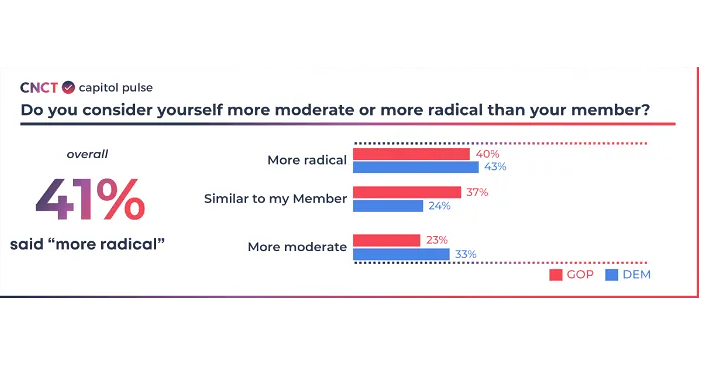
A Capitol Pulse survey found 41% of congressional aides identify as more politically radical than their members of Congress, including 43% of Democratic aides and 40% of Republican aides. Among Democratic aides under 30, the share was 53%; 33% of Democratic aides and 30% of Republican aides described themselves as more moderate than their bosses. The survey reports differences by age among Democratic staff and by role or experience among Republican staff, with no direct market implications stated.
Analysis
This is a weak market signal: staffers’ self-described ideological distance is not evidence that lawmakers will change votes, or that legislation is more likely to pass. A possible second-order channel is policy drafting and agenda-setting—especially if ideological mismatch contributes to staff turnover—but that would matter only if it changes committee priorities, bill text, or member behavior. The survey provides no basis to quantify that channel: sample size, response rate, question wording, and representativeness are not supplied, and “more radical” is not a common policy measure across parties.
Near term, expect little direct impact on equities, rates, or sector spreads. Over 1–3 months, watch observable outputs—committee schedules, bill language, leadership positions, and bipartisan vote counts—rather than sentiment headlines. Over 6–18 months, the relevant risk is policy uncertainty if staffing churn or internal ideological pressure makes durable compromise harder; that could affect regulated sectors, but the direction depends on the specific policy and election outcome. The contrarian point is that the headline may overstate staff influence: elected members, party leadership, and chamber arithmetic remain the binding constraints. No sector trade is justified by this survey alone.
AllMind Terminal
AI-powered research, real-time alerts, and portfolio analytics for institutional investors.
Request TrialMarket Sentiment
Overall Sentiment
neutral
Sentiment Score
0.00
Key Decisions for Investors
- No trade on the survey. Treat it as a low-confidence political sentiment indicator, not a forecast of legislation or election outcomes.
- Add a watch item for staff turnover and policy drafting only if corroborated by committee activity, bill text, or changes in lawmakers’ public positions.
- For regulated-sector exposure, use concrete policy catalysts and probability-weighted scenarios; do not infer a directional view for defense, healthcare, energy, or technology from this data.
- Reassess the thesis if subsequent evidence shows measurable changes in bipartisan vote counts, committee agendas, or legislative language; absent that, the market implication remains negligible.
More News
- 5 things to watch on Election Day as Democrats push for control of Congress
- Stock futures plunge as blue tsunami hits red states and data center hot spots. Wall Street usually likes political gridlock—but maybe not this time
- ‘Lawyer up’: Democrats take the House, and warn Trump’s family businesses are first in line for subpoenas
- Tax Cut Hopes Help Fuel Nifty’s Rally to a Two-Month High
- Florida Passes Property Tax Cuts in Challenge for Local Funding
- Investors poised for possible Democratic gains in Congress as US awaits election results