
Hanbat National University Study Shows Cation Disorder Could Improve Lithium-Rich Cathodes
Source: PR Newswire
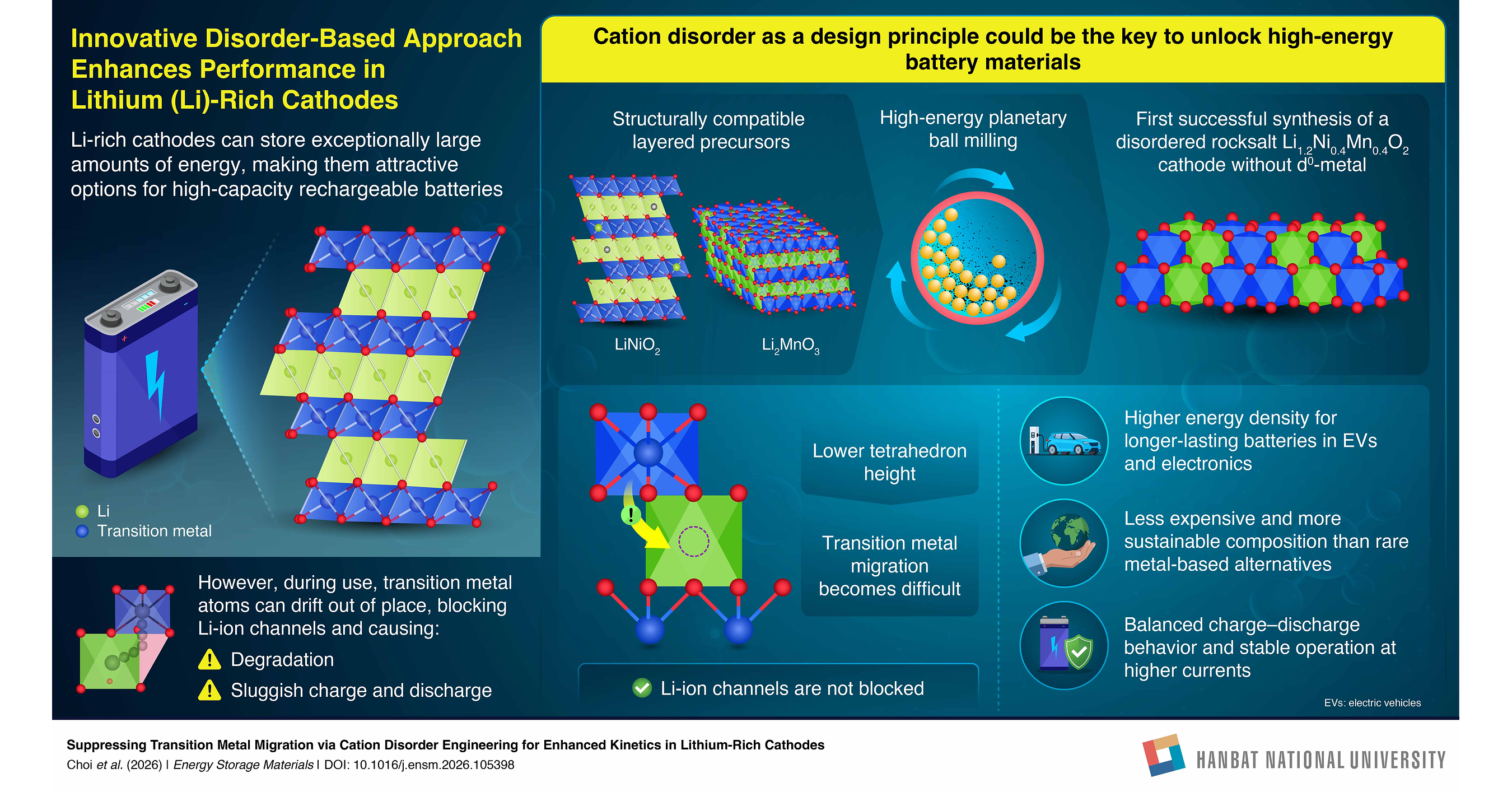
Researchers at Hanbat National University found that deliberately disordered Li1.2Ni0.4Mn0.4O2 cathodes delivered higher capacity and better performance at high currents than ordered counterparts, while retaining about 90% of initial capacity after 50 cycles with no voltage reduction. The findings suggest a potential route to more durable, higher-energy batteries for EVs and energy storage, but further development is needed before commercial use.
Analysis
This is a materials proof point, not yet an investable change in battery economics. The commercial bottleneck is whether the transport benefit survives practical electrode loading, electrolyte interaction, voltage fade, first-cycle loss, and long-duration cycling—not whether a lab half-cell beats an ordered control. Fifty-cycle retention is far short of the evidence needed for automotive qualification. The study was published in August; the October press release is unlikely, by itself, to reset near-term earnings expectations.
If scalable, cobalt-free lithium-rich chemistry could shift value toward cathode and cell developers able to qualify new materials, while weakening the strategic premium attached to incumbent cathode recipes. Higher cell energy density could reduce cells and pack materials per vehicle, but lower cost per range may also stimulate EV demand; lithium demand is therefore not a simple short. Mechanochemical processing could create a manufacturing and yield hurdle, so ball-milling feasibility at lab scale does not establish a low-cost route.
The key contrarian point: disorder is not automatically beneficial across compositions. A result in one Ni-Mn material does not establish a platform advantage or commercial readiness. Structural validation would require reproducible scale-up and independent cycling data under relevant conditions. Over 6–18 months, watch for follow-on studies, patent/licensing activity, and partnerships with cathode or cell manufacturers; absent those, treat this as scientific optionality rather than a sector catalyst.
AllMind Terminal
AI-powered research, real-time alerts, and portfolio analytics for institutional investors.
Request TrialMarket Sentiment
Overall Sentiment
moderately positive
Sentiment Score
0.45
Key Decisions for Investors
- No immediate directional trade: the report offers no company-level revenue signal, and its short-cycle laboratory result is not sufficient to underwrite commercial adoption.
- Put cathode and cell developers, including LG Energy Solution and Samsung SDI, on a research watchlist—not as presumed beneficiaries. Reassess only if they disclose validated testing, qualification timelines, or investment tied to lithium-rich disordered cathodes.
- Avoid a knee-jerk short in lithium producers: improved energy density could reduce material intensity per vehicle, but lower battery cost could expand unit demand. Revisit only with evidence on cathode loading, lithium intensity per kWh, and adoption economics.
- Falsifiers and confirmation points: independent results beyond 50 cycles, full-cell testing at commercially relevant loading, voltage/capacity retention, manufacturable process yield and cost, and a named industrial partner. Failure on these measures would leave the thesis as academic optionality.
More News
- AI Doubts Spread Cracks in Equities, Credit Markets: Evening Briefing Americas
- US-Iran war, then and now: How the landscape has changed since February
- 10-year Treasury yield drops back to 5% this week as investors seek cover from AI worries
- With earnings in rearview mirror, SpaceX-Tesla merger chatter takes center stage
- Stocks Fall as Oil Rally Keeps a Lid on Treasuries
- It’s another horrible day in the markets, and the usual suspects are to blame: AI, oil, and the French