
Introducing Outpost Space Factories: Orbital Manufacturing as a Service Unlocking Commercial Scale Production
Source: PR Newswire
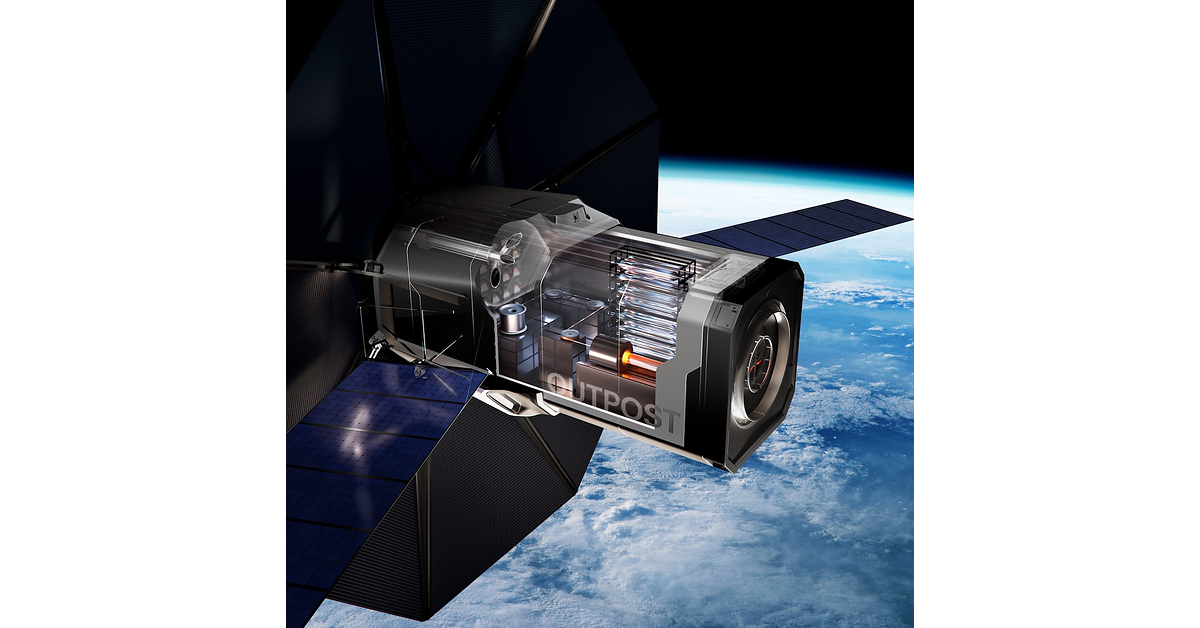
Outpost Technologies launched Space Factories, a modular manufacturing-as-a-service platform designed to let customers produce microgravity-enabled products in orbit and return them to Earth using its reusable CarryAll spacecraft and recovery infrastructure. The company will validate the model with StarFiber, a radiation-hardened metal-fluoride optical fiber intended to deliver lower signal loss than conventional silica fiber. The platform targets optical materials, pharmaceuticals, semiconductors and crystal growth, reducing customers' need to develop bespoke spacecraft, reentry and recovery systems.
Analysis
This is pre-revenue infrastructure positioning rather than a listed-equity catalyst. The key bottleneck is not launch capacity but economically repeatable return, recovery, and post-flight qualification; if Outpost validates that loop, it could lower experimentation costs for microgravity products and shift value from bespoke payload integrators toward standardized logistics providers. Public beneficiaries are indirect: RKLB and RDW gain from a broader commercial payload ecosystem, while LMT, NOC and RTX gain only if radiation-hardened fiber or orbital logistics converts into defense procurement rather than demonstration activity.
The near-term market implication is limited because there is no disclosed flight cadence, unit economics, customer backlog, yield data, or independent evidence that microgravity fiber can clear terrestrial cost/performance thresholds. For optical fiber, lower attenuation alone does not create volume demand: qualification cycles, connector/splicing compatibility, mechanical durability, and price per kilometer determine adoption. The more credible initial market is small-volume, high-value defense, space and sensing applications—not telecom backbone replacement—meaning any eventual revenue ramp is likely measured in years, not quarters.
Contrarian view: the sector may be over-crediting reusable-space narratives before proving recovery reliability and manufacturing yield. A single successful return validates engineering, not a scalable business; the relevant proof points are repeat-flight refurbishment cost, recovered-product yield, insurance pricing, and signed customer commitments. Failure to demonstrate these metrics within 12-18 months would likely reinforce the advantage of terrestrial specialty-fiber incumbents and existing space-station manufacturing approaches.
AllMind Terminal
AI-powered research, real-time alerts, and portfolio analytics for institutional investors.
Request TrialMarket Sentiment
Overall Sentiment
moderately positive
Sentiment Score
0.42
Key Decisions for Investors
- No standalone trade: Outpost is private and the announcement lacks disclosed backlog, pricing, flight schedule and unit economics needed to underwrite read-throughs.
- Create a 6-12 month watchlist on RKLB and RDW for disclosed hosted-payload, launch, recovery, or manufacturing-partnership contracts; initiate only after contract value and cadence support revenue estimates, rather than on press-release sentiment.
- Monitor Corning (GLW) and specialty fiber peers for defense/satellite fiber qualification announcements. Avoid treating orbital manufacturing as a near-term disruption to terrestrial fiber volumes unless recovered fiber demonstrates independently verified attenuation, mechanical reliability and delivered cost.
- For defense exposure, prefer incumbent optionality through LMT/NOC over speculative space-manufacturing beta; reassess if DoD procurement, not commercial pilots, funds repeatable return missions. Thesis is falsified by credible multi-mission commercial contracts and demonstrated refurbishment economics.
More News
- Saudi, Turkish, Pakistani chiefs plan urgent talks amid Yemen fighting
- Oil falls amid optimism over potential diplomatic solution to the Iran conflict
- Trump Versus Xi: How Their High-Stakes Summits Compare
- Trump, Xi Address AI, Taiwan During State Visit
- Oracle Japan shares surge 7% after record fiscal first quarter, bucking selloff of U.S. parent
- China's Xi urges U.S. to cooperate on AI
From AllMind Research
- Anthropic IPO Preview: Valuation, Timing, and What to Watch
- Shein After the IPO: Venue, Valuation, and What Must Be Proved
- What AI Research Tools Should a Small Hedge Fund Buy First?
- AllMind Fixed Income Compass for October 2025: Navigating Policy Divergence and Political Risk
- AI Equity Research Tools for RIAs and Wealth Managers