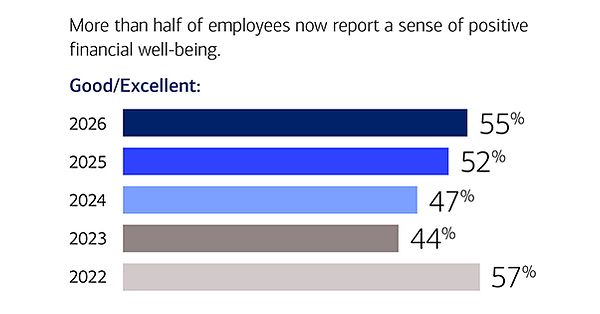
Bank of America’s 2026 Workplace Benefits Report finds overall employee financial wellbeing rose to a four-year high of 55% (up 11 points from 2023), and retirement confidence increased to 73% (up 6 points from 2025). Despite gains, employees still report stress from the economy (76%), inflation (62%), and cost of living (75%), while debt stress eased with credit card debt at 45% (down 11 points YoY). The report also highlights a benefits effectiveness gap—71% of employers rate workforce wellbeing as good/excellent versus 55% of employees—and notes underuse of AI in benefits administration (only 52% of employers).
The incremental bull case is not the survey itself; it is the mix shift toward sticky, low-churn relationship products. For BAC, workplace benefits, retirement, HSA and employee banking are more valuable as balance-sheet feeders than as near-term P&L drivers: they deepen payroll-linked deposits, create rollover opportunities, and improve customer retention across consumer and SMB households. The market should think of this as a modest moat expansion, not an earnings step-up.
The second-order winner is the integrated platform model. If employers keep leaning into benefits to retain labor, banks with bundled administration, custody, deposits and advice can widen share versus point solutions, while smaller administrators and regional banks without scale risk being squeezed on pricing and tech spend. One nuance the consensus may miss: higher financial wellness can reduce high-margin fee leakage from overdrafts and emergency borrowing, so the headline is more positive for balance-sheet quality than for transaction-fee intensity.
The catalyst path is slow-moving: 1-3 months for investor attention to show up in BAC commentary on workplace-benefits balances, HSA stickiness and client deposits; 6-18 months for any measurable uplift in cross-sell and retention. The thesis is falsified if BAC cannot translate the trend into deposit growth or fee durability over the next two quarters, or if a macro wobble re-accelerates card delinquencies and forces higher loan-loss provisioning. This is a small positive for BAC, but not a standalone catalyst worthy of an aggressive trade.
AI-powered research, real-time alerts, and portfolio analytics for institutional investors.
Request TrialOverall Sentiment
mildly positive
Sentiment Score
0.10
Ticker Sentiment
