
Applied Materials Eyes Nearly 40% Growth as AI Fuels Chip Equipment Demand
Source: marketbeat.com
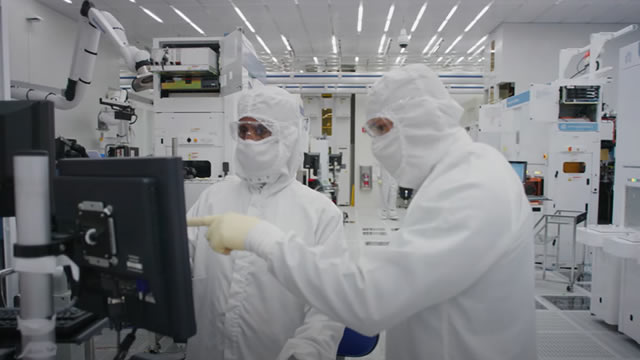
Applied Materials CEO Gary Dickerson said accelerating AI and data-center computing demand is improving both the company’s near- and long-term outlook. Based on recent company communications, the semiconductor-equipment maker is approaching 40% revenue growth for 2026, signaling a substantial uplift in its growth trajectory.
Analysis
AMAT’s setup is more attractive than a generic AI beta because incremental wafer-fab equipment demand is driven by process-intensity—advanced packaging, leading-edge logic, HBM and power delivery—not simply unit growth in servers. This favors AMAT’s broad deposition/materials portfolio and should support mix-led gross-margin resilience if utilization improves across foundry and memory. The second-order beneficiary is KLAC, where tighter process windows increase inspection intensity; the relative loser is lower-end, China-exposed WFE vendors if leading-edge spending continues to command a greater share of customer capex.
The key 1-3 month catalyst is whether management converts enthusiasm into raised fiscal-year revenue, services, and gross-margin guide rather than merely reiterating a favorable demand backdrop. A durable 6-18 month rerating requires evidence that HBM/advanced-packaging spending offsets cyclicality in mature-node capacity and that major customers—TSM, Samsung, Intel and SK Hynix—are not double-ordering tools ahead of fab ramps. Export-control tightening remains the principal asymmetric risk: AMAT has meaningful China exposure, and any broader restriction on mature-node tools or servicing could impair both revenue and multiple simultaneously.
Consensus may be underestimating the earnings torque if high-value materials tools grow faster than the company’s system revenue, but the stock is unlikely to sustain an AI-premium valuation on narrative alone. The more contrarian risk is that 2026 WFE expectations already embed a memory recovery and foundry node transitions; a customer capex delay would expose AMAT to order-pushout risk before reported revenue weakens. Falsify the constructive view if the next report fails to raise forward guide, gross margin contracts despite higher revenue, or disclosed China revenue declines faster than non-China growth can absorb.
AllMind Terminal
AI-powered research, real-time alerts, and portfolio analytics for institutional investors.
Request TrialMarket Sentiment
Overall Sentiment
moderately positive
Sentiment Score
0.68
Ticker Sentiment
Key Decisions for Investors
- Initiate or add AMAT only on confirmation of a forward revenue/gross-margin guide raise at the next earnings release; target a 6-12 month long with a 15-20% upside framework from estimate revisions and multiple expansion. Exit or reduce if management guides sequential system revenue down without a corresponding China-policy explanation.
- Express the process-intensity thesis as a 3-6 month pair: long AMAT and KLAC (KLAC) versus short SOXX only if AMAT’s relative performance remains below its pre-earnings range. This isolates leading-edge WFE content growth from broad semiconductor valuation risk; close if memory/foundry capex guidance is cut by a major customer.
- Use a watch alert rather than an immediate short on China risk: reassess AMAT exposure upon any Commerce Department rulemaking affecting deposition, etch, inspection, mature-node tools, or tool servicing. A material restriction would favor reducing AMAT/KLAC and could widen the discount of China-sensitive WFE versus ASML.
- Monitor TSM, Samsung, Intel and SK Hynix capex disclosures over the next two quarters. Upgrade position sizing only if at least two customers confirm advanced packaging/HBM or leading-edge logic spend increases; otherwise treat the growth outlook as potentially front-loaded demand rather than a structural revision.
More News
- Applied Materials: It's Time To Double Down (Earnings Preview)
- Here’s the ‘core economic flaw’ in the AI bull case as stock and bond trades unravel, according to a top economist
- Biotech stocks are surging. How investors can play the new drug innovation boom
- AI funding fears rattle Wall Street. Here's how we're adjusting our portfolio
- Braskem creditors, shareholders near deal on $11bn debt restructuring
- Instacart reportedly discussed selling itself with DoorDash and Uber