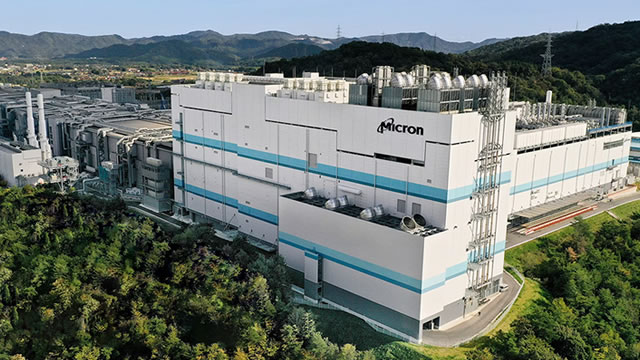
Micron shares jumped 12% after Bank of America said low-cost open-source Chinese AI models could increase demand for memory chips rather than substitute for it. The move is set against a key earnings week for Big Tech (e.g., Alphabet), where updates on AI spending could affect high-bandwidth memory (HBM) demand.
The market is starting to price AI as a bandwidth-and-capacity problem, not just a GPU story. If cheaper Chinese/open models accelerate experimentation and inference traffic, the incremental dollar can flow disproportionately into memory content per server, which is the cleaner earnings lever for MU than for the front-end AI software names. That also raises the odds of a tighter HBM/DRAM cycle: more model proliferation means more training clusters at the margin, but more importantly more deployment across enterprise and consumer workloads, which expands the installed base of memory-heavy AI infrastructure.
The second-order winner set likely extends beyond MU to the Korea memory complex and select equipment names, while the relative loser is any AI beneficiary whose valuation assumes model scarcity stays high and capex normalizes quickly. If the next wave of hyperscaler commentary confirms elevated AI budgets, the real read-through is that memory pricing can stay firm even if unit growth in GPUs moderates. Conversely, if cloud spending is pushed out or optimized through software improvements, the thesis weakens because memory demand is still cyclical and can unwind fast once inventories normalize.
The move is probably tactically justified but not yet structurally proven. The key falsifier over the next 1-3 months is any sign from large-cap tech that AI capex is flattening, or from MU that HBM supply is catching up faster than expected and ASPs are not inflecting. Over 6-18 months, the upside case is that AI workloads diffuse into more devices and more regions, keeping memory tight even without explosive frontier-model spending; the downside case is that open-source models compress compute intensity and turn this into a lower-margin commoditization story instead.
AI-powered research, real-time alerts, and portfolio analytics for institutional investors.
Overall Sentiment
mildly positive
Sentiment Score
0.35
Ticker Sentiment
