
Tsingke Enables High-Throughput Validation of AI-Designed Proteins and Antibodies
Source: PR Newswire
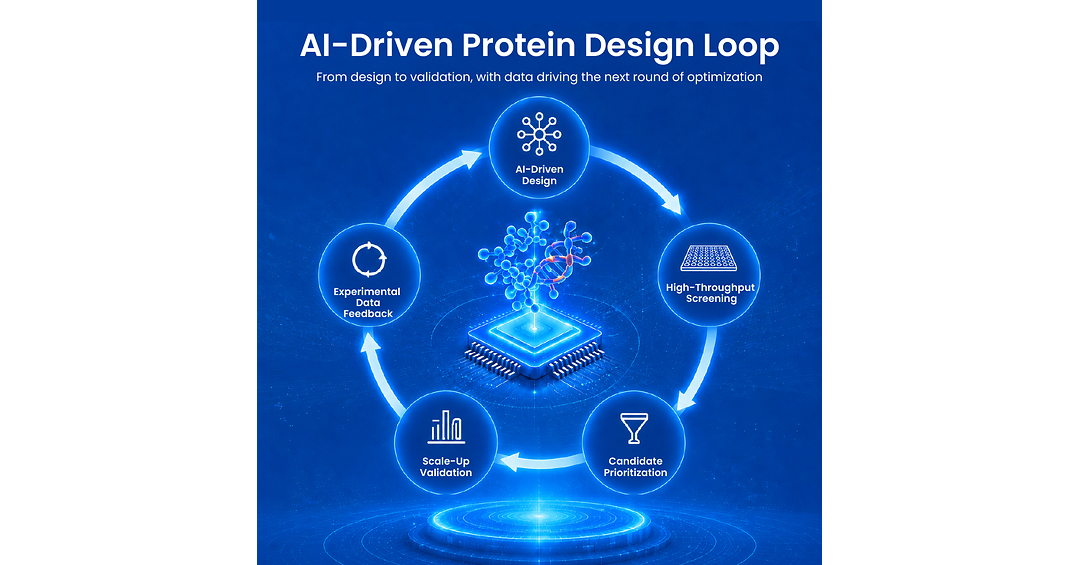
Tsingke launched an integrated high-throughput workflow for experimentally validating AI-designed proteins and antibodies, supporting up to 1,500 antibody candidates per day. The service combines gene synthesis, parallel expression, ELISA screening, scale-up production and BLI/SPR binding analysis, with applicable gene-to-antibody projects delivered in as little as 7 calendar days plus 5 days for shipping. The offering addresses a key bottleneck as AI tools such as AlphaFold, RFdiffusion and ProteinMPNN expand candidate libraries from dozens to thousands of sequences.
Analysis
The investable implication is not a near-term revenue event but evidence that the bottleneck in AI-enabled biologics is shifting from computational design to wet-lab throughput and data quality. Providers with vertically integrated design-build-test capabilities can capture a larger share of program spend and, more importantly, accumulate proprietary experimental datasets that improve future design models. This favors scaled public platforms such as TWST in synthetic DNA, ABCL in antibody discovery, and potentially RXRX/SDGR where experimentally validated data can improve model utility; it is less favorable for pure-play software narratives that cannot demonstrate translation from in silico hits to reproducible developable molecules.
The announced throughput and turnaround claims are marketing assertions rather than proof of commercial adoption, utilization, assay reproducibility, or economics. The key second-order risk is that cheaper candidate generation expands screening volumes faster than downstream development budgets, creating a glut of early hits without proportional growth in IND-stage assets; CROs and validation vendors benefit first, while therapeutic developers only benefit if hit-to-lead conversion improves. Over 6-18 months, the decisive metric will be whether AI-designed programs show better affinity, manufacturability, and clinical success rates—not simply larger candidate libraries.
Consensus may overvalue the headline speed of generative biology while underestimating that binding assays do not resolve immunogenicity, stability, pharmacokinetics, tissue delivery, and CMC constraints. That makes this constructive for picks-and-shovels suppliers with recurring workflow revenue, but insufficient on its own to support a broad rerating of AI-drug-discovery equities. Near-term sector moves should remain driven by partnership bookings, milestone payments, cash runway, and clinical readouts rather than announcements of laboratory capacity.
AllMind Terminal
AI-powered research, real-time alerts, and portfolio analytics for institutional investors.
Request TrialMarket Sentiment
Overall Sentiment
moderately positive
Sentiment Score
0.42
Key Decisions for Investors
- No direct trade on this private-company press release; treat it as a watch signal rather than a catalyst for public equities.
- Monitor TWST over the next 1-3 quarters for growth in synthetic-biology and biopharma orders, gross-margin progression, and customer concentration. A sustained acceleration in order volume with stable margins would support a long thesis; weaker margins from price competition or rising low-complexity mix would falsify it.
- Use ABCL as the cleaner listed antibody-platform read-through, but only add on independently disclosed program advances or partner economics. The core risk/reward hinges on funded partnerships converting to milestones, not on increased screening throughput alone.
- Avoid chasing high-beta AI-drug-discovery names such as RXRX and SDGR solely on generative-protein headlines. Require evidence of downstream validation—partner pipeline progression, clinical candidate nominations, or improved economics—before positioning for a 6-18 month rerating.
More News
- Wall Street’s Nasdaq hits all-time high as AI frenzy gathers pace
- Data-Center Bet Makes ESDS One of India’s Best New Listings
- Asia stocks ride tech wave higher, oil stays subdued
- Trump Says US Team Met With Iranians at UNGA
- U.S. regulators rush to write crypto rulebook after Clarity Act stalls in Senate
- How Kevin Warsh’s rate hike exposed a 2-speed U.S. economy, with AI and housing at the poles
From AllMind Research
- Anthropic IPO Preview: Valuation, Timing, and What to Watch
- Shein After the IPO: Venue, Valuation, and What Must Be Proved
- What AI Research Tools Should a Small Hedge Fund Buy First?
- How to Evaluate Consensus Estimates Platforms With AI
- Weekly Update: Adding Live MBO Level 3 Data - Liquidity Heatmap, OFI Charts, and More