
Andy Burnham to Meet Donald Trump as Aides Blame President for Economic Woes
Source: Bloomberg
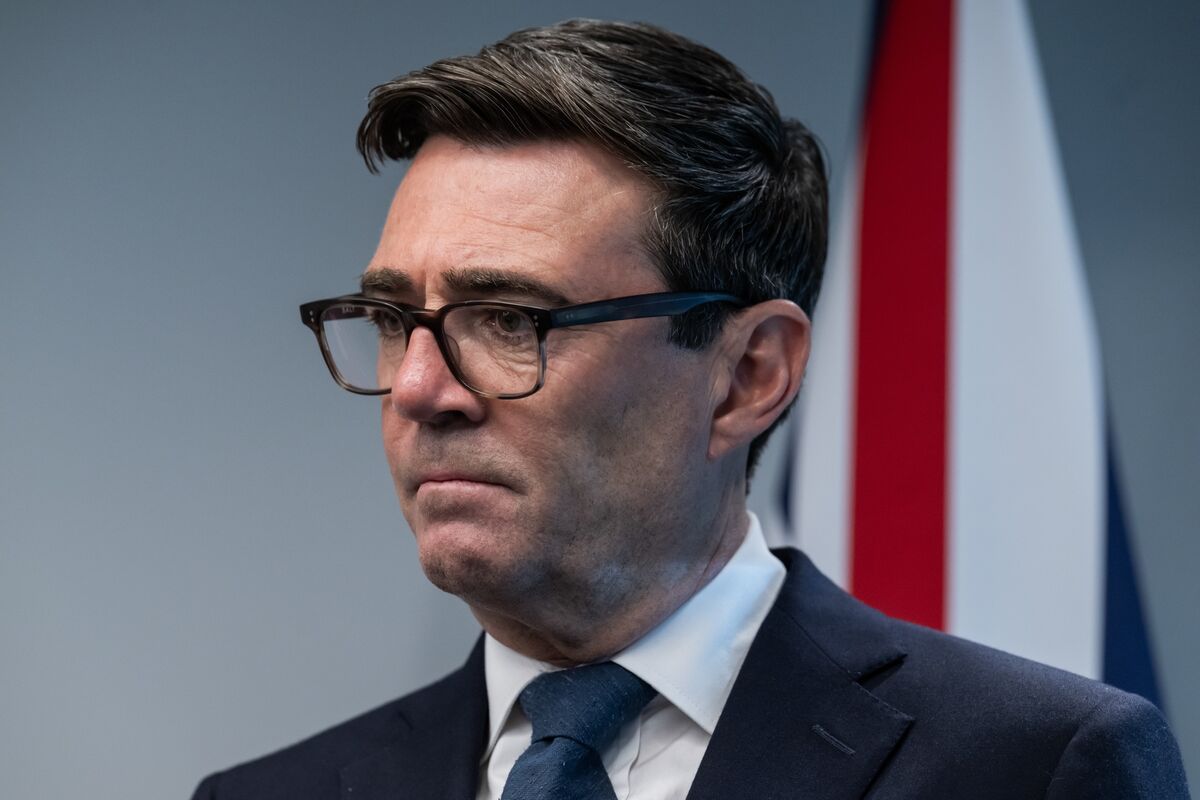
UK Prime Minister Andy Burnham is scheduled to meet US President Donald Trump at the UN General Assembly next week as his aides attribute part of the UK's economic headwinds ahead of the budget to Trump. The meeting highlights the potential influence of US policy and bilateral relations on Britain's fiscal outlook, though the article provides no specific budget measures or economic estimates.
Analysis
The market-relevant issue is not the meeting itself but whether UK fiscal plans become subordinated to managing US trade and geopolitical demands. That uncertainty raises the probability of a delayed or diluted budget, which would keep UK domestic-risk premia elevated: sterling is most exposed near term, while rate-sensitive UK equities and gilts will trade on credibility signals around borrowing, not political rhetoric. Export-heavy FTSE 100 constituents have a partial currency hedge, making them relatively more resilient than UK banks, housebuilders and consumer-discretionary names if GBP weakens.
Over the next 1-3 months, any evidence of tariff exemptions, defense-spending concessions, or energy agreements could produce a relief move in GBP and UK cyclicals, but the upside is capped if concessions imply additional fiscal spending. The more adverse 6-18 month outcome is a widening gilt term premium: higher defense or industrial-policy commitments without offsetting revenue would pressure long-duration UK assets and constrain household-facing sectors through mortgage rates. This is not yet a high-conviction directional trade; the key falsifier is a budget that funds new commitments credibly while preserving fiscal headroom, alongside stable 10-year gilt yields and GBP appreciation.
Consensus may overstate the value of a diplomatic reset for broad UK equities. A weaker pound can support multinational earnings translation, but it simultaneously imports inflation and reduces the Bank of England's room to ease; that combination favors global earners over domestically levered businesses. Watch the GBP/USD reaction and the 10-year gilt–Bund spread: a sustained widening after any announced agreement would indicate markets view the outcome as fiscally costly rather than economically supportive.
AllMind Terminal
AI-powered research, real-time alerts, and portfolio analytics for institutional investors.
Request TrialMarket Sentiment
Overall Sentiment
mildly negative
Sentiment Score
-0.20
Key Decisions for Investors
- Maintain a defensive UK equity tilt for the next 1-3 months: favor FTSE 100 multinational exposure via EWU over UK domestic cyclicals; avoid adding to UK housebuilder and consumer-discretionary exposure until the budget clarifies funding and mortgage-rate implications.
- Use a relative-value expression rather than a broad UK short: long EWU / short EZU in equal volatility weights if GBP/USD breaks lower and the UK 10-year gilt–Bund spread widens. The thesis is UK-specific fiscal-risk premium; exit if the spread retraces materially after budget details.
- For portfolios with sterling exposure, retain downside protection through 1-3 month GBP puts or reduced unhedged GBP exposure ahead of the budget and bilateral-policy headlines. The hedge should be reduced if GBP strengthens alongside falling gilt yields, signaling credible fiscal containment.
- Set an alert rather than initiate a rates trade: a sustained rise in long-end gilt yields following fiscal announcements, without a parallel global-rate move, would justify underweighting UK duration through IGLT or equivalent gilt futures exposure. A funded package that preserves fiscal rules would invalidate the short-duration-risk thesis.
More News
- Flames, smoke seen near Riyadh airport; Houthis claim attacks on Saudi capital
- Treasury yields are already blowing up the CBO’s long-term forecasts, and experts who previously downplayed U.S. debt fears are now starting to worry
- Polish prime minister warns Russia is planning drone or rocket strikes on European countries supporting Ukraine as ‘Carpathian Eight’ meet
- Iran says conditions to re-engage in talks, end war sent to US via Qatar
- Diesel Prices Keep Pressure on Fed and Markets
- Trump vows to create an ‘AI Force’ and nods to justice system after rejecting calls to slow down industry. ‘Rather, we will cherish it’