
Intel: The $23 Billion Dilution I'm Willing To Accept
Source: seekingalpha.com
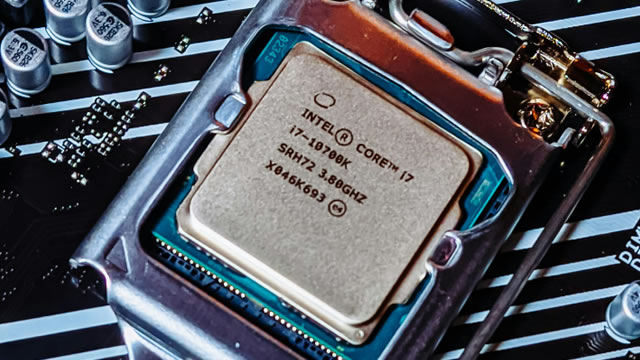
Intel raised $23 billion through an upsized equity offering, strengthening funding capacity for capital expenditures, working capital, advanced 14A and 18A-P process nodes, foundry transformation, and AI infrastructure. The raise improves strategic flexibility despite expectations for continued negative near-term free cash flow. The analyst assigns a $113.33 price target, implying 18% upside, with additional upside contingent on stronger execution.
Analysis
The financing removes the near-term liquidity discount that has constrained INTC’s strategic optionality, but converts the investment case into an execution-and-dilution debate. The relevant question is whether incremental capital produces externally validated foundry revenue and competitive yields before depreciation, startup costs, and customer incentives pressure gross margin; absent that proof, a larger equity base can cap per-share upside even if enterprise value rises. The immediate beneficiary is INTC’s capex supply chain—ASML, AMAT, LRCX and KLAC—but only if management translates funding capacity into firm tool orders rather than a slower, staged deployment.
Over the next 1-3 months, the key catalyst is disclosure around the offering’s share count, pricing, lockups and use of proceeds, followed by evidence that 18A yields and customer qualification remain on schedule. A meaningful post-raise rally is vulnerable if guidance implies cash burn persists beyond 2026 or if gross-margin recovery is deferred; the market will likely value INTC on FCF inflection rather than node-roadmap rhetoric. TSMC remains the principal competitive benchmark: any further evidence that leading-edge customers remain unwilling to dual-source to Intel Foundry would make the capital raise defensive rather than transformational.
The contrarian view is that the raise may be more constructive for creditors and strategic customers than for common equity. A stronger balance sheet improves Intel’s ability to offer long-duration capacity commitments and absorb early foundry losses, potentially increasing competitive pressure on TSMC and Samsung over a 6-18 month horizon. But the equity-market benefit requires utilization: funded fabs without anchor customers create a fixed-cost burden, especially if AI demand shifts toward specialized accelerators and reduces the strategic value of Intel’s CPU-centric platform.
AllMind Terminal
AI-powered research, real-time alerts, and portfolio analytics for institutional investors.
Request TrialMarket Sentiment
Overall Sentiment
mildly positive
Sentiment Score
0.38
Ticker Sentiment
Key Decisions for Investors
- Do not chase INTC solely on the financing announcement; wait for final dilution details and a post-deal stabilization period. Initiate only if management maintains a credible 2026-27 FCF-inflection timeline and provides measurable 18A customer or yield milestones; a guidance cut to gross margin or capex would falsify the thesis.
- For a 6-12 month semiconductor-capex expression, prefer a basket long ASML / AMAT / KLAC over outright INTC. These companies capture equipment demand with less exposure to Intel’s foundry utilization, customer-acquisition and execution risk; reduce exposure if Intel signals capex phasing rather than incremental tool commitments.
- Use a relative-value watch: long INTC versus short TSM only after independently verifiable Intel Foundry customer wins and 18A qualification progress. Until then, TSM’s superior utilization and margin structure make it the higher-quality exposure; the pair becomes attractive only if Intel closes a credible technology and customer-validation gap.
- Monitor the offering discount, new shares issued, quarterly operating cash flow and foundry backlog. If share issuance is materially larger than expected or quarterly cash burn fails to narrow after capacity investments begin, treat the financing as dilution protection rather than an equity catalyst and avoid adding risk.
More News
- Intel surges 12% as CPU stocks rally. Here's what's driving the move
- AMD joins $1 trillion market cap club on AI computing bets
- Market Indexes Rally as Oil Retreats and Chip Stocks Surge
- Wall St futures rise as AI stocks rally, crude prices fall
- Why Novo Nordisk Stock Just Crashed
- Intel options flow analysis: 1.78M contracts traded as stock surges 11.69%