
Dog Parents Ask AI About Their Dogs Daily. It's Never Met Their Dog. Maven Pet's Companion Has
Source: PR Newswire
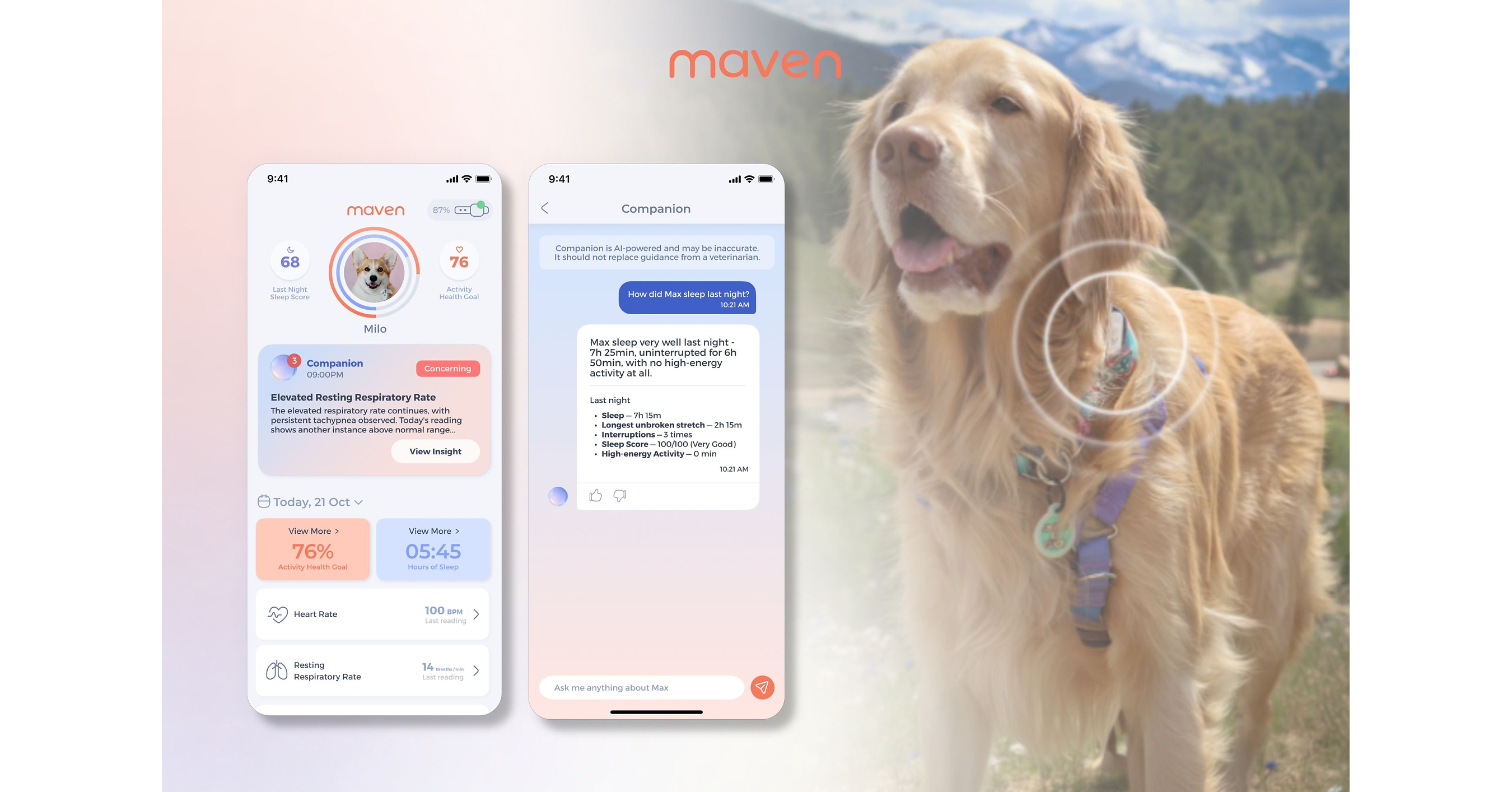
Maven Pet launched Companion, an AI assistant for subscribers that uses a dog's health sensor and profile data—up to 25 million data points per dog per day—to monitor changes against its individual baseline. The company says it has delivered more than 125,000 proactive health insights to date; an April 2026 survey of 2,000 pet owners found 43% use ChatGPT for pet health information and 59% had changed their dog's care as a result. The annual subscription, including hardware, costs $167.92.
Analysis
The investable question is whether continuous pet monitoring creates durable subscription retention—not whether owners are curious about AI. A personalized baseline could make the product harder to replace over time, while proactive alerts may pull spending forward to diagnostics or veterinary visits. If alerts are noisy, however, the same mechanism drives cancellations and weakens trust. That puts sensor accuracy, alert precision, and subscriber retention ahead of the headline volume of data or insights.
The competitive pressure is on pet wearables and connected-care providers such as Fi, Tractive, and Whistle: a software layer that converts tracking into individualized guidance could shift differentiation from hardware features to longitudinal data and engagement. Veterinary platforms and insurers could benefit if monitoring produces validated earlier intervention or useful risk data, but neither clinical nor insurance economics are established by the company’s claims. Increased alerts could also create vet demand without reducing total care costs.
Near term, the announcement is not enough to underwrite a public-equity trade: Maven Pet is not mapped to a ticker, and the release gives no subscriber base, conversion, churn, or independent outcome data. Over 1–3 months, watch for independent validation and evidence that subscribers use alerts and renew. Over 6–18 months, the structural test is whether recurring revenue and retention justify hardware and support costs. The contrarian risk is that high AI use among owners signals demand for advice, not willingness to pay for a dedicated device subscription. Falsifiers include weak renewal or engagement, high false-alert rates, and no independently demonstrated improvement in time-to-vet assessment or outcomes.
AllMind Terminal
AI-powered research, real-time alerts, and portfolio analytics for institutional investors.
Request TrialMarket Sentiment
Overall Sentiment
moderately positive
Sentiment Score
0.30
Key Decisions for Investors
- No direct trade on this launch: the company is private and the release does not establish a material listed-company earnings exposure.
- Put pet-wearable and connected-care names including Fi, Tractive, and Whistle on a competitive watchlist; seek evidence of subscriber growth, renewal, and alert accuracy before taking a relative-value position.
- Treat veterinary and pet-insurance spillovers as conditional, not a buy thesis. Revisit only if independent studies show earlier detection or changed claims/care economics.
- Monitor for subscriber count and cohort retention, hardware and support costs, false-positive rates, and independently verified clinical outcomes; these are the missing inputs needed to assess recurring-revenue quality.
More News
- South Korean carmaker Hyundai plans 'strategic' investment of $15.5 billion in India by 2032
- Applied Materials’ $5 billion AI lab aims to cut chip development time in half—and restore Silicon Valley’s edge
- China's exports likely grew by double-digits in September
- Meta’s Muse models reach the AI frontier—and kill any hopes to ‘pace’ it
- Singapore third-quarter GDP growth softens from four-year high but beats estimates
- FBI arrests OpenAI employee accused of planting secret recording device in conference room