
Brayton Purcell LLP Welcomes Federal Bill Addressing Artificial Stone Silicosis Epidemic
Source: PR Newswire
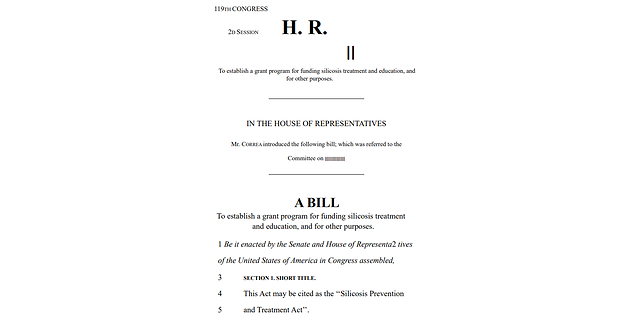
U.S. Representatives Lou Correa and Maxine Dexter introduced the proposed Silicosis Prevention and Treatment Act on October 14, 2026; it would authorize $10 million annually for fiscal years 2027–2031 to fund screening, treatment, education, rehabilitation, and coordinated care. California has reported more than 662 confirmed artificial stone silicosis cases, including more than 135 in Orange County. The bill would create a nationwide grant program, but it has been introduced rather than enacted.
Analysis
The investable signal is not the proposed care funding itself: an introduced bill is not enacted funding, and the authorized annual amount is unlikely to move provider earnings absent evidence of awards at scale. Earlier diagnosis and coordinated care may improve patient access, but cannot reverse established lung damage; the larger economic channel is whether the bill increases scrutiny of fabrication practices, product composition, and manufacturers’ liability.
If attention prompts stricter controls or faster substitution away from high-silica engineered stone, exposed slab suppliers and fabricators could face compliance costs, product-liability exposure, and weaker demand; lower-silica alternatives and other countertop materials could gain share. Those are conditional industry effects, not established outcomes from this bill. Clinics and hospitals may benefit at the margin if grants are funded, but the proposed program is too small and uncertain to underwrite a broad healthcare trade. The release comes from a plaintiffs’ law firm, so its disease and litigation framing is not independent evidence of company-level financial impact.
Near term, expect limited fundamental impact; the key 1–3 month catalysts are committee action, bipartisan support, and whether funding survives the legislative process. Over 6–18 months, workplace rules, enforcement, product redesign, and litigation developments matter more than screening grants. The contrarian point: investors may dismiss the bill as immaterial while underestimating its potential to add political momentum to product and workplace scrutiny—but that risk is not yet a standalone short thesis.
AllMind Terminal
AI-powered research, real-time alerts, and portfolio analytics for institutional investors.
Request TrialMarket Sentiment
Overall Sentiment
mildly positive
Sentiment Score
0.20
Key Decisions for Investors
- No direct trade on the bill’s introduction. Treat enactment, actual appropriations, grant awards, and the size of recipients’ funding as required evidence before positioning in healthcare providers.
- Place engineered-stone exposure on a watchlist rather than shorting the sector now. Reassess if legislative progress is accompanied by tighter fabrication requirements, product restrictions, or company disclosures showing material liability or demand effects.
- Monitor for substitution signals—supplier disclosures, product mix, and customer adoption of lower-silica or alternative materials. A sustained shift would support relative research on alternative-material suppliers versus exposed engineered-stone businesses, but the article does not identify companies or quantify exposure.
- Falsifiers: the bill stalls or receives no meaningful funding; workplace and product rules do not tighten; or affected suppliers report no material change in orders, compliance costs, or litigation exposure.
More News
- Stock fixing scandal could see Turkish companies frozen out of global indexes
- MSCI Ignites Indonesia Market Reckoning After Months of Warnings
- Yields continue to rattle investors. These sectors are most at risk if rates stay elevated
- Indonesia stocks suffer biggest daily slump since 1998 as MSCI weighs downgrade
- Kimberly-Clark is having its best week in four years. Here's what is propelling shares higher
- Trump waives many Russia-related sanctions, tariffs before they were to take effect under new law