
GameStop preliminary Q2 report: does it change the investment thesis?
Source: invezz.com
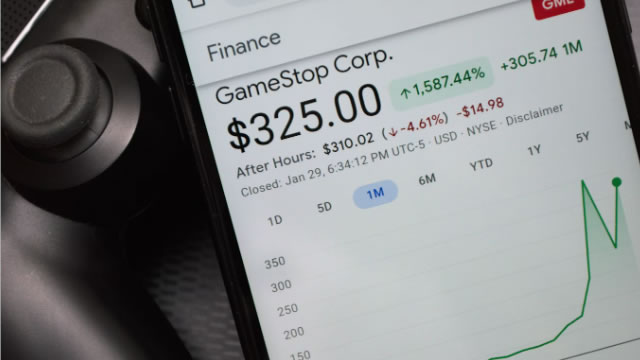
GameStop shares rose on Monday after a surprise release of preliminary Q2 results, but the outlook remains weak. The company projects net sales of $780M–$800M, a year-on-year decline from $972M (down roughly $172M–$192M). Despite the positive reaction, investors are likely weighing continued demand pressure and earnings risk.
Analysis
The first-order move is mostly positioning, not fundamentals: a surprise preannouncement can trigger a reflexive squeeze in a heavily narrative-driven name even when the underlying operating trajectory is still deteriorating. That makes the stock dangerous to fade blindly intraday, but it does not change the core issue that a shrinking top line will continue to lever fixed costs against equity value.
The more important second-order effect is that every incremental share loss in physical game/merchandise distribution further entrenches the shift to digital storefronts and platform ecosystems. That is constructive for console/platform owners like MSFT and SONY, which monetize software and in-game content with higher lifetime value and no retail take-rate leakage, while specialty retail peers with similar traffic mix see a weaker read-through on holiday demand.
For GME, the key question is not solvency but whether cash can be redeployed before the business model decays further. The stock can stay detached from fundamentals for months, but the setup reverses if holiday sales fail to stabilize, if gross margin compresses alongside revenue, or if operating cash flow turns meaningfully negative again. If management can prove sustained positive FCF, the bear case loses force; absent that, this is still a slow-burn value trap with high squeeze risk.
Contrarian view: the market may be underestimating the endurance of meme/fund-flow support, so outright shorts are poor timing into strength. The better expression is to wait for volatility to reset and then define downside with options, because the business thesis may be right while the path is extremely noisy.
AllMind Terminal
AI-powered research, real-time alerts, and portfolio analytics for institutional investors.
Request TrialMarket Sentiment
Overall Sentiment
mildly negative
Sentiment Score
-0.05
Ticker Sentiment
Key Decisions for Investors
- Do not chase the long on the opening spike; if entering bearish exposure, use 1-2 month put spreads in GME after implied vol normalizes, targeting a move back toward the preprint range with defined risk.
- Avoid naked shorting GME into the print; if borrow is tight or flow is still retail-driven, use a small tactical short only after the first-hour volume confirms exhaustion and price fails to hold gains.
- Pair trade over 6-12 months: long MSFT or SONY vs short GME to express the migration of spend from physical retail to platform/digital monetization; the long leg should have cleaner earnings quality and better multiple support.
- Set an alert for the next quarter/holiday sell-through update: if revenue declines persist without gross-margin recovery, add to bearish exposure; if operating cash flow stays positive and inventory shrinks, reduce the short bias.
- If GME rallies on no fresh fundamental improvement, consider selling out-of-the-money call spreads rather than shorting common to monetize elevated event volatility while capping squeeze risk.
More News
- CoreWeave credit default swaps hit distress levels as investors sour on AI debt
- Brian Sullivan: Why the 'real' price of oil is likely $30-$40 higher than where it is now
- Penske Automotive agrees to be taken private by Penske, Mitsui
- Faraday Copper completes acquisition of BHP’s San Manuel project
- Supermicro promised a new CFO in December 2024. A $2.5 billion smuggling case and a co-founder’s arrest later, it has one
- Blackstone President Jon Gray Bets Big on AI Boom