
Bitmine Immersion Technologies (BMNR) gibt bekannt, dass die ETH-Bestände 6,06 Millionen Token erreichen und sich die Gesamtbestände an Kryptowährungen sowie an Barmitteln und marktfähigen Wertpapieren auf 14,5 Milliarden US-Dollar belaufen
Source: PR Newswire
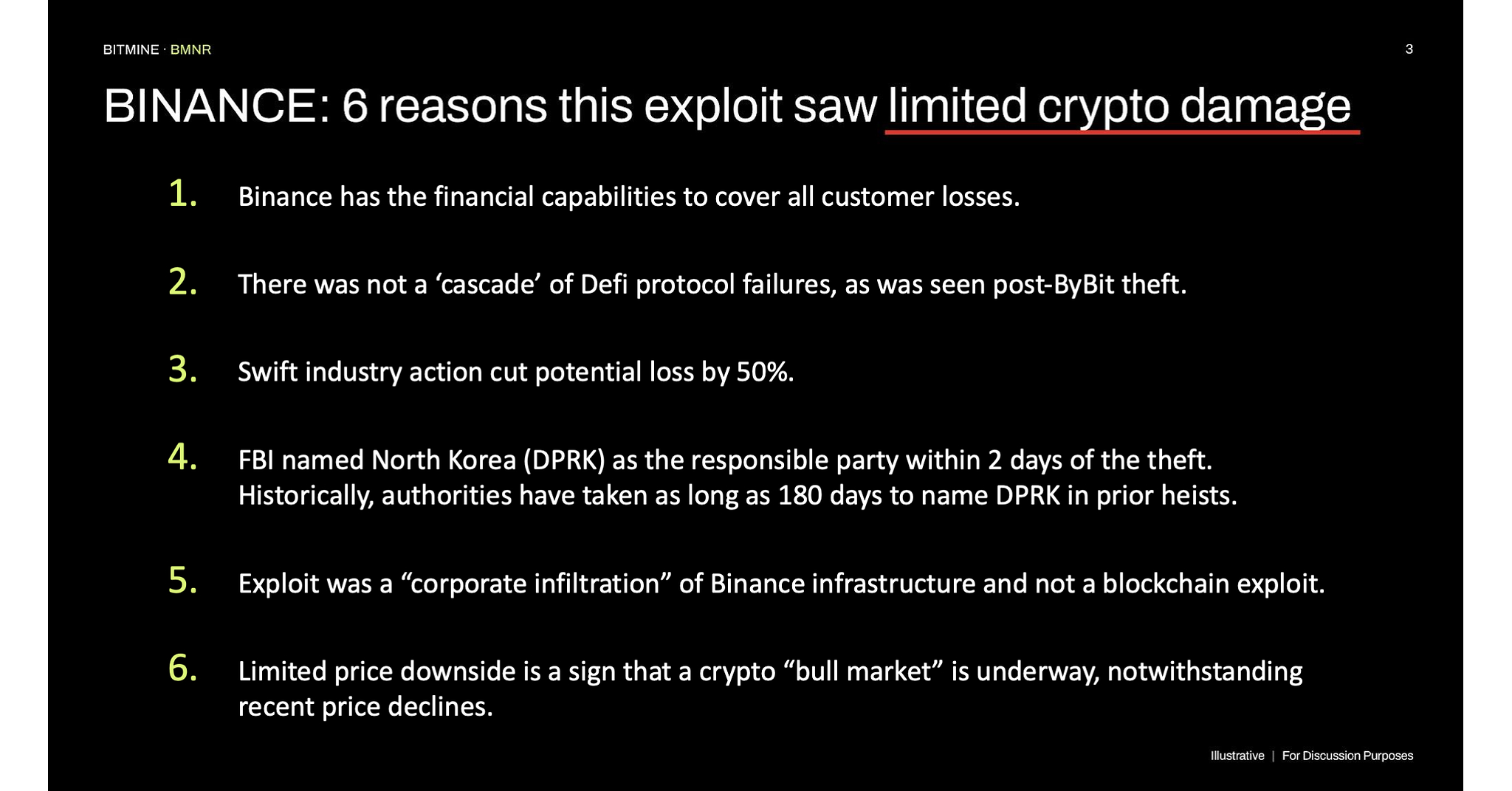
Bitmine reported total crypto, cash, marketable securities and “Moonshots” holdings of $14.5 billion as of November 1, including 6,060,506 ETH—4.9% of the 122.2 million ETH supply—and 5,227,037 ETH staked, valued at $11.8 billion. Chairman Tom Lee said ETH had fallen 4% since the reported $6.3 billion Binance theft, contrasting with an 8% drop on the day of the 2025 ByBit theft and a 20% decline within a week; he attributed the more muted response to stronger industry resilience. Bitmine also projected annualized staking rewards of $358 million at current staking levels, or $415 million at full deployment; these are company projections.
Analysis
The key market signal is not the muted ETH reaction itself; it is the gap between a company’s bullish interpretation and independently verifiable evidence that exchange and custody risks have fallen. An attack attributed to contractor access is a reminder that operational controls—not just blockchain security—remain a source of tail risk. Over the next days, a second incident, delayed customer reimbursements, or contagion into lenders and DeFi would quickly invalidate the resilience narrative. Over 1–3 months, verify Binance’s actual loss allocation and whether institutional flows, spreads, and ETH volatility normalize; one quiet price response is weak evidence of durable confidence.
For ETH, Bitmine’s concentrated accumulation and staking may tighten liquid supply at the margin, but the same concentration creates exit and governance risk: a large unstaking or treasury sale could amplify downside, while protocol withdrawal queues and validator concentration may complicate liquidity in stress. Staking revenue projections are management estimates, not a hedge against ETH drawdowns; the claimed yield needs validation against realized net rewards, operating costs, and slashing or downtime. MAVAN could benefit if third-party institutional demand converts into recurring delegated assets, but the release provides no independent traction or economics. Conversely, institutional custodians and security vendors may see demand for stronger controls, while centralized exchanges face a higher operational-risk discount.
Contrarian view: a limited spot move may reflect positioning or confidence that losses are contained, not a structural bull-market confirmation. Nor should a treasury’s ETH accumulation automatically be treated as value accretion: confirm per-share ETH exposure, financing/dilution, and any premium to underlying assets before valuing Bitmine. Strategy Inc. remains a distinct BTC treasury exposure; the article does not establish a direct fundamental read-through to it. Eightco Holdings’ indirect OpenAI exposure is peripheral to the core ETH thesis.
AllMind Terminal
AI-powered research, real-time alerts, and portfolio analytics for institutional investors.
Request TrialMarket Sentiment
Overall Sentiment
mixed
Sentiment Score
0.10
Key Decisions for Investors
- Prefer a staged, modest long-ETH/short-BTC relative-value position over buying Bitmine on this release: enter only if exchange outflows/credit stress remain contained and ETH holds up through the next 1–2 weeks; size to tolerate a renewed crypto-wide drawdown. Exit if customer-loss coverage proves inadequate or ETH underperforms BTC alongside widening crypto credit/liquidity stress.
- Do not pay a treasury-company premium for Bitmine based on headline holdings or projected staking income until filings verify diluted shares, acquisition funding, realized net staking yield, custody arrangements, and the marked value of non-core investments. Reassess after the next filing or material financing announcement.
- Watch 1–3 month catalysts: Binance’s independently confirmed reimbursement and loss figures; ETH staking net rewards and validator concentration; Bitmine’s per-share ETH exposure and any change in staking/treasury policy. These determine whether supply tightening is durable or merely a crowded, concentrated position.
- Falsify the resilience thesis on renewed exchange/custodian losses, customer withdrawal restrictions, material DeFi or lender contagion, or a sustained rise in crypto funding/credit stress. Treat any new incident involving contractor access as a catalyst to reduce exposure rather than extrapolating from the initial muted reaction.
More News
- Binance co-CEO Richard Teng says hackers used fake job interviews, AI tool to steal $6.3 billion in crypto 108511116
- AMD stock jumps 7% on earnings as data center revenue nearly doubles
- Marvell Technology could plunge on latest multibillion-dollar acquisition
- Disney Plans Thousands of Layoffs Companywide
- 5 things to watch on Election Day as Democrats push for control of Congress
- AMD rides data center riches to ‘largest and most profitable’ quarter in history