
Hanwha Power obtient l'approbation de principe de l'ABS pour la conception d'un porte-conteneurs à batterie de 1 700 EVP
Source: PR Newswire
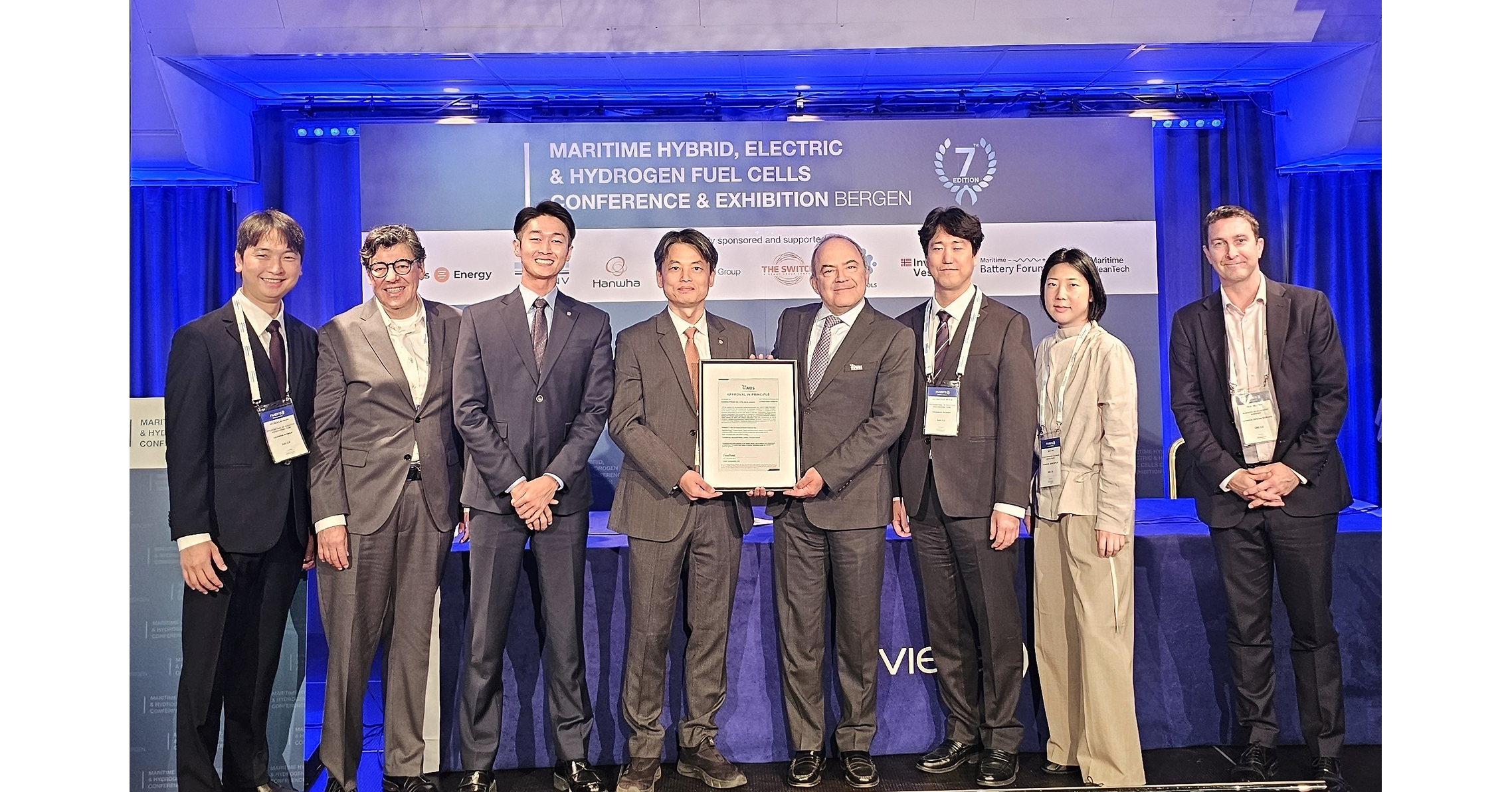
Hanwha Power received ABS approval in principle for a 1,700-TEU fully electric container-ship design powered by a 151 MWh battery energy-storage system, intended to enable zero direct-carbon-emission operations using port charging infrastructure. The company also completed the basic design for a 1,000-TEU battery-powered vessel and aims to expand its range of electric ships; the announcement marks a technology and product-development milestone, not a reported vessel order.
Analysis
The investable signal is lower than the engineering milestone suggests: ABS AiP can reduce design and safety-approval uncertainty, but does not establish class certification, a customer order, financing, or viable route economics. Near term, this is unlikely to change earnings for Hanwha Power or the broader shipbuilding chain. The 1,700-TEU concept instead makes shore-side grid capacity, high-throughput charging, battery replacement logistics, and fire-safety systems potential gating items. Those dependencies shift value toward ports, electrical-equipment providers, and marine battery integrators only if projects progress to contracted deployments; they also limit substitution of conventional propulsion to routes with predictable short distances and reliable charging.
Over 1–3 months, watch for a named shipowner, shipyard, route, and charging partner—not further design announcements. Over 6–18 months, the thesis strengthens only with orders and disclosed lifecycle economics, including battery degradation/replacement, lost cargo capacity, charging time, and electricity cost. A 151-MWh system is a substantial infrastructure commitment, so vessel economics may be weakest where grid upgrades or charging dwell time are costly. The contrarian point: “zero direct emissions” is not equivalent to zero lifecycle emissions or commercially scalable deep-sea propulsion. A broad clean-shipping rally on this announcement would likely overstate the evidence; no company-specific valuation or revenue impact is supportable from the supplied information.
AllMind Terminal
AI-powered research, real-time alerts, and portfolio analytics for institutional investors.
Request TrialMarket Sentiment
Overall Sentiment
mildly positive
Sentiment Score
0.35
Key Decisions for Investors
- No immediate directional trade: treat the AiP as a de-risking milestone, not a commercial inflection. Avoid extrapolating it into near-term earnings or broad-based displacement of marine fuel demand.
- Add marine battery, port electrification, and electrical-equipment suppliers to a watchlist; consider exposure only after a named project identifies contracted suppliers, funding, route, and charging infrastructure.
- Use a 1–3 month catalyst checklist: customer/order announcement, shipyard selection, ABS follow-on certification, and port charging commitments. Reassess negatively if these fail to emerge or if deployment timing slips.
- For any 6–18 month long thesis, require evidence of route-level economics and battery lifecycle costs. Falsifiers include an order cancellation/delay, charging constraints, poor utilization, or disclosed costs that undermine competitiveness versus conventional or hybrid propulsion.
More News
- AI Doubts Spread Cracks in Equities, Credit Markets: Evening Briefing Americas
- With earnings in rearview mirror, SpaceX-Tesla merger chatter takes center stage
- AI agents could disrupt bank deposits. Why Wall Street may be overreacting
- Apple’s $2,000 iPhone Duo Debuts With Limited Supply
- Are global oil reserves sufficient to withstand renewed US-Iran war?
- Boeing 777 freighter output halted for two months over supplier row