
Budowanie nowej wartości sieci na rzecz wzrostu w erze AI
Source: PR Newswire
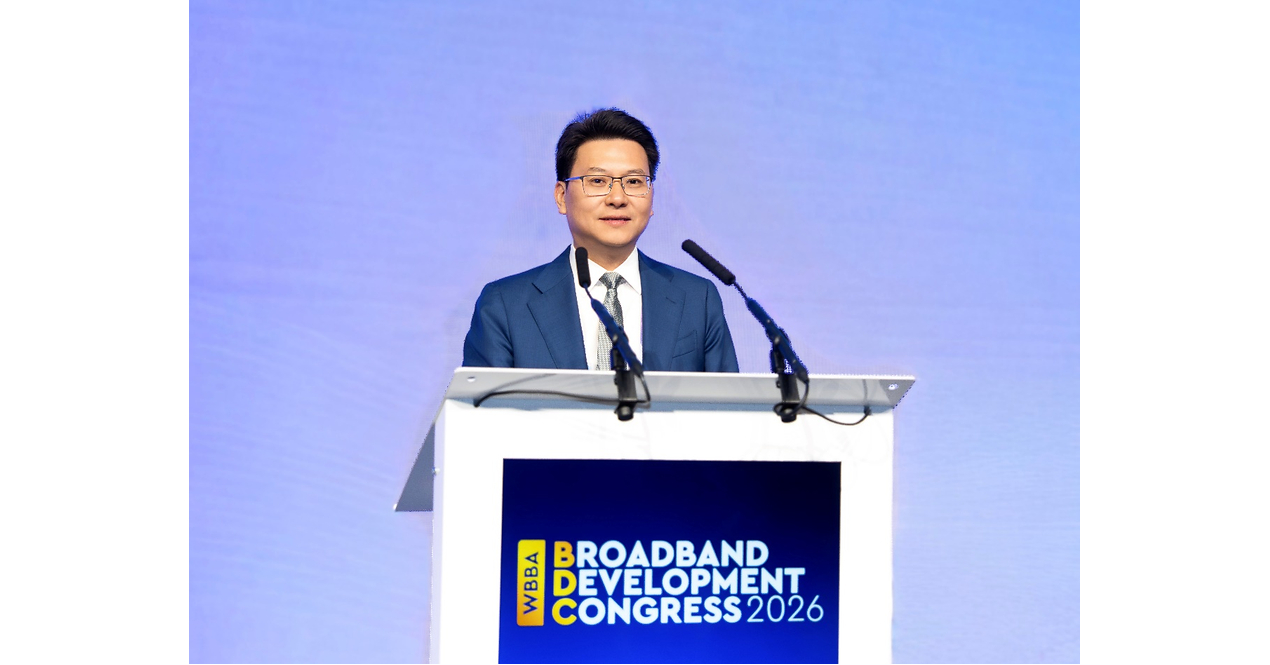
Huawei optical-products chief Bob Chen called for telecom networks to be rebuilt around AI data centers, with new business models bundling bandwidth, latency and reliability, and AI-led network operations. He cited near-10-fold growth in AIDC numbers, AI-related traffic above 10% of China’s total capacity in Zhongwei, and company-reported improvements of about 20% in Wi-Fi speed under interference and over 20% lower equipment energy use. The article is a conference speech and does not report financial results or market reaction.
Analysis
The investable implication is a possible mix shift in telecom capex—not evidence of an AI-driven earnings inflection. If AI workloads create sustained data-center-to-data-center traffic, spending could tilt toward optical transport, coherent optics, switching and fiber routes that connect compute hubs, benefiting suppliers such as Ciena and Nokia more directly than consumer-access vendors. But hyperscalers may keep much of this traffic on privately owned networks, limiting carriers’ ability to capture returns. The operator opportunity depends on selling measurable service-level guarantees and bundled compute, not simply carrying more bits; otherwise incremental traffic can raise capex and power costs without lifting ARPU.
The home-network pitch could support premium broadband tiers and lower support costs, but customer willingness to pay for whole-home Wi-Fi or AI agents remains unproven. Huawei’s claimed efficiency and performance improvements are vendor-reported, not independently verified. Huawei’s restricted access to some markets also means any global demand benefit need not accrue to Huawei; it may instead support alternative suppliers, subject to local procurement rules.
Near term, treat this as a thesis signal rather than a catalyst: the release cites no operator orders, contract values or revenue contribution. Over 1–3 months, look for operator capex plans, data-center interconnect awards and evidence of paid low-latency services. Over 6–18 months, the key test is whether carrier returns improve after network investment. Contrarian risk: AI traffic growth may be real while monetization accrues to cloud platforms and private-network owners, leaving telecoms with the capex burden.
AllMind Terminal
AI-powered research, real-time alerts, and portfolio analytics for institutional investors.
Request TrialMarket Sentiment
Overall Sentiment
mildly positive
Sentiment Score
0.25
Key Decisions for Investors
- Watch, rather than chase, optical-networking exposure. Consider Ciena and Nokia only on confirmation from operator guidance, order growth or data-center interconnect awards; falsify the thesis if capex commentary remains flat or awards do not convert to revenue.
- Avoid treating this announcement as a reason to buy telecom operators broadly. Revisit only where operators demonstrate paid enterprise latency/reliability tiers or improving broadband ARPU alongside capex discipline.
- Track hyperscaler network-build disclosures and operator capex plans over the next 1–3 months. If traffic growth is largely served by private networks, favor infrastructure suppliers with direct hyperscaler exposure over carrier monetization stories.
- Discount the release’s performance and energy-saving claims until independently validated. Monitor operator trial results, realized energy expense and customer support costs; failure to show measurable savings would weaken the network-efficiency case.
More News
- Why did CoreWeave stock get crushed this week? Look to this corner of the debt market for clues
- AI stock sell-off ramps up over debt-fueled data center spending fears: ‘Full-blown crisis of confidence'
- Dow falls 189 points as AI stocks slide and oil prices surge
- Wall Street Anxiety Spreads as AI Rout Meets $110 Oil Shock
- Wall Street's fear gauge is ripping. Traders see it going even higher
- All the news about the iPhone Duo