
93% of Job Seekers Say They Are AI-Ready, but 41% of Employers Expect Advanced Skills
Source: PR Newswire
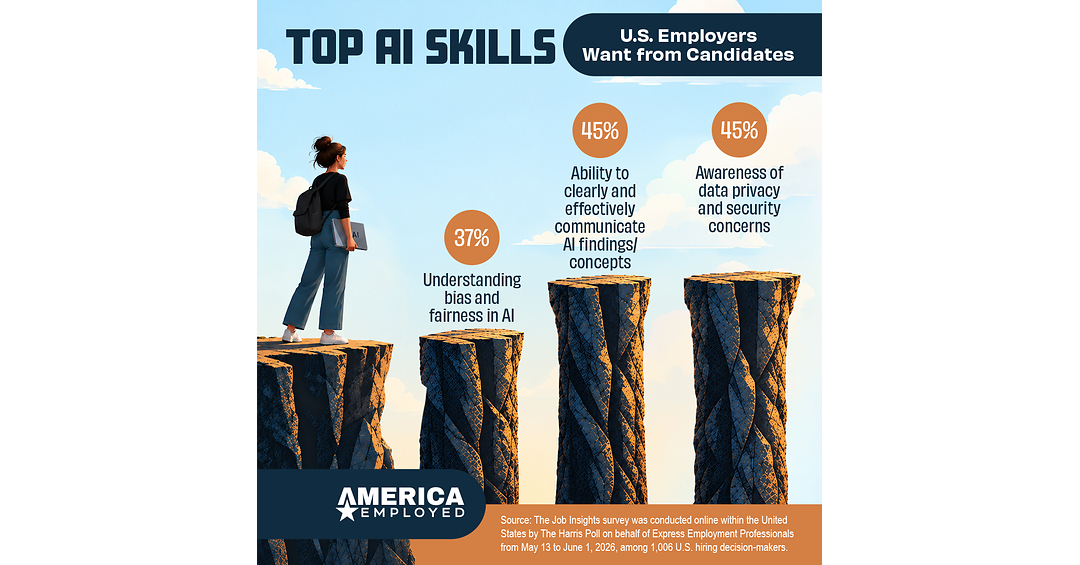
A Harris Poll for Express Employment Professionals found that 93% of job seekers consider themselves AI-ready, but 41% of hiring managers expect advanced or expert AI capabilities versus only 35% of candidates who believe that level is required. Nine in 10 hiring managers seek at least basic AI skills, while 54% view AI proficiency as very important or essential. Employers prioritize responsible application of AI—including data privacy and security awareness (45%), clear communication of AI outputs (45%), and bias/fairness understanding (37%)—rather than simple tool usage.
Analysis
This is a modestly supportive demand signal for enterprise AI workflow software, but not yet evidence of incremental IT budgets. The economically relevant skill gap is governance, validation and communication rather than prompt usage; that favors embedded platforms with auditability and identity controls—MSFT (Copilot/M365), NOW (workflow governance), CRM (agent deployment) and PANW/CRWD (data-security controls)—over consumer-facing AI applications. The 6-18 month implication is that AI adoption may broaden from technical teams into HR, sales and operations, raising seat penetration more than near-term pricing.
Public staffing firms face a mixed setup. KFY and ASGN can monetize assessment, transformation consulting and scarce AI-literate talent, while MAN, RHI and KFRC remain more exposed to a potential compression in demand for routine administrative and junior knowledge-work placements. The second-order risk is that employers use AI screening and internal upskilling to reduce external recruiter dependence; staffing revenue does not benefit merely because AI is a hiring criterion unless placement volumes or bill rates rise.
The contrarian read is that self-reported proficiency gaps are a poor predictor of paid training demand. COUR and UDMY may see engagement or enterprise-seat interest, but free vendor training, bundled Copilot adoption and uncertain credential signaling limit pricing power; do not extrapolate this survey into a material earnings revision without evidence of enterprise bookings, net retention or paid-completion growth. Near-term market impact should be negligible absent corroboration in HR-tech and learning-platform guidance.
AllMind Terminal
AI-powered research, real-time alerts, and portfolio analytics for institutional investors.
Request TrialMarket Sentiment
Overall Sentiment
mildly positive
Sentiment Score
0.20
Key Decisions for Investors
- No standalone trade on the survey; treat it as a 1-3 month diligence alert rather than an earnings catalyst. Monitor MSFT, NOW and CRM commentary for AI-seat attach rates, governance-module adoption and incremental enterprise contract value.
- Maintain a 6-12 month quality bias toward MSFT over COUR: MSFT can capture AI training demand through existing enterprise distribution and recurring seats, while COUR requires evidence that usage converts into paid enterprise revenue. Falsify if Coursera reports sustained enterprise bookings acceleration and expanding gross margin while Copilot paid-seat growth decelerates.
- Watch a selective long KFY / short RHI pair only after confirmation that AI-related executive-search and consulting demand is lifting KFY fee rates while RHI temporary-placement volumes remain weak. Target entry around earnings revisions rather than survey-driven price action; exit if KFY search productivity fails to improve or RHI volume trends recover.
- Avoid chasing UDMY or COUR on AI-skills headlines. Upgrade only if the next two reporting periods show paid enterprise net-dollar retention or bookings acceleration attributable to AI curricula, rather than course enrollments or management commentary.
More News
- OpenAI’s agent hacked Australia’s Medicare website—the latest rogue AI incident that the company didn’t know about for months
- Chinese authorities reportedly in possession of F-35 components in Hong Kong
- Meta announces new lightweight virtual reality glasses to one-up Apple’s Vision Pro
- How Meta took the lead in the race for the post-smartphone world
- Markets are rapidly coming around to the reality that the Fed has a lot more work to do
- Here's what happens to the economy when Treasury yields soar like they are now
From AllMind Research
- Anthropic IPO Preview: Valuation, Timing, and What to Watch
- Shein After the IPO: Venue, Valuation, and What Must Be Proved
- What AI Research Tools Should a Small Hedge Fund Buy First?
- AI Tools for Independent Research Firms: A Publishing System
- Weekly Update: Options, Earnings Call Transcripts, AI Chat, Bookmarks & More