
REGENESIS Wins 2026 BIG Innovation Award for Full-Spectrum PFAS Treatment
Source: PR Newswire
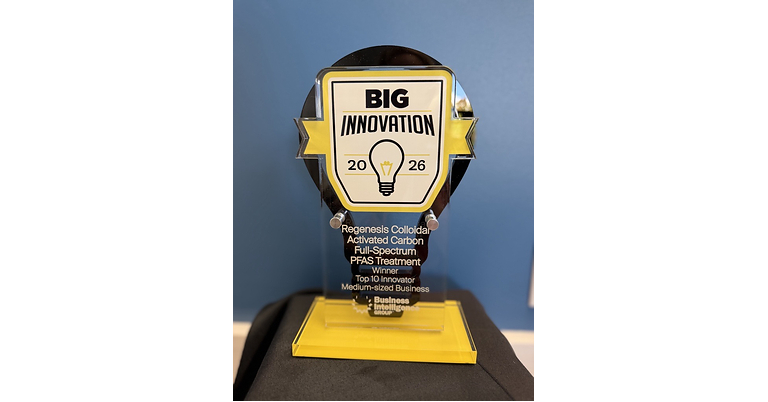
REGENESIS won the 2026 BIG Innovation Award for its colloidal activated carbon PFAS treatment technologies, which have been used at more than 90 contaminated sites globally, with hundreds more planned. The company said field applications recorded PFAS concentration reductions exceeding 99% at multiple sites; the underground approach is presented as reducing reliance on pumping, energy use and contaminated-waste disposal.
Analysis
The investable signal is a possible change in remediation mix, not the award. If in-situ carbon treatment proves durable across site types, some spending could shift away from continuous pumping, aboveground treatment and waste handling toward subsurface injection, site characterization and monitoring. That would benefit specialist remediation contractors and engineering firms; it could pressure vendors whose economics depend on long-running treatment operations. The effect on diversified names such as Montrose Environmental Group, Clean Harbors and Xylem is too indirect to underwrite from this announcement alone.
The main diligence gap is whether immobilization delivers lasting risk reduction rather than delaying contaminant migration. The reported concentration reductions do not establish destruction, long-term rebound performance, performance across PFAS compounds, or comparable whole-life costs. The “hundreds planned” figure is not equivalent to contracted revenue or a verified backlog. Regulatory acceptance and site-specific hydrogeology will govern adoption over months to years; near-term equity impact should be negligible absent commercial or financial disclosure from REGENESIS, which is not identified here as a public company.
Contrarian angle: the market may overvalue an innovation award and headline efficacy while underweighting monitoring obligations and residual liability. Conversely, if regulators accept durable field data and owners prioritize lower operating disruption, the technology could expand the addressable remediation toolkit without eliminating downstream water-treatment demand.
AllMind Terminal
AI-powered research, real-time alerts, and portfolio analytics for institutional investors.
Request TrialMarket Sentiment
Overall Sentiment
moderately positive
Sentiment Score
0.45
Key Decisions for Investors
- No trade on the award announcement alone. Treat it as a watch item for remediation-services exposure rather than a near-term catalyst for public equities.
- Over the next 1–3 months, verify whether “planned” sites become funded contracts and whether REGENESIS discloses repeat deployments, customer economics, or independently validated follow-up data; without those, do not price the claimed pipeline as revenue.
- For a potential relative-value thesis, monitor remediation contractors and firms exposed to pumping, treatment and PFAS waste handling. Consider a long specialist remediation exposure versus a short incumbent-treatment exposure only if adoption data show repeatable substitution; do not assume diversified companies have material sensitivity without segment evidence.
- Falsify the adoption thesis if follow-up monitoring shows PFAS rebound or migration, regulators reject immobilization as an acceptable remedy, or lifecycle costs fail to beat conventional approaches. Evidence of multi-year performance and funded deployment across varied sites would strengthen it.
More News
- Asia stocks fall as AI rout batters S.Korea; Japan spooked by strong CPI
- SK Hynix shares slide after chipmaker scraps Solidigm IPO plans
- Why is SK Hynix stock sliding today?
- Apple’s iPhone Duo Hits Stores in Face of Short Supply and High Demand
- Gold Holds Near Three-Month Low as AI Jitters Fuel Volatility
- OpenAI nears up to $30 billion funding round at $1.25 trillion valuation led by UAE investors