
Altria's Price Realization at 4.5%: Can Pricing Momentum Stay Strong?
Source: zacks.com
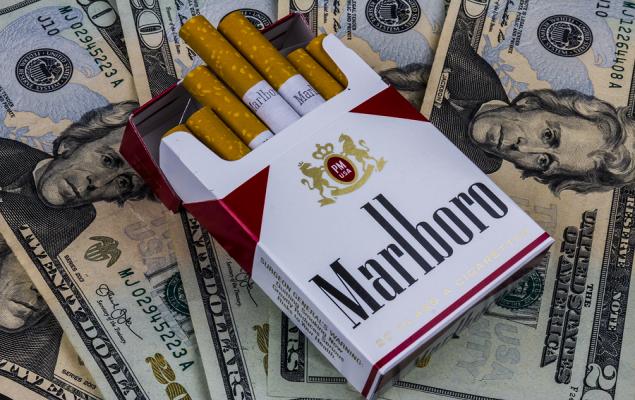
Altria’s Q2 2026 smokeable-products price realization was 4.5%, with Marlboro retail prices up about 7% year over year, helping revenue net of excise taxes rise 2% and adjusted OCI increase 2.4% to $3.018 billion. These gains offset ongoing volume pressure only partly: domestic cigarette shipments fell 3.2% (or an estimated 4.5% excluding trade-inventory effects), while Marlboro’s retail share declined 1.5 percentage points to 39.5%. Growth in discount brand Basic increased discount-mix exposure, with discount-brand shipments up 67.3%, tempering the benefit of premium Marlboro pricing. Consensus expects Altria EPS growth of 4.6% in 2026 and 3.0% in 2027; shares have gained 0.6% over three months versus 2.5% for the industry.
Analysis
MO's issue is not whether nominal pricing can offset volume decline this quarter; it is whether down-trading converts a premium-brand franchise into a lower-ARPU internal substitution cycle. Basic's rapid penetration protects Altria's manufacturing utilization and retailer shelf space, but every consumer migrating from Marlboro to Basic reduces the realized price/mix benefit and makes future list-price increases more elastic. The near-term earnings floor remains intact, yet the market should assign a lower terminal multiple if premium-share losses persist for two consecutive quarters.
PM is better positioned competitively because stable combustible share allows price capture without the same visible trade-down signal, while its international footprint diversifies U.S. excise-tax and value-tier pressure. The relative setup favors PM over MO over the next 1-3 months: PM's pricing durability can support upward margin expectations, whereas MO must demonstrate that discount-brand growth is incremental rather than cannibalistic. TPB is a less direct beneficiary, but sustained consumer value-seeking supports its broader value-oriented tobacco ecosystem; its smaller liquidity and valuation sensitivity make it unsuitable as the primary expression.
Contrarian view: MO's low multiple may already discount secular volume erosion, and internal trading-down is preferable to losing smokers to competitors or illicit channels. A re-rating requires evidence that premium share stabilizes while discount volumes normalize; absent that, consensus EPS growth can be met through price but with worsening quality. The key falsifier for the bearish-quality thesis is renewed Marlboro retail-share stabilization alongside segment margin expansion of at least 50 bps despite a growing discount mix over the next two reports.
AllMind Terminal
AI-powered research, real-time alerts, and portfolio analytics for institutional investors.
Request TrialMarket Sentiment
Overall Sentiment
mixed
Sentiment Score
0.12
Ticker Sentiment
Key Decisions for Investors
- Initiate a 1-3 month pair trade: long PM / short MO, sized beta-neutral. Target 8-12% relative outperformance as investors differentiate stable share plus pricing from mix-diluted pricing; exit if MO premium share stabilizes and PM's organic pricing decelerates materially at the next earnings release.
- Do not add outright MO solely on its headline P/E discount. Maintain only income-oriented exposure until retailer scanner data show Basic growth is largely competitor capture rather than Marlboro cannibalization; a second consecutive quarter of premium-share loss would justify reducing exposure.
- For MO holders, sell 3-6 month out-of-the-money covered calls following any price rebound into earnings. The likely catalyst path is limited: EPS resilience is offset by multiple risk from deteriorating mix, making upside more likely to be yield-driven than rerating-driven.
- Place TPB on a watch list rather than initiate: consider a long only if future results confirm margin retention while value-tier demand broadens. The missing data are category volumes, nicotine-product mix, and valuation versus its own history; without these, the read-through is insufficient for a high-conviction trade.
More News
- Grab aims for 'next level' in financial services with purchase of buy-now pay-later platform Atome
- China's AI leaders keep quiet despite U.S. 'publicity' on tech risks
- Exclusive-Malaysia talks to rival airlines as it monitors AirAsia’s financial health, sources say
- Chinese investors rush into US stocks as Beijing opens wider path overseas
- Is Amazon Stock a Buy After Its Best Quarter in Years?
- Australia’s Reliance Worldwide agrees to Brookfield’s $2.9 billion buyout bid