
The Top 25% of DTC Ambassador Programs Refer 5.6% of Revenue -- Millions a Year in Sales From Existing Customers
Source: PRWeb
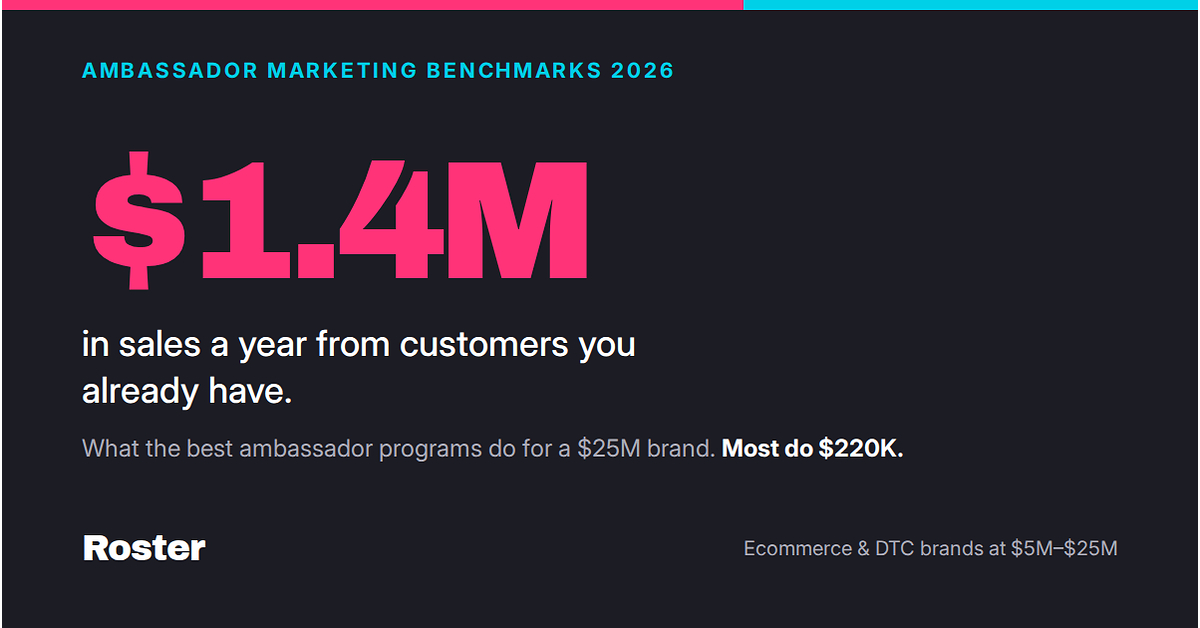
Roster's 2026 benchmark study found that top-quartile established DTC ambassador programs generated referred revenue equal to 5.58% of brand sales, versus a 0.88% baseline—a 6.3x gap. At that rate, a $25M brand would generate about $1.4M in annual referred revenue and a $100M brand about $5.6M, although the larger-brand figures are illustrative rather than directly measured. Top-quartile programs also delivered $63 of referred revenue per active member versus $20 at baseline and generated 38 Instagram posts per 100 active members per month versus 10.
Analysis
This is not a near-term earnings driver for SHOP or KVYO, but it reinforces a longer-duration merchant-retention mechanism: first-party customer data becomes more valuable when paid-social CAC rises and brands can convert owned audiences into attributable commerce. KVYO is the cleaner read-through because segmentation, automated flows and customer-list activation sit closer to the workflow; SHOP benefits principally through merchant GMV durability rather than incremental take-rate expansion. The economic benefit to merchants may also be overstated if referred orders cannibalize organic repeat purchases or require meaningful commissions, discounts and content-management costs.
The press-release data are self-selected to mature programs running on one vendor and should not be extrapolated into broad DTC conversion assumptions. The relevant investable signal is whether merchants increase spend on CRM/automation and attribution rather than whether ambassador revenue itself grows; check KVYO net revenue retention, customers above $50k ARR, and Shopify Plus GMV commentary over the next 1-3 quarters. A deterioration in discretionary DTC marketing budgets, weaker consumer repeat-purchase rates, or Meta/TikTok algorithm changes that reduce creator reach would impair this workflow despite its apparent CAC advantages.
Consensus may underappreciate that customer-generated content is both a demand-generation and creative-production substitute, potentially reducing agency and paid-content budgets before it materially lifts revenue. That favors software platforms embedded in customer-data orchestration, but the likely value capture accrues to the merchant and specialist vendors, not automatically to SHOP. With no disclosed adoption, pricing, or partner-revenue data, this is an ecosystem watch item rather than a standalone catalyst.
AllMind Terminal
AI-powered research, real-time alerts, and portfolio analytics for institutional investors.
Request TrialMarket Sentiment
Overall Sentiment
mildly positive
Sentiment Score
0.32
Ticker Sentiment
Key Decisions for Investors
- No directional trade on this release alone; maintain SHOP and KVYO position sizing pending quarterly evidence that merchant marketing-software budgets are accelerating rather than merely reallocating.
- Watch-list relative-value setup: long KVYO / short a basket of ad-agency and creator-marketing exposure only if KVYO reports reaccelerating net revenue retention or material expansion in higher-value customer cohorts over the next 1-2 earnings prints. Thesis fails if retention weakens or sales-and-marketing expense rises faster than subscription growth.
- For SHOP holders, monitor Shopify Plus merchant growth, merchant-solutions gross profit and GMV trends over the next 3-6 months; treat any improvement in merchant retention without GMV acceleration as neutral, since referral conversion can replace rather than create orders.
- Set an alert for evidence of commission/discount inflation at DTC brands or weaker repeat-purchase cohorts. Those outcomes would indicate that ambassador programs are transferring margin to customers and creators, not delivering the implied merchant EBITDA uplift.
More News
- Zocdoc CEO: will AI agents make your business more valuable or more vulnerable?
- Amazon warns against tokenmaxxing, telling engineers that using more AI doesn’t necessarily mean they’re doing better work
- What investors need to know about Alphabet's stock-busting earnings report
- Our next steps for Alphabet stock after earnings disappoint at nearly every turn
- Fortinet’s stock is taking a dive after earnings. Here’s why.
- Wendy's shares jump 15% as Nelson Peltz's Trian offers $1.4 billion to buy burger chain