
Global community unites at the second edition of the World Fire Congress to advance fire and life safety worldwide
Source: PR Newswire
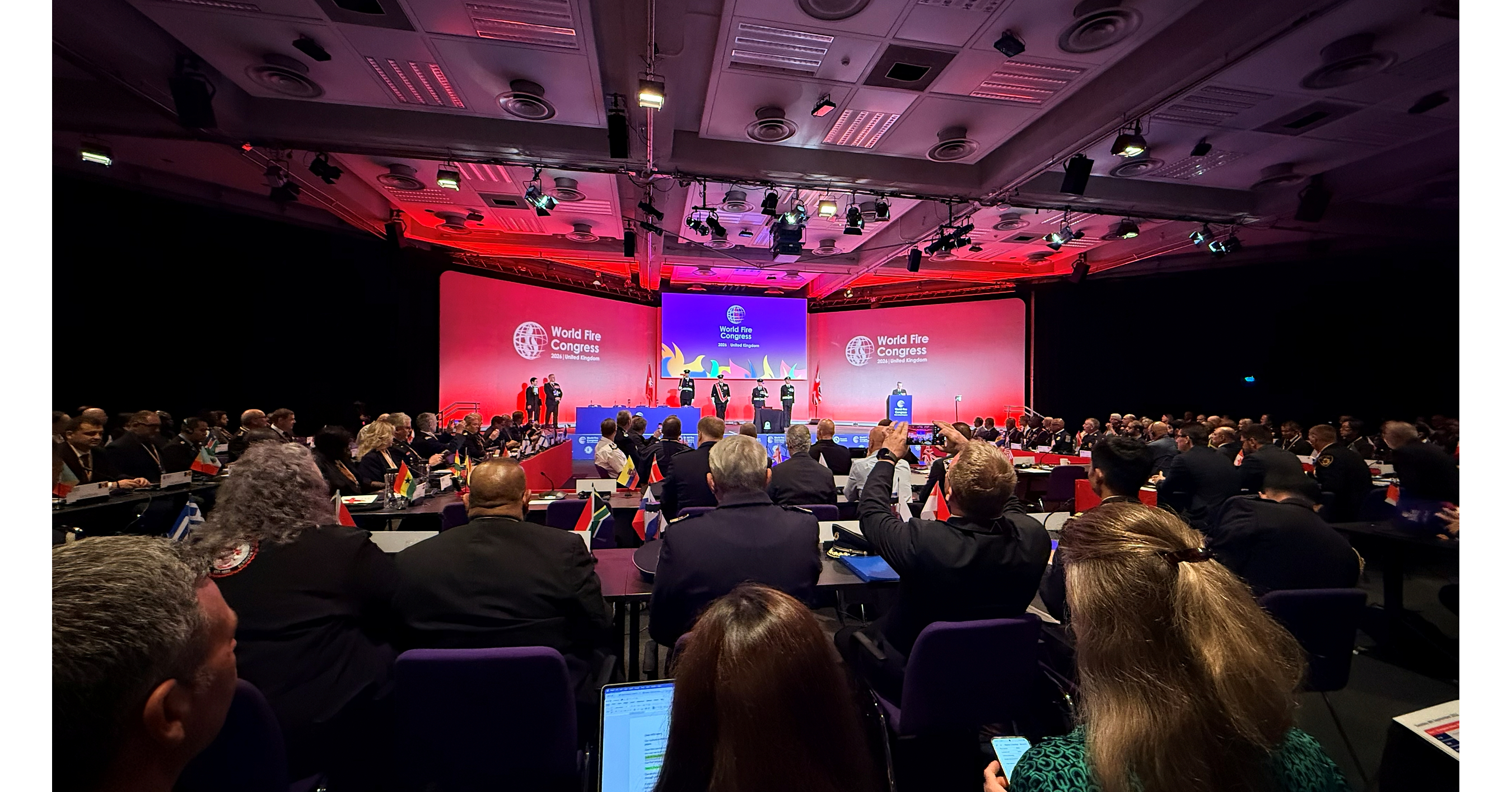
The second World Fire Congress opened in London with delegates from more than 60 countries to address global fire prevention, disaster preparedness, firefighter wellbeing, and infrastructure risks. The two-day forum will focus on collaboration and practical responses to climate-driven disasters, urbanization, large-scale emergencies, and emerging fire and life-safety risks. The announcement is a sector-focused organizational initiative with no material financial or market-moving disclosures.
Analysis
This is a low-signal industry-conference announcement rather than a procurement award, regulatory mandate, or disclosed spending program; it does not independently support a near-term revenue estimate for public safety-equipment vendors. The most plausible medium-term read-through is that climate resilience and dense-urban infrastructure are shifting fire protection from a discretionary building add-on toward a compliance- and insurance-driven capex category, but budgets, standards adoption, and contract awards—not conference commitments—will determine investability.
If global resilience standards tighten over the next 6-18 months, installed-base service providers should capture more durable economics than equipment makers. Honeywell (HON), Carrier (CARR), Johnson Controls (JCI), and Siemens (SIEGY) have exposure to fire detection, suppression, building controls, and recurring inspection/service; JCI is comparatively more levered to commercial-building retrofit cycles, while HON and Siemens have broader industrial diversification. Second-order beneficiaries could include specialty insurers/reinsurers if improved detection and mitigation reduce loss severity, but this is far too diffuse to trade today.
Consensus may overstate the immediacy of climate-adaptation spending: municipal fire-service budgets are constrained, procurement cycles commonly extend 12-36 months, and public discussion of resiliency can favor operating expenditure and training rather than equipment capex. A tradable signal would be an announced national code revision, insurer premium differentiation tied to certified systems, or a material order-book/guidance uplift from JCI, CARR, HON, or Siemens. Absent those, no position is warranted on this release alone.
AllMind Terminal
AI-powered research, real-time alerts, and portfolio analytics for institutional investors.
Request TrialMarket Sentiment
Overall Sentiment
neutral
Sentiment Score
0.08
Key Decisions for Investors
- No immediate trade: classify as a watch-item, not a catalyst. Require independently verifiable regulatory, insurer, or procurement follow-through before assigning revenue impact.
- Monitor JCI, CARR, HON, and SIEGY over the next 1-3 months for backlog commentary, retrofit-order growth, and fire/security segment margin guidance; a broad-based upward revision would support a basket long, with JCI likely the highest commercial-retrofit beta.
- Set an alert for major UK/EU/North American building-code changes or post-disaster reconstruction packages requiring upgraded detection/suppression systems. A mandated retrofit framework would be the catalyst to revisit long JCI/CARR versus a short commercial-construction proxy.
- Falsify any resilience-capex thesis if commercial retrofit orders remain flat through the next two reporting cycles or if public-sector budgets prioritize staffing and emergency response over capital equipment.
More News
- Energy markets are adapting to the Iran war as a ‘forever conflict’ while oil producers keep supplies flowing and avoid ‘mutually assured destruction’
- Kinder Morgan, Energy Transfer and Williams could benefit from cheap natural gas
- Elon Musk’s dangerous grip on outer space
- Brazil’s Lula and Bolsonaro debate policy proposals before run-off
- US-Iran war, then and now: How the landscape has changed since February
- Ukraine Says Restrictions on Starlink Speed Have Been Lifted