
Intersignal Closes the Loop on Local AI Ideas With Braid and Folio
Source: PR Newswire
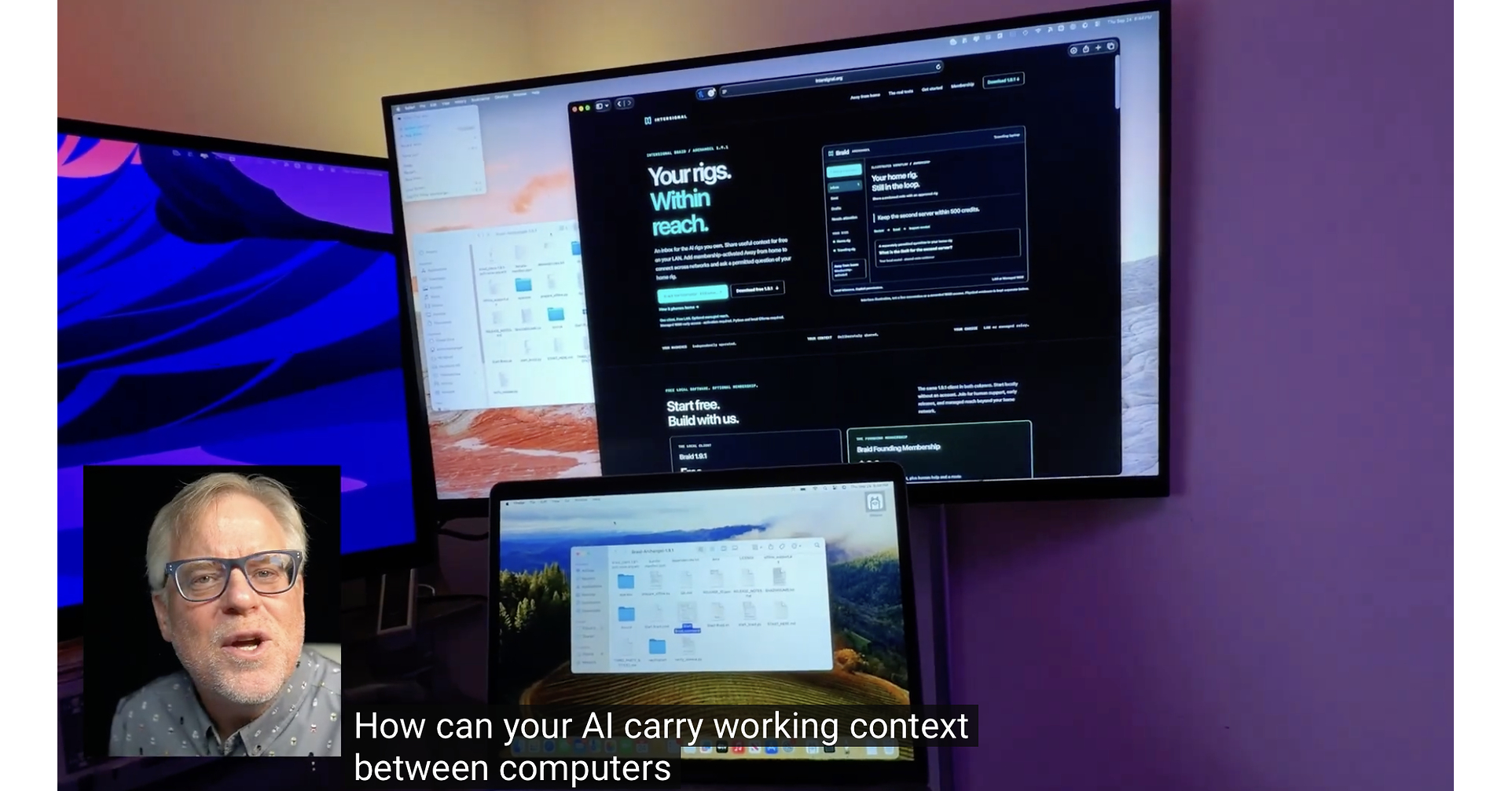
Intersignal released Folio 0.2.2, a local test build that converts selected Braid AI conversations into user-reviewed HTML or static-site publication packages. The release complements the free Braid Archangel 1.9.1 local client, enabling approved context transfers between user-controlled computers while requiring explicit review, acceptance and editing at each stage. Braid is available for macOS, Windows and Linux, while managed cross-network access remains in activation-based early access.
Analysis
This is not presently investable as a standalone catalyst: there is no disclosed commercial traction, pricing, user base, distribution relationship, or evidence that the workflow materially changes local-model adoption. The key diligence question is whether managed cross-network access becomes a recurring SaaS control plane rather than a niche utility; without that transition, free local tooling is more likely a developer-acquisition expense than a durable revenue stream.
The broader implication is modestly supportive of endpoint AI and privacy-preserving inference, but the economic beneficiary is unlikely to be the tool vendor. If enterprises adopt similar “approved context” workflows, value accrues to local-model infrastructure, device compute, and endpoint management: NVIDIA (NVDA), AMD (AMD), Apple (AAPL), Microsoft (MSFT), and CrowdStrike (CRWD) are more scalable proxies. The second-order constraint is governance: moving context between devices creates audit, retention, and data-classification requirements, potentially favoring Microsoft Purview/Defender and Palo Alto Networks (PANW) rather than decentralized point tools.
Near term, treat paid social promotion and a version release as awareness signals, not demand validation. Over 1-3 months, monitor whether the product gains a managed-access pricing model, enterprise identity integration, reproducible security documentation, or developer adoption metrics. Over 6-18 months, local-AI workflows can expand premium-device demand only if model quality on-device narrows the gap with cloud systems; improving cloud economics or stronger enterprise policy centralization would undermine the local-first thesis.
Contrarian view: privacy messaging alone does not create a moat. Open-source tooling and platform vendors can replicate context transfer and publication features quickly, while customers may prefer existing collaboration suites over adding Python- and local-model-dependent workflows. This raises a risk that apparent local-AI momentum remains technically visible but economically diffuse.
AllMind Terminal
AI-powered research, real-time alerts, and portfolio analytics for institutional investors.
Request TrialMarket Sentiment
Overall Sentiment
mildly positive
Sentiment Score
0.25
Key Decisions for Investors
- No direct trade on this release; place Intersignal on a watchlist pending independently verifiable signals of paid managed-access adoption, disclosed pricing, or enterprise integrations.
- Maintain a selective 6-12 month long bias in endpoint-AI beneficiaries NVDA and AAPL rather than treating small local-AI software launches as investable proxies; reassess if enterprise device-refresh data fail to improve or cloud inference pricing declines materially.
- Monitor CRWD, PANW, and MSFT for an enterprise governance angle: consider longs only if local-model deployment drives incremental endpoint, identity, or data-governance attach rates in reported billings and remaining performance obligations.
- Avoid extrapolating a consumer/developer privacy workflow into a broad cybersecurity revenue catalyst until there is evidence of centralized logging, policy enforcement, and paid cross-network deployment.
More News
- Asian stocks dip, bonds in focus after torrid September
- Tencent leases 100,000 chips from Oracle for $7 bln- FT
- California Gov. Gavin Newsom bans AI 'robo bosses' in landmark state law, reversing his earlier veto
- RAM supply set to worsen, says Micron, as CEO celebrates ‘much higher’ prices
- Why is Kioxia stock rallying today?
- We're raising our Micron price target after an incredible quarter and robust guidance
From AllMind Research
- Anthropic IPO Preview: Valuation, Timing, and What to Watch
- Shein After the IPO: Venue, Valuation, and What Must Be Proved
- What AI Research Tools Should a Small Hedge Fund Buy First?
- Weekly Update: New Reporting Features, UI Improvements, and Chat Optimizations
- Selecting an AI Research Platform for Institutional Investors