
Společnost Huawei představila vylepšené řešení Stellar AI Network, které má pohánět „agentický svět" prostřednictvím bezpečné a inteligentní konektivity
Source: PR Newswire
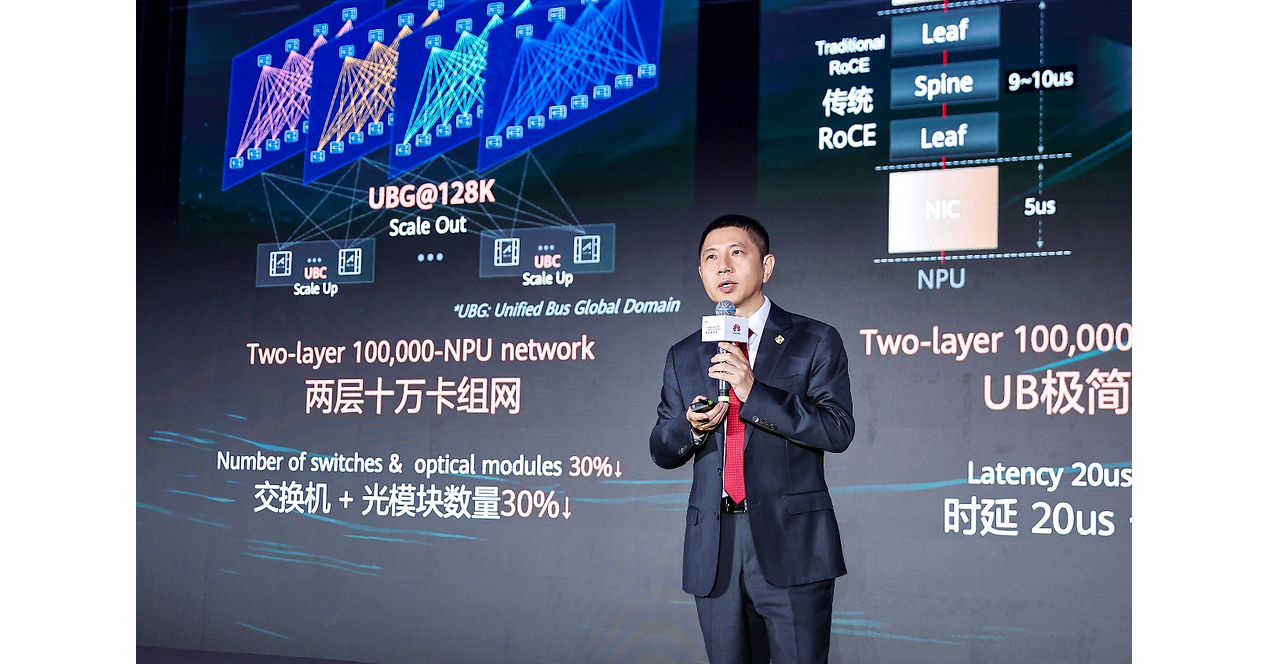
Huawei unveiled its upgraded Stellar AI Network at HUAWEI CONNECT 2026, spanning AI Fabric, AI WAN and AI Campus networking products designed for secure AI workloads. The company says the Fabric architecture can reduce network deployment costs by 30%, cut endpoint latency from 20 μs to 11 μs, and reduce interconnect power consumption from 1,000 W to 600 W. Its WAN offering targets over 95% remote-computing efficiency across distances above 1,000 km, while AI Campus automation is claimed to cut mean repair time to under five minutes. The announcement strengthens Huawei's AI-networking and cybersecurity product positioning, though the performance and cost figures are company claims without disclosed customer revenue impact.
Analysis
The relevant equity implication is regional substitution rather than a near-term change in global AI infrastructure demand. Huawei can bundle networking, compute and security into a single procurement stack in China and sanction-aligned emerging markets, putting the greatest incremental pressure on Cisco (CSCO), Arista (ANET) and Palo Alto Networks (PANW) where enterprise buyers prioritize local support, data sovereignty and financing over best-of-breed architecture. NVIDIA (NVDA) is largely insulated outside China, but a more complete Ascend-centered ecosystem reduces the probability that constrained Chinese AI demand ultimately returns to NVIDIA when export rules ease.
The optical-interconnect claims matter more as a 6-18 month technology watch than a current earnings event. If near-package optics is deployed at scale, it would shift value away from conventional pluggable transceiver and DSP content toward integrated switching, photonics packaging and thermal management; that is a medium-term risk for portions of Coherent (COHR), Lumentum (LITE), Fabrinet (FN), Marvell (MRVL) and Credo (CRDO). The key uncertainty is field reliability, yield and multi-vendor interoperability: press-release performance claims are not evidence of carrier-grade volume adoption or gross-margin accretion.
Near term, this is unlikely to move US-listed infrastructure estimates because Huawei does not disclose the order, shipment, or customer-conversion data needed to establish revenue impact. Consensus may overstate the threat to ANET, whose hyperscaler positioning, Ethernet ecosystem and Western customer base are structurally distinct; the more immediate vulnerability is incumbent enterprise networking share in markets where Huawei is already qualified. Falsify the substitution thesis if Huawei fails to disclose material commercial deployments by mid-2027, or if CSCO/ANET report stable China/emerging-market order trends and no networking-security pricing pressure.
AllMind Terminal
AI-powered research, real-time alerts, and portfolio analytics for institutional investors.
Request TrialMarket Sentiment
Overall Sentiment
mildly positive
Sentiment Score
0.38
Key Decisions for Investors
- No directional trade on the announcement alone; set an alert for disclosed production deployments, named customers, and external benchmark validation over the next 1-3 months before underwriting a revenue-impact thesis.
- Maintain a 6-12 month relative-value watch: long ANET / short CSCO only if CSCO shows renewed emerging-market enterprise weakness or security/network bundle discounting. ANET's hyperscaler exposure makes it the cleaner quality leg; exit if ANET order growth decelerates materially versus CSCO or valuation dispersion widens without estimate support.
- Avoid adding aggressively to COHR, LITE, FN, MRVL or CRDO solely on AI-optics enthusiasm until co-packaged/near-package optics adoption timing is clarified. Use any evidence of Huawei volume deployment as a prompt to reassess exposed legacy-pluggable assumptions, not as an immediate short.
- For China AI exposure, prefer a cautious long NVDA stance rather than treating Huawei ecosystem progress as a catalyst to short it: the downside is concentrated in inaccessible Chinese demand, while global accelerator demand remains the earnings driver. Reassess if export-policy relaxation coincides with Huawei reporting meaningful domestic cluster displacement.
More News
- Google's Gemini becomes latest AI model to break out and hack computer systems
- Trump says U.S. to build a 'large Military presence' in Greenland as part of a security deal with it and Denmark
- Stocks face a key hurdle in next week’s U.S.-China summit. Here’s what’s at stake
- Houthis accuse Saudi Arabia of launching 26 strikes in 24 hours
- European Economies Eye Another Energy Crisis Heading Into Winter
- AI almost led the US military to start a war with China, report says