
Riverside Research Welcomes Retired Lt. Gen. David A. Deptula and Stacey A. Dixon to Board of Trustees
Source: PR Newswire
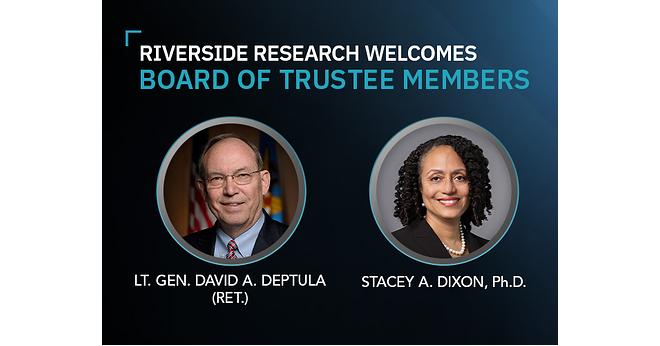
Riverside Research appointed retired Air Force Lt. Gen. David A. Deptula and former U.S. intelligence technology official Stacey A. Dixon to its Board of Trustees. The nonprofit said the additions strengthen its national-security research capabilities across AI/ML, ISR, zero-trust security, geospatial intelligence and other advanced technologies. The announcement is strategically positive for Riverside’s defense and intelligence-community positioning but provides no financial metrics or contract disclosures.
Analysis
No listed-company read-through is directly investable: a nonprofit board refresh does not establish funded program awards, procurement timing, or incremental revenue. The relevant signal is thematic rather than financial—continued institutional emphasis on ISR, geospatial intelligence, autonomous systems and AI-enabled collection supports the medium-term addressable market for defense primes and specialized data/analytics vendors, but this announcement alone should not alter estimates.
The more actionable second-order implication is that DoD/IC buyers increasingly favor open architectures and commercial-data integration over sole-source, vertically integrated platforms. That can favor Palantir (PLTR), Leidos (LDOS), Booz Allen (BAH), CACI (CACI), Kratos (KTOS), BlackSky (BKSY) and Planet Labs (PL) in discrete software, ground-system, counter-UAS and commercial-ISR opportunities; it is less clearly additive to Lockheed Martin (LMT) and Northrop Grumman (NOC), whose exposure is larger but tied to longer-cycle classified platforms.
Over 1-3 months, the decisive catalysts are FY27 appropriations marks, IC/Space Force procurement disclosures, and actual task-order awards—not advisory appointments. Over 6-18 months, a shift toward AI-enabled exploitation of proliferated sensing could expand recurring software and analytics mix, supporting multiple expansion for PLTR and BAH; the counter-risk is budget resolution delay, continuing-resolution constraints, or classified award concentration that preserves incumbent-prime economics. Treat all claimed innovation benefits as unverified until contract vehicles, backlog, or funded R&D obligations are disclosed.
Contrarian view: defense-AI enthusiasm is already heavily capitalized in PLTR and, to a lesser extent, KTOS. The underappreciated beneficiaries may be lower-multiple services integrators LDOS/CACI, which monetize deployment, accreditation and sustainment after AI pilots move into production. A broad thematic rally without identifiable program funding would be a signal to fade higher-beta ISR/software names rather than chase it.
AllMind Terminal
AI-powered research, real-time alerts, and portfolio analytics for institutional investors.
Request TrialMarket Sentiment
Overall Sentiment
mildly positive
Sentiment Score
0.20
Key Decisions for Investors
- No standalone trade on this release; place a watch alert for named DoD/IC contract awards or FY27 budget line-item growth in commercial ISR, AI/ML exploitation, geospatial intelligence and zero-trust programs.
- For a 6-12 month defense-AI allocation, prefer a pair of long LDOS or CACI versus short PLTR on relative valuation: implementation and classified integration revenue are more likely to convert funded pilots into earnings. Falsify if PLTR reports material defense/IC acceleration that drives sustained commercial-plus-government growth above consensus without margin dilution.
- Use KTOS as the higher-beta tactical expression only after a funded counter-UAS, tactical drone or open-architecture award; size small given program concentration. Exit on a missed award, delayed production transition, or a 10%+ reduction in relevant FY27 procurement accounts.
- Maintain exposure to BKSY/PL only as event-driven commercial-ISR satellites, not as a governance-driven thesis: require evidence of backlog conversion, improving gross margin, and funding runway before initiating. Their principal risk remains dilution and lumpy government procurement.
More News
- Why Wendy’s is losing the burger wars—and is now a takeover target for Nelson Peltz
- Companies promised AI gains— here's how the payoff showed up in earnings
- AWS grows 39% and Amazon will spend even more on AI in 2027
- Stocks started the week with promise but ended in despair. Our take on the big reversal
- Fears over $828 billion AI capex spending spree help erase $1 trillion in market value
- Intel stock plunges 29%. Analysts urge caution on buying the dip