
Emerging Currencies Extend Losses as Bond Market Stress Builds
Source: Bloomberg
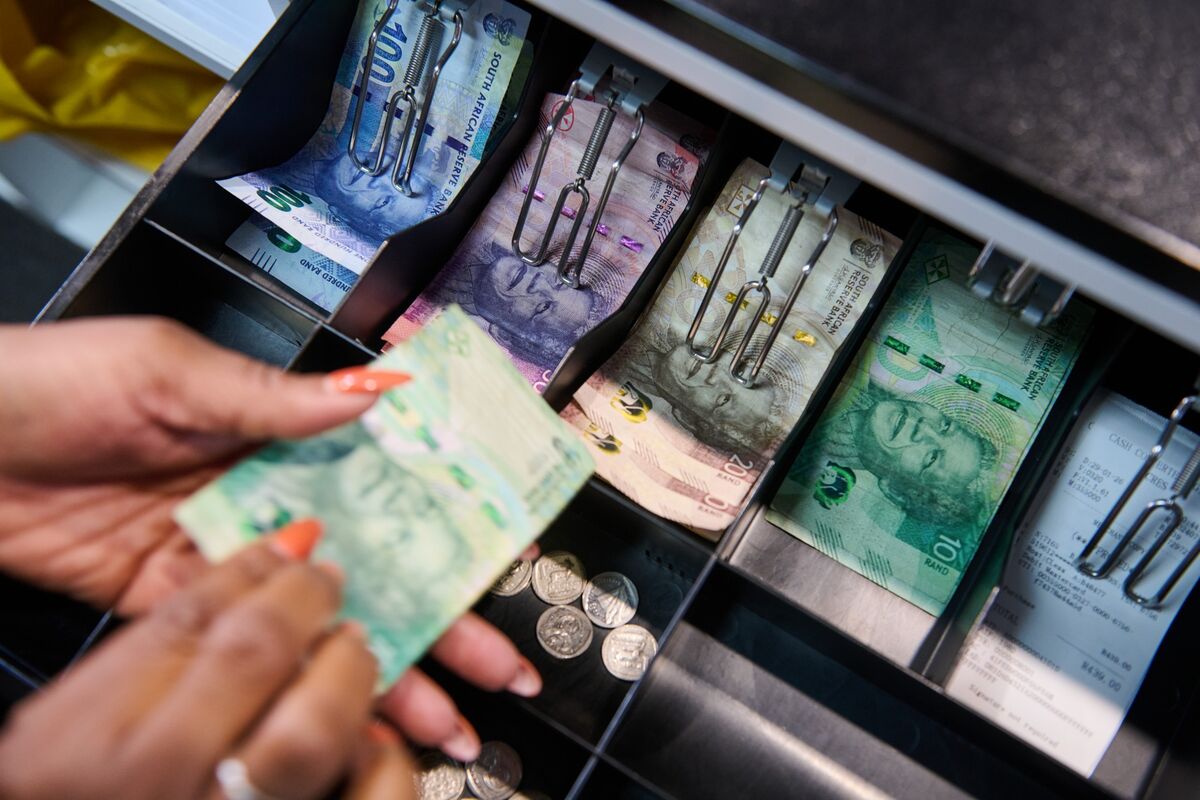
Emerging-market currencies fell for a fourth consecutive day as rising global bond yields intensified pressure on risk assets. MSCI's developing-nation currency index declined 0.3% by 11:47 a.m. London time, putting it on track for its longest losing streak since June, while the corresponding emerging-market equity gauge fell 0.9%. The move signals broadening bond-market stress and weaker investor appetite for higher-risk emerging-market assets.
Analysis
The relevant transmission is not the modest spot-FX move but the potential shift in external-financing conditions: higher developed-market term yields raise the hurdle for EM carry trades, widen sovereign funding costs, and force local pension/real-money investors to retain capital domestically. Countries with large current-account deficits, short-duration external debt, or managed currencies are most exposed; the stress should concentrate in high-beta EM FX and dollar-denominated sovereign credit before broad EM equity indices fully reprice.
MSCI has limited direct earnings sensitivity to a short risk-off episode, but sustained EM outflows can reduce ETF/index-linked assets and trading activity at the margin. The more actionable expression is a relative one: EM equity benchmarks are vulnerable to both weaker currencies and higher discount rates, while USD liquidity proxies benefit. Over the next 1-3 months, the key catalyst is whether US real yields continue higher; a stabilization in Treasury term premium would likely produce a sharp short-covering rally in crowded EM underweights.
Consensus may overgeneralize EM risk. Commodity-exporting, externally funded-surplus markets can outperform deficit-country peers even during broad dollar strength, particularly if the yield backup reflects resilient global growth rather than a recessionary liquidity shock. The bearish thesis is falsified by a sustained decline in US 10-year real yields, narrowing EM sovereign spreads, and renewed inflows into local-currency debt; those signals would favor covering broad EM hedges rather than adding to them.
Near term, avoid treating this as a standalone MSCI short: the company is more levered to durable asset-based fee growth and index licensing than day-to-day EM volatility. A persistent six-to-eighteen-month rise in global term premia would matter through lower risk-asset AUM and slower ETF flows, but that requires confirmation from monthly fund-flow data and broader equity-market weakness.
AllMind Terminal
AI-powered research, real-time alerts, and portfolio analytics for institutional investors.
Request TrialMarket Sentiment
Overall Sentiment
mildly negative
Sentiment Score
-0.38
Ticker Sentiment
Key Decisions for Investors
- Establish a 1-3 month defensive pair: long UUP / short EEM, sized to a 1% portfolio risk budget. This captures dollar-strength and EM duration/FX sensitivity simultaneously; take profit if US 10-year real yields fall 25-35bp from entry or EEM outperforms UUP by 5%.
- For EM exposure that must remain invested, rotate away from broad EEM toward relative overweight commodity-exporter and current-account-surplus markets; use EEM puts as the macro hedge rather than indiscriminate single-country liquidation. Reassess after the next US CPI and Treasury refunding/auction cycle.
- Monitor EMB versus LQD credit-spread performance and EM local-debt fund flows weekly. A meaningful widening in EMB relative spreads alongside continued dollar appreciation is confirmation to increase the EEM hedge; absent spread confirmation, treat the FX weakness as positioning noise rather than a new systemic episode.
- Keep MSCI neutral. Consider a tactical short only if broad EM equity weakness persists long enough to show up in index ETF AUM/flow data and management guidance risk; the present information does not establish a sufficiently direct earnings impairment.
More News
- Asian markets make nervous start ahead of Fed decision
- Morning Bid: Warsh on collision course with Trump administration
- BOJ expected to hike rates by 25 basis points to fresh three-decade high: CNBC survey
- Grab aims for 'next level' in financial services with purchase of buy-now pay-later platform Atome
- BOJ set to raise interest rates to 31-year high as inflation risks loom
- Three Big Central Bank Decisions Loom: Evening Briefing Americas