
Healthcare Revenue Cycle Management Software Market Report 2026. Forecasts Market Growth from $40.58B (2026) to $57.35B by 2030, Profiling Epic Systems, Optum, Oracle Health, R1 RCM, and 17 Other Key Players
Source: globenewswire.com
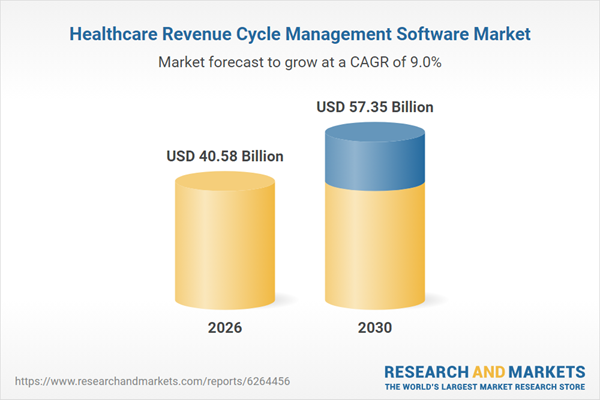
A new ResearchAndMarkets report on the Healthcare Revenue Cycle Management (RCM) software market has been added to its offering. The article says the market has grown strongly in recent years and projects continued growth from a stated market size of $37B+ (text truncated). Overall, this is informational/market-research news with no direct company or policy impact.
Analysis
This is not an investable demand signal yet; it is closer to marketing copy around a durable efficiency theme. The real mechanism is not top-line software expansion, but labor substitution in provider admin functions: if adoption is real, the economic winner is whichever vendor can convert manual claims work into recurring software or high-margin tech-enabled services with low implementation friction. That favors scaled platforms and BPO/automation hybrids, while standalone billing shops and legacy point solutions face pricing pressure and faster commoditization.
The consensus risk is overestimating near-term revenue conversion from a large market estimate. Hospital and payer buyers usually adopt RCM tools to defend margins, not to unlock new budgets, so spend often comes in the form of vendor swaps and headcount reduction rather than net-new dollars. That means revenue growth can lag the narrative for 1-3 quarters even if unit economics improve, and many of the gains accrue to customers first through lower denial rates and faster cash conversion rather than to software vendors immediately.
Time horizon matters: there is likely no days-to-weeks catalyst here, only a months-long screening thesis around earnings calls, bookings, and IT spend commentary. The thesis would be falsified if provider labor costs normalize, bad-debt trends improve, or management teams stop emphasizing automation in favor of broader capex restraint. In that case, the market may rotate away from healthcare automation names and back into higher-quality defensive healthcare cash generators.
AllMind Terminal
AI-powered research, real-time alerts, and portfolio analytics for institutional investors.
Request TrialMarket Sentiment
Overall Sentiment
neutral
Sentiment Score
0.05
Key Decisions for Investors
- No immediate directional trade: treat this as a watch item, not a catalyst, until a public vendor reports bookings acceleration or management commentary confirms budget conversion.
- Watch EXLS as the cleanest public proxy for revenue-cycle automation and tech-enabled services; initiate only on a pullback if next-quarter commentary shows higher win rates and margin leverage.
- Avoid chasing broad healthcare indices on this theme alone; if you need exposure, prefer a small starter long in healthcare automation/outsourcing versus a sector basket, with the thesis invalidated by weak guidance or delayed implementations.
- Set an alert for provider earnings over the next 1-3 months: if denial rates, collections, or labor expense do not worsen, the market likely overestimates the urgency of RCM software adoption.
More News
- ‘I told you so’: China’s chip sector is making breakthroughs—and U.S. export controls are the reasons why
- CoreWeave credit default swaps hit distress levels as investors sour on AI debt
- The IPO drought is driving private equity-owned companies to the debt market to pay investors
- Hybe shares jump 10% as K-pop sensation BTS' tour lifts earnings hopes
- Giant Taiwanese chipmaker TSMC confirms it’s in talks with Elon Musk to join ‘Terafab’ complex in Texas: ‘The AI market continues to be very strong’
- What's behind the sell-off in AI neocloud stocks like CoreWeave and Nebius