
JAGUAR URANIUM ANNOUNCES MAIDEN MINERAL RESOURCE ESTIMATE AT LAGUNA SALADA IN ARGENTINA
Source: PR Newswire
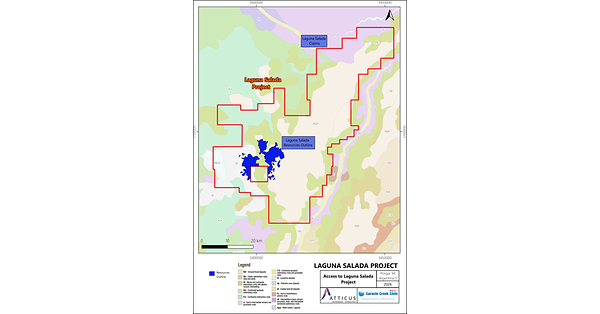
Jaguar Uranium reported an independent resource estimate for its 100%-owned Laguna Salada project in Argentina: 4.2 million lb of indicated and 10.1 million lb of inferred U₃O₈, plus 31.1 million lb indicated and 57.3 million lb inferred V₂O₅. The estimate covers about 4.3% of the 210,284-hectare project; Jaguar plans roughly 250 infill pits and trenches and 1,500 metres of sonic drilling to upgrade and expand resources. The company reported nearly US$18 million in cash and no debt, but the resources are not reserves and do not demonstrate economic viability.
Analysis
The market-relevant step is improved project definition, not proof of economic value. Resource classification is still split between Indicated and lower-confidence Inferred, with no reserves or demonstrated viability; the headline scale should therefore not be capitalized like a development-stage mine. Near-surface gravel and physical-beneficiation claims could support a lower-complexity route, but the economic case is unusually sensitive to whether representative samples confirm recoveries—especially vanadium—and whether fine carnotite is retained through mining and processing. The stated equivalent grade embeds assumed metal prices and recoveries, so it is not a substitute for a uranium-only project case or a feasibility study.
Near term, the MRE may attract speculative attention, but the more investable catalysts are the technical reports due within 45 days and results from infill work and sonic drilling. Over 1–3 months, any resource conversion matters only if sampling and metallurgical data validate continuity and saleable product quality. Over 6–18 months, permitting, Argentine policy/currency conditions, funding needs and development studies dominate. The claimed cash balance reduces immediate financing pressure but does not establish exploration runway without a work-program budget.
Contrarian read: large land area and resource ounces invite extrapolation, yet only a small footprint is modeled and expansion is not assured. The resource may be underappreciated as a low-capital exploration option, but promotional “secure Western supply” framing risks overpricing strategic value before economics are demonstrated. Missing market capitalization, liquidity, share structure and planned spend preclude a defensible valuation or position size.
AllMind Terminal
AI-powered research, real-time alerts, and portfolio analytics for institutional investors.
Request TrialMarket Sentiment
Overall Sentiment
mildly positive
Sentiment Score
0.35
Ticker Sentiment
Key Decisions for Investors
- Do not chase an opening spike in JAGU solely on the resource headline. Consider only a small, speculative position after checking market capitalization, free float, trading liquidity and dilution history; no valuation anchor is available from the release.
- Treat the next 1–3 months as a catalyst watch: review the filed technical reports, infill results and bench-scale recovery data. Upgrade the thesis only if they support continuity and recoveries near the assumptions used in the resource economics; specifically verify vanadium recovery and the treatment of screened historical samples.
- Falsifiers: materially weaker metallurgical results, failure to upgrade Inferred resources, a work-program delay or cost increase, adverse Argentine policy/currency developments, or financing that meaningfully dilutes holders. Until these are resolved, prefer an alert/watch-list stance over a sector-proxy or options trade.
More News
- Oil rises amid growing Mideast tensions between Iran-backed Houthis and Saudi Arabia
- South Korean carmaker Hyundai plans 'strategic' investment of $15.5 billion in India by 2032
- Applied Materials’ $5 billion AI lab aims to cut chip development time in half—and restore Silicon Valley’s edge
- Wells Fargo CFO on Earnings, Deals, Consumer Strength
- Bank of America hit with more than $1.2 billion in penalties over money-laundering violations
- Meta’s Muse models reach the AI frontier—and kill any hopes to ‘pace’ it