
Seoul National University of Science and Technology Researchers Develop a Reliable AI System for SSD Failure Prediction
Source: PR Newswire
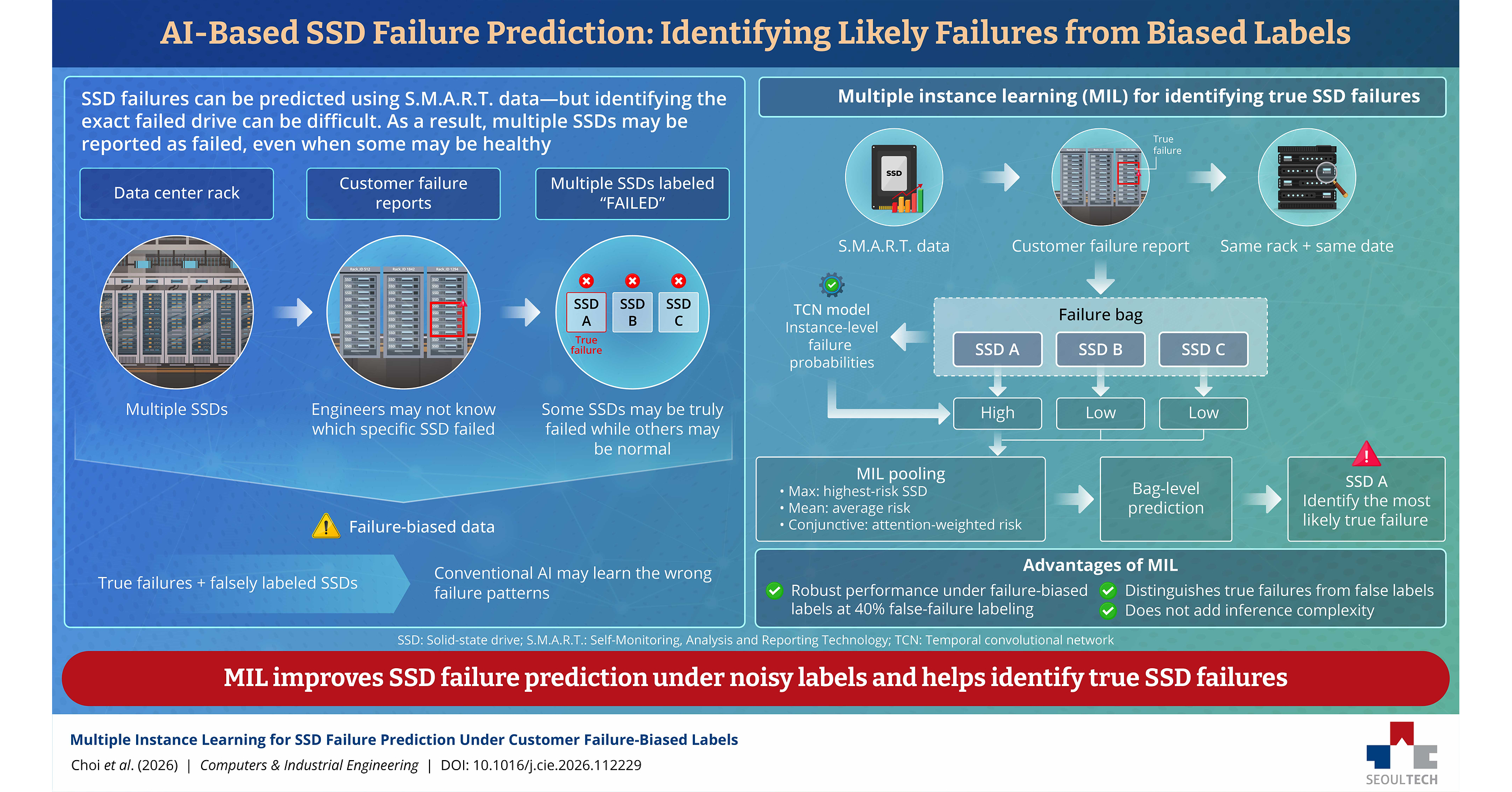
Researchers at SeoulTech, with Samsung Electronics and Alibaba Cloud data, developed a multiple-instance-learning model for SSD failure prediction that remains robust despite mislabeled failure reports. At a simulated 40% false-failure rate, the conventional model's F1 score fell from 0.731 to 0.261, while the proposed mean-pooling model achieved 0.717. The approach could improve data-center maintenance prioritization and may extend to batteries and industrial equipment, but the announcement is research-focused and unlikely to materially move markets.
Analysis
This is not a near-term BABA earnings catalyst: the work appears pre-commercial and there is no evidence of deployment, pricing, or an attributable reduction in Alibaba Cloud’s hardware-maintenance expense. Even if implemented, predictive maintenance primarily improves cloud gross margin through fewer unnecessary drive swaps, lower technician time, and reduced service-interruption credits; those savings are likely immaterial versus BABA’s consolidated earnings over the next 1-3 quarters. The investable signal is instead that data-center operators are treating operational telemetry as a margin lever as AI infrastructure raises fleet size and replacement complexity.
The more relevant 6-18 month implication is competitive differentiation among hyperscalers. Operators able to convert imperfect field data into lower failure-related downtime can support tighter SLA economics and higher utilization, modestly favoring scaled cloud platforms such as BABA, AMZN, MSFT and GOOGL over smaller regional providers that lack comparable failure datasets. Enterprise SSD suppliers including MU, WDC and STX face a mixed second-order effect: better screening may reduce precautionary replacement volumes, but validated reliability analytics can also raise qualification barriers and favor vendors with richer controller/firmware telemetry and stronger hyperscaler relationships.
Consensus should not capitalize a university research result into BABA’s AI valuation. The key unknown is the false-positive rate and avoided-replacement cost in production versus a controlled dataset; without a disclosed deployment or Cloud Intelligence Group margin benefit, this remains a watch item. The thesis would gain credibility if BABA references autonomous infrastructure operations, lower maintenance costs, or improved cloud-service reliability in the next two earnings cycles; it is falsified as an equity-relevant angle if no operational rollout emerges by mid-2027.
AllMind Terminal
AI-powered research, real-time alerts, and portfolio analytics for institutional investors.
Request TrialMarket Sentiment
Overall Sentiment
moderately positive
Sentiment Score
0.42
Ticker Sentiment
Key Decisions for Investors
- No directional BABA trade on this release; maintain existing exposure only. Reassess after the next two BABA earnings calls for quantified cloud-margin, reliability, or infrastructure-automation commentary.
- Create an event watch on BABA: a disclosed Alibaba Cloud production deployment plus measurable improvement in Cloud Intelligence Group profitability would support a 6-12 month long thesis; absent disclosure, treat any AI-infrastructure rally as sentiment-driven rather than fundamentals-backed.
- For storage exposure, avoid assuming an immediate demand benefit for MU, WDC or STX. Monitor hyperscaler capex disclosures and SSD qualification language: evidence that predictive maintenance extends drive life would be a modest replacement-demand headwind, while increasing AI-server deployments should remain the dominant volume driver.
- Potential relative-value expression only after corroboration: long scaled hyperscaler cloud exposure (BABA or MSFT) versus smaller data-center operators, contingent on evidence that reliability automation improves SLA performance or maintenance cost. Exit if cloud gross-margin trends fail to improve despite rising infrastructure spend.
More News
- AI agents can modify themselves without humans telling them to do so
- 'Hostile act': Trump threatens EU with tariffs over Canada associate-membership proposal
- US military claims Strait of Hormuz remains open amid ongoing blockade
- US official says upcoming spectrum auctions could generate more than $100 billion
- Investors react to Fed hike and market sell-off: Brace for 'higher for longer' rates
- Yemeni forces target Houthis and a Saudi base as US rules out direct role